Acetaminophen
Acetaminophen relieves pain and lowers fever. The label says the precise way it does this is not established, but that it is thought to act mainly in the brain and spinal cord. In the doses studied, acetaminophen given into a vein has not been shown to affect platelet clumping significantly, and studies of repeated doses by mouth, in healthy people and in people with hemophilia, found no significant change in bleeding time.
- Acts on
- Not established (thought to act mainly in the brain and spinal cord)
- Where
- The brain and spinal cord
- Medicine type
- Small molecule
- Used for
- Brain & nerves
Step 2: not established
The acetaminophen injection label says: The precise mechanism of the analgesic and antipyretic properties of acetaminophen is not established but is thought to primarily involve central actions.
Clinical study: In Toms and colleagues' 2008 Cochrane review of 51 randomized, double-blind, placebo-controlled trials of single doses (500 to 1,000 mg) of paracetamol (acetaminophen) by mouth for pain after surgery in adults; the trials measured pain relief, not how it works: About half of participants treated with paracetamol at standard doses achieved at least 50% pain relief over four to six hours, compared with about 20% treated with placebo.
Toms L et al., Cochrane Database Syst Rev 2008 (PMID 18843665)
How it works
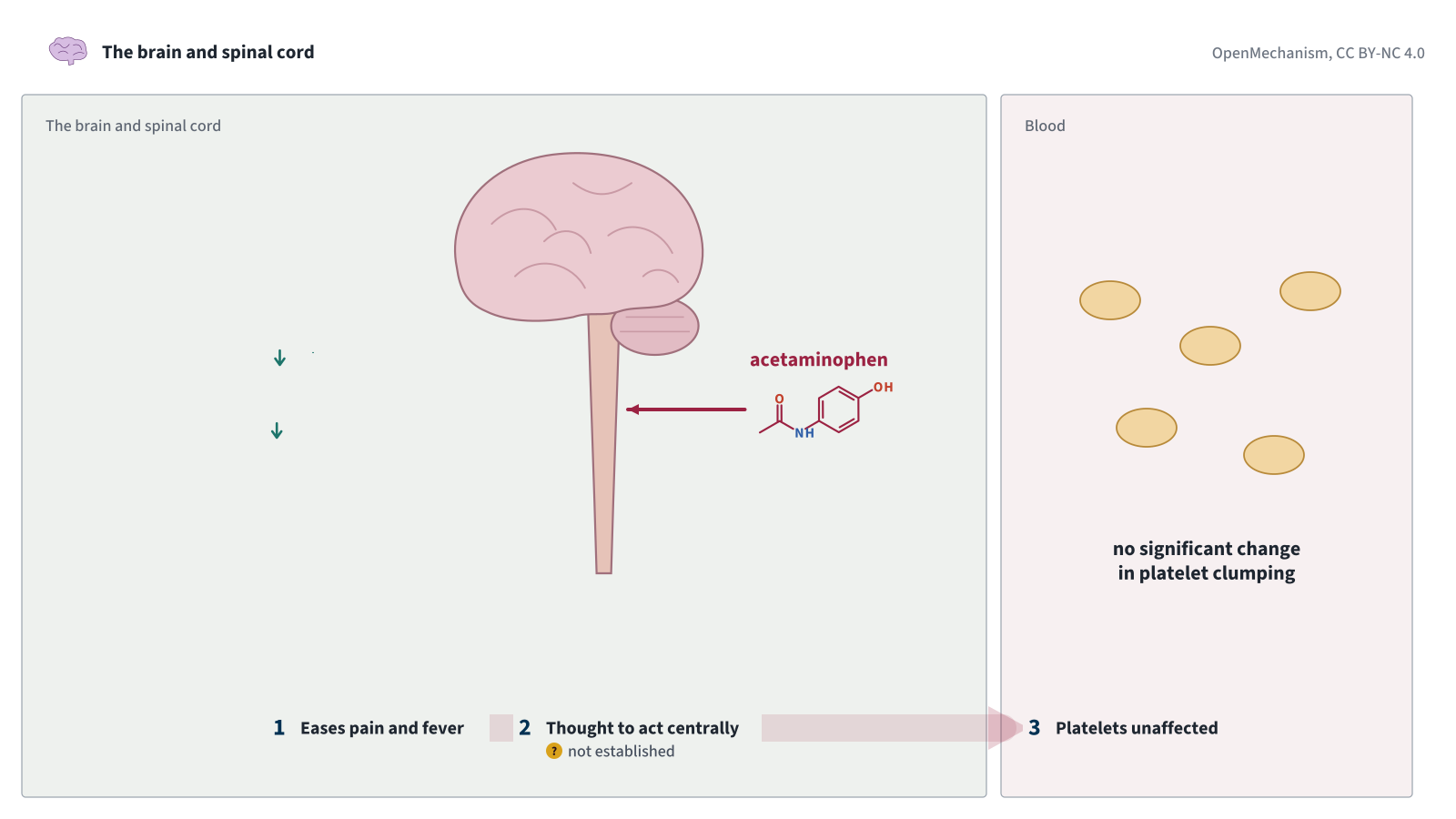
Eases pain and fever. Acetaminophen has pain-relieving (analgesic) and fever-lowering (antipyretic) activity in animal and human studies.1
Thought to act centrally. The label says the precise mechanism of these effects is not established, but is thought to involve mainly actions in the central nervous system (the brain and spinal cord).1
Platelets unaffected. In the doses studied, acetaminophen given into a vein has not been shown to affect platelet clumping (aggregation) significantly. Acetaminophen has no immediate or delayed effects on the sealing of small blood vessels (small-vessel hemostasis). Bleeding time did not change significantly in studies of healthy people and of people with hemophilia after repeated doses of acetaminophen by mouth.1
For teachers: download this drawing.
See also
Condition pages: acute pain and period pain.
Side effects: acetaminophen overdose.
Explained: why too much acetaminophen harms the liver.
Body system: brain & nerves.
Sources
- 1Acetaminophen injection: FDA label1 Indications and Usage; 12.1 Mechanism of Action; 12.2 Pharmacodynamics
- 2ChEMBL CHEMBL112Target and action classification: Anandamide amidohydrolase inhibitor; Cyclooxygenase inhibitor; Vanilloid receptor opener
- 3Single dose oral paracetamol (acetaminophen) for postoperative pain in adultsToms L et al. Cochrane Database Syst Rev 2008 (abstract)
Spotted a mistake? Report an error (hello@openmechanism.com). Since launch, every published error we fix is listed on the corrections page.
Notes and limits
- A schematic teaching drawing: not to scale, not exact structures, binding poses or a complete pathway, and not a guide to dosing, treatment or how a person will respond.
- The label says the precise mechanism of the analgesic and antipyretic properties of acetaminophen is not established but is thought to primarily involve central actions.
All recorded limits are on the evidence page, and notes that apply to every page are on How to read a page. Version 1.0.1, medically reviewed by Daniel Tran, PharmD, on 6 November 2026.
Cite this page
Tran D. Acetaminophen [Internet]. OpenMechanism; 2026 [updated 2026 Nov 6; cited 2026 Nov 6]. Available from: https://openmechanism.com/medicines/acetaminophen