Oxycodone
Oxycodone switches on mu-opioid receptors. It relieves pain with no ceiling to the effect, though side effects such as slowed breathing may limit the dose; the label says exactly how it relieves pain is unknown, but opioid receptors throughout the brain and spinal cord are thought to play a role. It also slows breathing by acting on the brainstem, narrows the pupils and slows the gut. The OxyContin label lists it for severe and persistent pain that needs an opioid and that other options, including immediate-release opioids, cannot treat well enough, in adults and in children 11 and older who already take and tolerate a minimum daily opioid dose of at least 20 mg of oxycodone by mouth or its equivalent, and not for as-needed use; it says the risks of addiction, abuse, misuse, overdose and death can occur at any dose or duration and persist throughout treatment.
- Acts on
- Mu-opioid receptors (it can bind others at higher doses)
- Where
- The brain and spinal cord
- Medicine type
- Small molecule
- Used for
- Brain & nerves
- Drug class
- Opioids
Also called OxyContin (extended-release oxycodone hydrochloride).
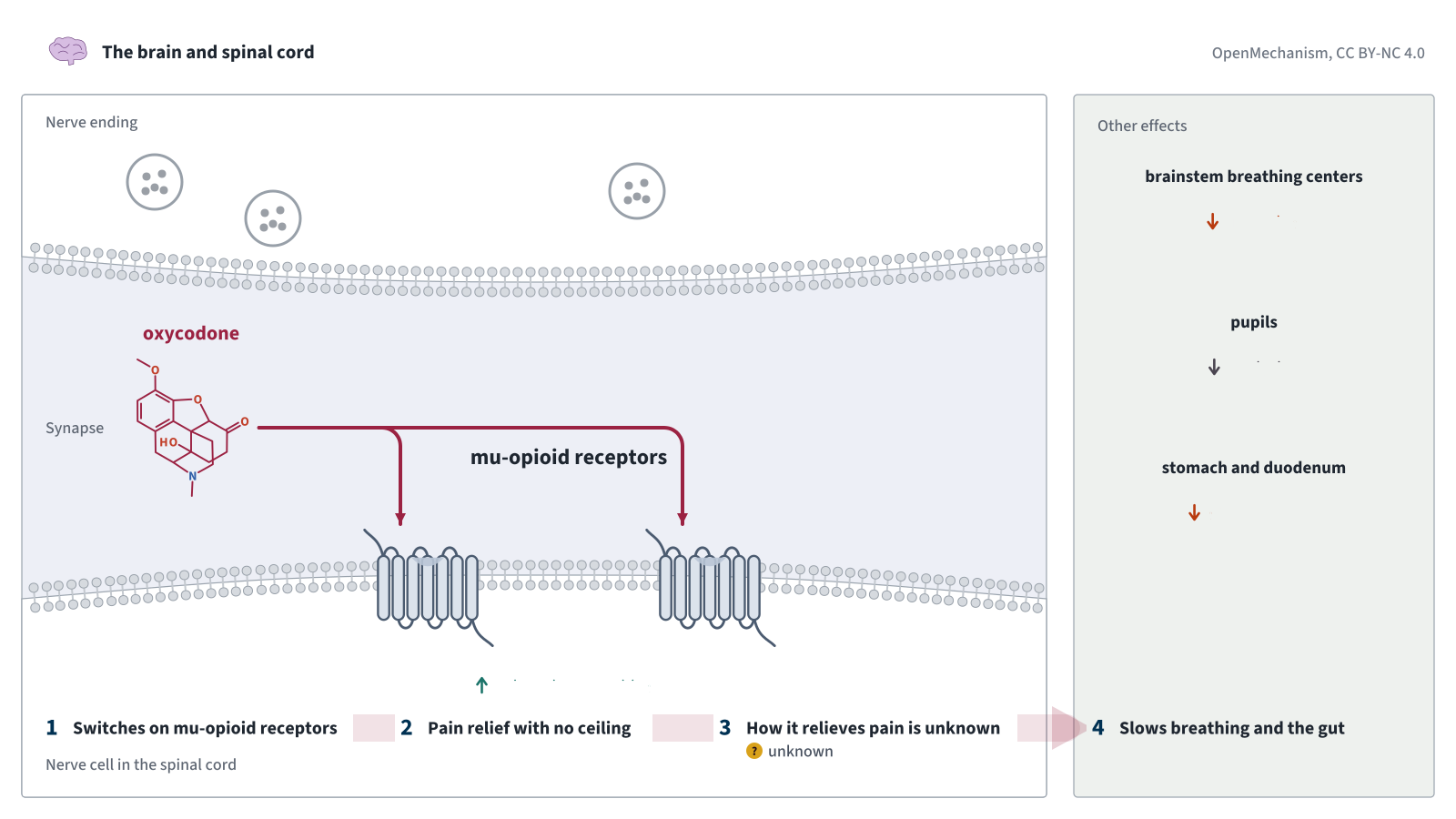
Step 3: unknown
The OxyContin label says: The precise mechanism of the analgesic action is unknown. However, specific CNS opioid receptors for endogenous compounds with opioid-like activity have been identified throughout the brain and spinal cord and are thought to play a role in the analgesic effects of this drug.
How it works
Switches on mu-opioid receptors. Oxycodone is a full opioid , relatively selective for the mu-opioid receptor, though it can bind to other opioid receptors at higher doses.1
Pain relief with no ceiling. Its main therapeutic action is pain relief (analgesia), and like all full opioid agonists it has no ceiling for pain relief; the dose may be limited by side effects such as slowed breathing and slowing of the central nervous system ( depression).1
How it relieves pain is unknown. The label says the precise mechanism of its pain relief is unknown, but opioid receptors for the body's own opioid-like compounds, found throughout the brain and spinal cord, are thought to play a role.1
Slows breathing and the gut. Oxycodone slows breathing by acting directly on the brainstem's breathing centers, making them less responsive to carbon dioxide. The label's boxed warning says serious, life-threatening or fatal slowed breathing may occur, especially when the medicine is started or its dose is raised. It also narrows the pupils, even in darkness, and it reduces movement (motility) in the stomach and duodenum.1
For teachers: download this drawing.
See also
Condition pages: severe and persistent pain.
Other opioids: buprenorphine, fentanyl, hydrocodone, loperamide, morphine and tramadol.
Explained: opioids and benzodiazepines; and rifampin and other medicines.
Body system: brain & nerves.
Sources
- 1OxyContin (oxycodone hydrochloride) extended-release tablets: FDA label1 Indications and Usage; Boxed Warning; 12.1 Mechanism of Action; 12.2 Pharmacodynamics
- 2ChEMBL CHEMBL656Target and action classification: Mu opioid receptor agonist
Spotted a mistake? Report an error (hello@openmechanism.com). Since launch, every published error we fix is listed on the corrections page.
Notes and limits
- A schematic teaching drawing: not to scale, not exact structures, binding poses or a complete pathway, and not a guide to dosing, treatment or how a person will respond.
- The steps are in the order that explains them; one step is said to cause the next only where the source says so.
- The label says the precise mechanism of the analgesic action is unknown, and that CNS opioid receptors for endogenous compounds with opioid-like activity are thought to play a role.
All recorded limits are on the evidence page, and notes that apply to every page are on How to read a page. Version 1.0.1, medically reviewed by Daniel Tran, PharmD, on 4 November 2026.
Cite this page
Tran D. Oxycodone [Internet]. OpenMechanism; 2026 [updated 2026 Nov 4; cited 2026 Nov 4]. Available from: https://openmechanism.com/medicines/oxycodone