Vertigo
Vertigo is the illusion of motion, usually of turning. Common causes include loose particles in a semicircular canal (benign paroxysmal positional vertigo) and a sudden loss of balance function in one inner ear (vestibular neuritis), which leaves the two sides unmatched. Meclizine treats vertigo from vestibular disease; positional vertigo usually improves with a repositioning maneuver.
- Where
- The balance system
- Body system
- Brain & nerves
- Medicines
- 1 medicine
Presumed
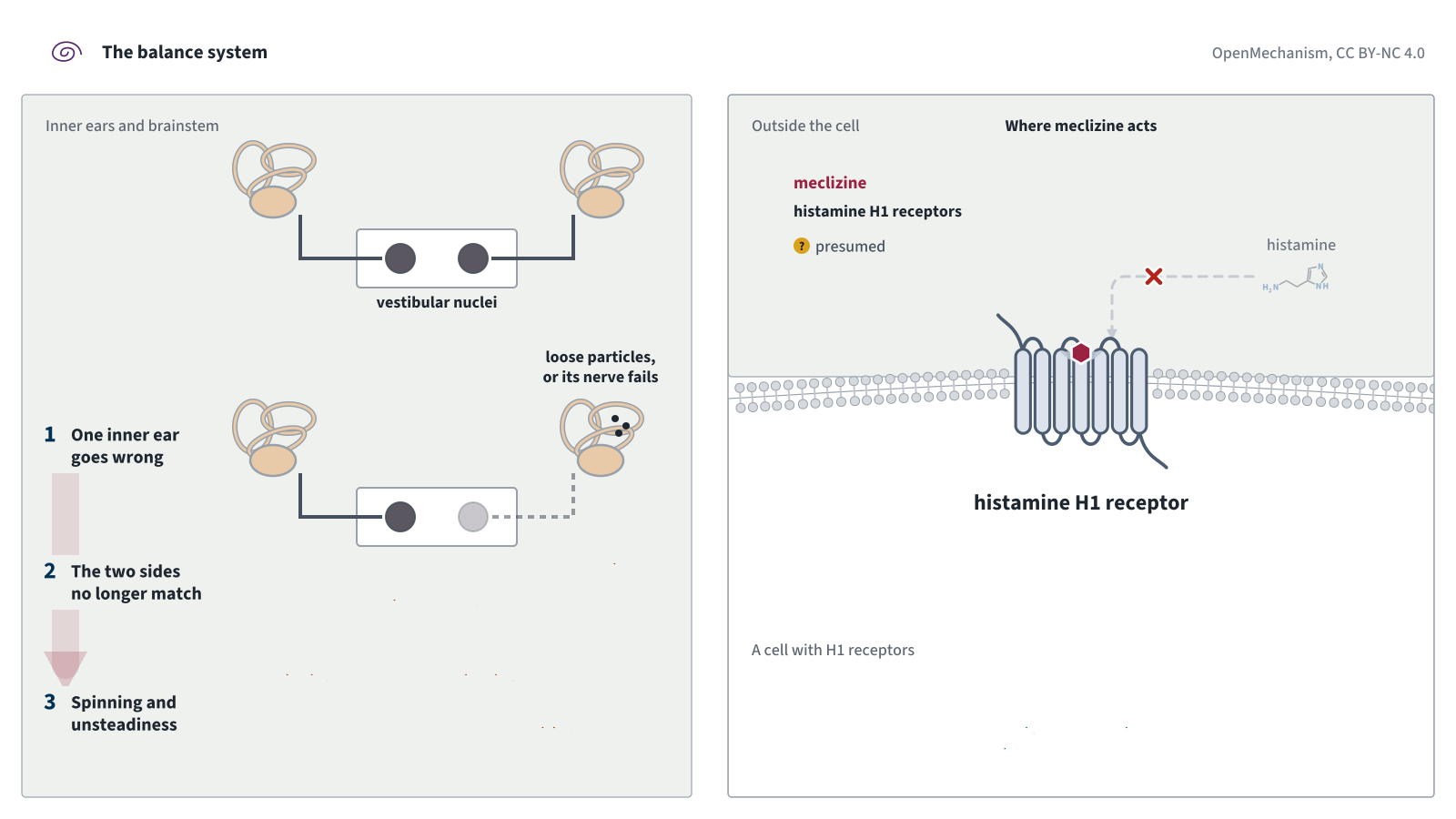
The meclizine label says: The precise mechanism by which meclizine exerts its therapeutic effect is unknown but is presumed to involve antagonism of the histamine H1 receptor.
Source 5: Meclizine hydrochloride tablets: FDA label, 1 Indications and Usage; 12.1 Mechanism of Action
Clinical study: In a small randomized, triple-blinded, placebo-controlled study of eye-movement reflexes in 12 healthy volunteers: This indicates that meclizine may not primarily work through sensory-specific mechanisms, but rather on a more central level.
Wibble T et al., Br J Clin Pharmacol 2020 (PMID 32077140)
This study was picked with a literature search and is not yet checked by our reviewer.
For teachers: download this drawing.
Key terms in this drawing
- H1 receptor
- Histamine H1 receptor. A histamine receptor; medicines that block it (antihistamines) treat allergies and often make people sleepy.
What goes wrong
One inner ear goes wrong. Common causes include benign paroxysmal positional vertigo, in which loose particles, probably otoconia, float in a semicircular canal and make it sensitive to gravity, and vestibular neuritis, a sudden loss of balance function in one inner ear, probably from a reactivated herpes simplex virus.1,2,3
What the source says
“The most common causes of this condition are benign paroxysmal positional vertigo, acute vestibular neuronitis or labyrinthitis, Ménière's disease, migraine, and anxiety disorders.”
Source 1“There is compelling evidence that free-floating endolymph particles in the posterior semicircular canal underlie most cases of benign paroxysmal positional vertigo (BPPV).”
Source 2“Recent pathological findings suggest that these particles are otoconia, probably displaced from the otolithic membrane in the utricle. They typically settle in the dependent posterior canal and render it sensitive to gravity.”
Source 2“Vestibular neuritis is ascribed to acute unilateral loss of vestibular function, probably due to reactivation of herpes simplex virus in the vestibular ganglia.”
Source 3The two sides no longer match. After damage to one inner ear, the nerve cells of the vestibular nucleus on that side become much less active, so the eye and posture reflexes of the two sides no longer match.4
What the source says
“After unilateral peripheral vestibular lesions, the neural activity of neurons in the ipsi-lesional medial vestibular nucleus (ipsi-MVe) are markedly decreased, resulting in static and dynamic asymmetries of the vestibulo-ocular and vestibulo-spinal reflexes.”
Source 4Spinning and unsteadiness. The result is vertigo, the illusion of motion, usually of turning, with jerking eye movements (nystagmus), drifting posture and an unsteady walk; vestibular neuritis also brings nausea and vomiting.1,3,4
What the source says
“Vertigo is the illusion of motion, usually rotational motion.”
Source 1“Consequently, static vestibular symptoms such as spontaneous nystagmus and postural deviation and dynamic vestibular symptoms such as oscillopsia and swaying gait are induced.”
Source 4“Symptomatic medication is indicated only during the acute phase to relieve the vertigo and nausea/vomiting.”
Source 3
Where medicines act
In the balance system
- A
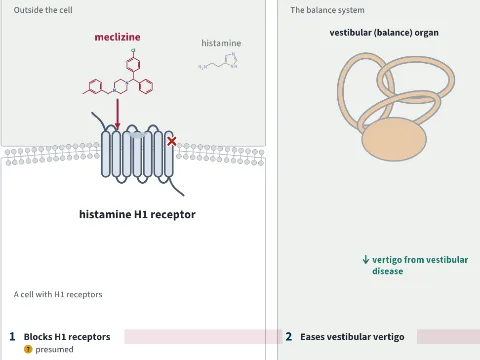
Meclizine targets Histamine H1 receptors
Presumed to block histamine ; how it eases vertigo is unknown.5
Used forVertigo from vestibular disease: adults
What the label says
“Meclizine hydrochloride is indicated for the treatment of vertigo associated with diseases affecting the vestibular system in adults.”
Source 5“The precise mechanism by which meclizine exerts its therapeutic effect is unknown but is presumed to involve antagonism of the histamine H1 receptor.”
Source 5
See also
Body system: brain & nerves.
Other conditions: migraine.
Side effects: why gentamicin can damage hearing and balance.
Sources
- 1Treatment of vertigoSwartz R, Longwell P. Am Fam Physician 2005 (abstract). Saved copy
- 2Diagnosis and management of benign paroxysmal positional vertigo (BPPV)Parnes LS, Agrawal SK, Atlas J. CMAJ 2003 (abstract). Saved copy
- 3Vestibular neuritisJeong SH, Kim HJ, Kim JS. Semin Neurol 2013 (abstract). Saved copy
- 4Vestibular compensation: neural mechanisms and clinical implications for the treatment of vertigoTakeda N et al. Auris Nasus Larynx 2024 (abstract). Saved copy
- 5Meclizine hydrochloride tablets: FDA label1 Indications and Usage; 12.1 Mechanism of Action. Saved copy
- 6The effects of meclizine on motion sickness revisitedWibble T et al. Br J Clin Pharmacol 2020 (abstract). Saved copy
Notes and limits
- Benign paroxysmal positional vertigo usually improves with a canalith repositioning maneuver, which moves the particles back into the utricle; well over 90% of people can be treated this way.1,2
- A 2005 review says acute vestibular neuritis improves with stabilizing measures and a vestibular suppressant medicine at first, then vestibular rehabilitation exercises; a 2013 review says the exercises hasten recovery.1,3
- Over time the two sides come back into balance, a recovery called vestibular compensation.4
- Less common causes include reduced blood flow in the vertebrobasilar arteries and retrocochlear tumors.1
Notes that apply to every page are on How to read a page.
Spotted a mistake? Report an error (hello@openmechanism.com). Since launch, every published error we fix is listed on the corrections page.
Cite this page
Tran D. Vertigo [Internet]. OpenMechanism; 2026 [updated 2026 Nov 18; cited 2026 Nov 18]. Available from: https://openmechanism.com/conditions/vertigo