Lamotrigine
Laboratory studies suggest lamotrigine blocks voltage-sensitive sodium channels, steadying nerve cells and changing how much glutamate they release; this is one proposed mechanism, not established in people. Its label lists it for epilepsy, added to other medicines from age 2 for partial-onset seizures, primary generalized tonic-clonic seizures and the generalized seizures of Lennox-Gastaut syndrome, or alone from age 16 for partial-onset seizures when switching from carbamazepine, phenytoin, phenobarbital, primidone or valproate taken as the only antiseizure medicine; and for maintenance treatment of bipolar I disorder, to delay mood episodes after an acute episode has been treated with standard therapy. The label says its effectiveness in treating acute mood episodes has not been established, that the precise way it acts against seizures is unknown, and that how it works in bipolar disorder has not been established.
- Acts on
- Voltage-sensitive sodium channels (a proposed mechanism)
- Where
- Nerve cells in the brain
- Medicine type
- Small molecule
- Used for
- Brain & nerves
- Drug class
- Sodium channel blockers (antiseizure)
Also called Lamictal.
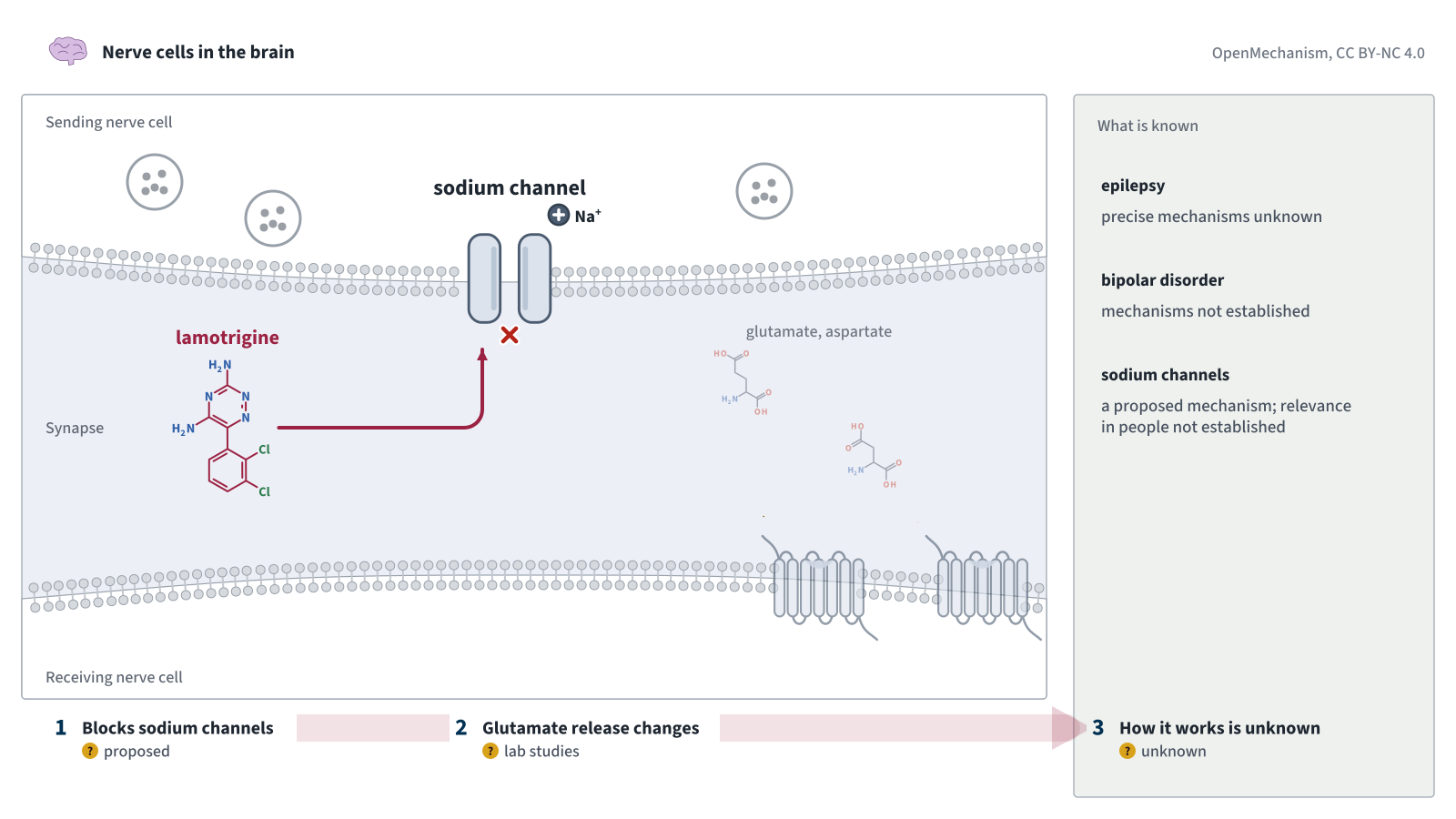
Step 1: proposed
The Lamictal label says: One proposed mechanism of action of lamotrigine, the relevance of which remains to be established in humans, involves an effect on sodium channels. In vitro pharmacological studies suggest that lamotrigine inhibits voltage-sensitive sodium channels, thereby stabilizing neuronal membranes and consequently modulating presynaptic transmitter release of excitatory amino acids (e.g., glutamate and aspartate).
Source 1: Lamictal (lamotrigine): FDA label, 1 Indications and Usage; 12.1 Mechanism of Action
Clinical study: In Matsuo and colleagues' 1993 randomized, double-blind, placebo-controlled trial, 216 people with refractory partial seizures took add-on lamotrigine (300 or 500 mg a day) or placebo for 6 months; the trial measured seizure frequency, not how lamotrigine works: Reductions in seizure frequency and seizure days were statistically significant, compared with placebo, for the 500-mg group but not the 300-mg group.
Matsuo F et al., Neurology 1993 (PMID 8232944)
Step 2: lab studies
The Lamictal label says: In vitro pharmacological studies suggest that lamotrigine inhibits voltage-sensitive sodium channels, thereby stabilizing neuronal membranes and consequently modulating presynaptic transmitter release of excitatory amino acids (e.g., glutamate and aspartate).
Source 1: Lamictal (lamotrigine): FDA label, 1 Indications and Usage; 12.1 Mechanism of Action
Clinical study: In SANAD, Marson and colleagues' 2007 unblinded randomized trial, 1721 people with partial epilepsy for whom carbamazepine was deemed standard treatment were randomly assigned carbamazepine, gabapentin, lamotrigine, oxcarbazepine or topiramate; the trial measured time to treatment failure and time to a 12-month remission, not glutamate release: Lamotrigine is clinically better than carbamazepine, the standard drug treatment, for time to treatment failure outcomes
. For time to a 12-month remission, estimates suggest a non-significant advantage for carbamazepine against lamotrigine
. Marson AG et al., Lancet 2007 (PMID 17382827)
Step 3: unknown
The Lamictal label says: The precise mechanism(s) by which lamotrigine exerts its anticonvulsant action are unknown. … The mechanisms by which lamotrigine exerts its therapeutic action in bipolar disorder have not been established.
Source 1: Lamictal (lamotrigine): FDA label, 1 Indications and Usage; 12.1 Mechanism of Action
Clinical study: In Bowden and colleagues' 2003 double-blind, placebo-controlled trial in people with bipolar I disorder after a recent manic or hypomanic episode, everyone first took lamotrigine in an 8- to 16-week open-label phase, and the 175 who then met stabilization criteria were randomized to lamotrigine (100 to 400 mg a day), lithium (0.8 to 1.1 mEq/L) or placebo for up to 18 months; the trial measured how long until a new mood episode needed treatment, not how lamotrigine works: Both lamotrigine and lithium were superior to placebo at prolonging the time to intervention for any mood episode (lamotrigine vs placebo, P =.02; lithium vs placebo, P =.006).
Bowden CL et al., Arch Gen Psychiatry 2003 (PMID 12695317)
How it works
Blocks sodium channels. One proposed mechanism, whose relevance in people remains to be established, involves sodium channels: laboratory (in vitro) studies suggest lamotrigine blocks voltage-sensitive sodium channels, which steadies nerve cell membranes.1
Glutamate release changes. Those laboratory studies suggest this in turn changes (modulates) the release of excitatory messengers such as glutamate and aspartate from nerve endings.1
How it works is unknown. The label says the precise mechanisms of its anticonvulsant action are unknown, and that the mechanisms of its effect in bipolar disorder have not been established.1
For teachers: download this drawing.
See also
Condition pages: bipolar disorder and epilepsy.
Other sodium channel blockers (antiseizure): carbamazepine, oxcarbazepine, phenytoin and topiramate.
Explained: lamotrigine with estrogen-containing contraceptives; and valproate and lamotrigine.
Related drawings: ethosuximide (another antiseizure medicine, used for absence seizures).
Body system: brain & nerves.
Sources
- 1Lamictal (lamotrigine): FDA label1 Indications and Usage; 12.1 Mechanism of Action; Boxed Warning
- 2ChEMBL CHEMBL741Target and action classification: Sodium channel alpha subunit blocker
- 3Placebo-controlled study of the efficacy and safety of lamotrigine in patients with partial seizures. U.S. Lamotrigine Protocol 0.5 Clinical Trial GroupMatsuo F et al. Neurology 1993 (abstract)
- 4
- 5A placebo-controlled 18-month trial of lamotrigine and lithium maintenance treatment in recently manic or hypomanic patients with bipolar I disorderBowden CL et al. Arch Gen Psychiatry 2003 (abstract)
Also used for the drawing
The drawing places lamotrigine's action in nerve cells in the brain. The Lamictal label names the nerve cell membranes that laboratory studies suggest it steadies, but not where they are; this randomized, double-blind, crossover trial in healthy young men used magnetic stimulation and functional MRI to measure lamotrigine's effect on the excitability of the brain's cortex.
- 6Interleaved transcranial magnetic stimulation/functional MRI confirms that lamotrigine inhibits cortical excitability in healthy young menLi X et al., Neuropsychopharmacology 2004 (abstract)
Spotted a mistake? Report an error (hello@openmechanism.com). Since launch, every published error we fix is listed on the corrections page.
Notes and limits
- A schematic teaching drawing: not to scale, not exact structures, binding poses or a complete pathway, and not a guide to dosing, treatment or how a person will respond.
- The Lamictal label has a boxed warning: lamotrigine can cause serious rashes, including Stevens-Johnson syndrome, that require hospitalization and stopping treatment; serious rash is more common in children than in adults.
- The label calls the sodium-channel effect one proposed mechanism, the relevance of which remains to be established in humans.
- The label says the precise mechanisms of lamotrigine's anticonvulsant action are unknown and that its mechanisms in bipolar disorder have not been established.
All recorded limits are on the evidence page, and notes that apply to every page are on How to read a page. Version 1.0.1, medically reviewed by Daniel Tran, PharmD, on 3 November 2026.
Cite this page
Tran D. Lamotrigine [Internet]. OpenMechanism; 2026 [updated 2026 Nov 3; cited 2026 Nov 3]. Available from: https://openmechanism.com/medicines/lamotrigine