ADHD
Attention deficit hyperactivity disorder (ADHD) shows mainly as poor impulse control and trouble regulating attention. The prefrontal cortex, which steers attention, behavior and emotion, is underactive in many people with ADHD and sensitive to small changes in norepinephrine and dopamine. Lisdexamfetamine becomes dextroamphetamine, which blocks their reuptake and increases their release; exactly how it helps in ADHD is not known.
- Where
- Prefrontal cortex
- Body system
- Brain & nerves
- Medicines
- 1 medicine
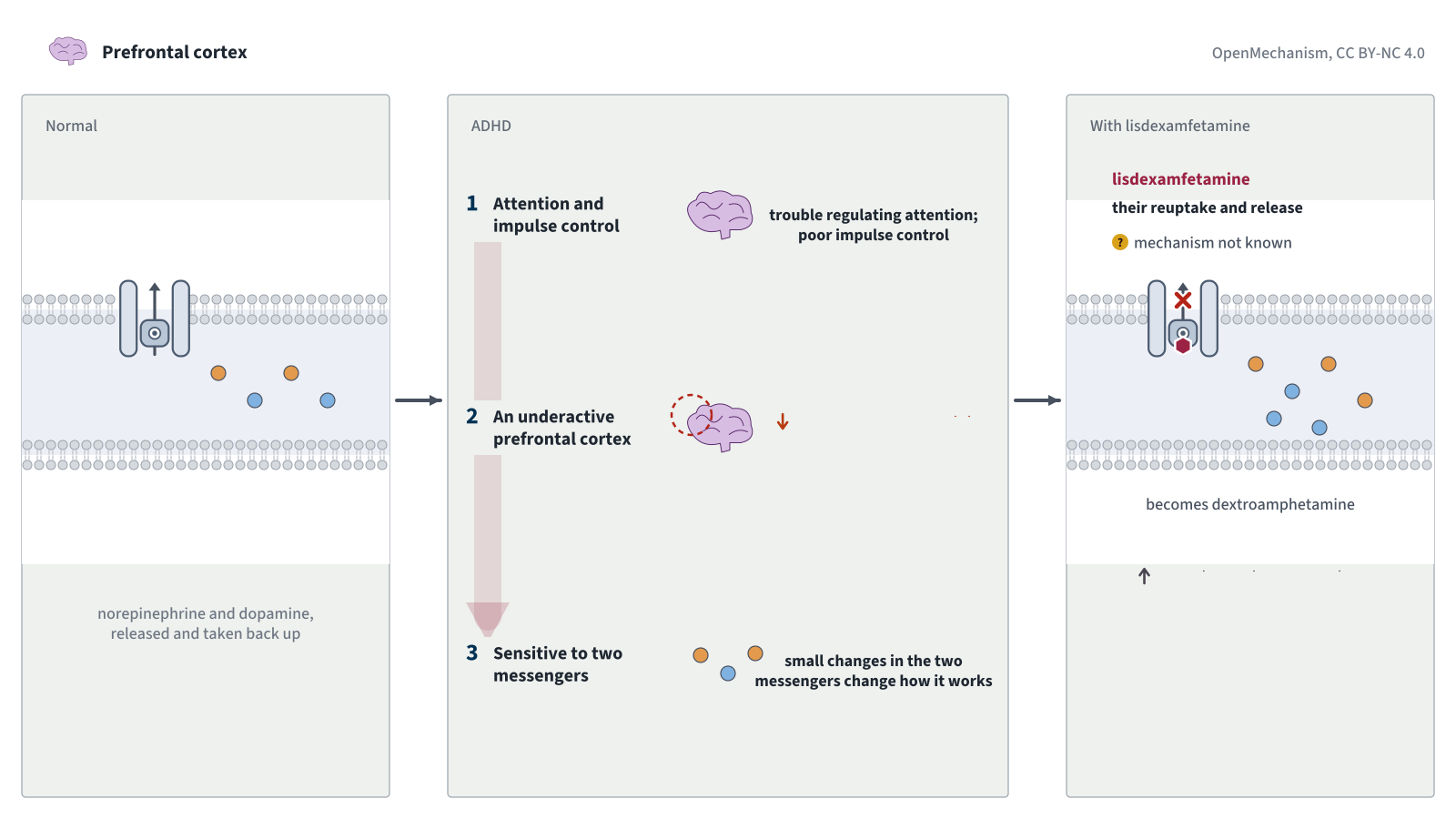
Mechanism not known
The Vyvanse (lisdexamfetamine) label says: The exact mode of therapeutic action in ADHD and BED is not known.
Clinical study: In a 4-week randomized, double-blind trial of lisdexamfetamine or placebo in 290 children aged 6 to 12 with ADHD; the trial measured ADHD symptom ratings, not how it works: In this population of children with ADHD, treatment once daily with the prodrug LDX at doses of 30 to 70 mg appeared to be effective and had a tolerability profile similar to those of currently marketed extended-release stimulants.
Biederman J et al., Clin Ther 2007 (PMID 17577466)
This study was picked with a literature search and is not yet checked by our reviewer.
For teachers: download this drawing.
Key terms in this drawing
- ADHD
- Attention-deficit/hyperactivity disorder. A condition that affects attention and activity levels.
- reuptake
- Reuptake. Nerve cells taking a messenger such as serotonin back up, which helps end its signal.
What goes wrong
Attention and impulse control. The main symptoms of are poor impulse control and trouble regulating attention.1
What the source says
“The primary symptoms of attention deficit/hyperactivity disorder (ADHD) include poor impulse control and impaired regulation of attention.”
Source 1An underactive prefrontal cortex. The prefrontal cortex steers attention, behavior and emotion, and it is underactive in many people with ADHD.1
What the source says
“the prefrontal cortex (PFC) is essential for the "top-down" regulation of attention, behavior, and emotion, and that this brain region is underactive in many patients with ADHD.”
Source 1Sensitive to two messengers. Small changes in norepinephrine and dopamine can change how well the prefrontal cortex works.1
What the source says
“relatively small changes in the levels of norepinephrine and dopamine can produce significant changes in its function.”
Source 1
Where medicines act
- A
Lisdexamfetamine: more norepinephrine and dopamine
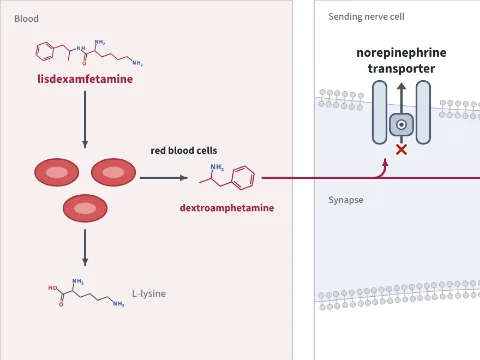
Lisdexamfetamine is turned into dextroamphetamine, which blocks the of norepinephrine and dopamine and increases their release; exactly how it helps in ADHD is not known. It treats ADHD in adults and children 6 years and older.2
What the source says
“Lisdexamfetamine is a prodrug of dextroamphetamine.”
Source 2“Amphetamines block the reuptake of norepinephrine and dopamine into the presynaptic neuron and increase the release of these monoamines into the extraneuronal space.”
Source 2“The exact mode of therapeutic action in ADHD and BED is not known.”
Source 2“Attention Deficit Hyperactivity Disorder (ADHD) in adults and pediatric patients 6 years and older”
Source 2
See also
Body system: brain & nerves.
Related medicines: amphetamine, methylphenidate and atomoxetine.
Other conditions: binge eating disorder.
Side effects: why stimulants can raise heart rate and blood pressure.
Sources
- 1Catecholamine influences on prefrontal cortical function: relevance to treatment of ADHD and related disordersArnsten AF, Pliszka SR. Pharmacol Biochem Behav 2011 (abstract). Saved copy
- 2Vyvanse (lisdexamfetamine): FDA label1 Indications and Usage; 12.1 Mechanism of Action; 12.2 Pharmacodynamics. Saved copy
- 3
Notes and limits
- Much of the evidence on how these messengers act in the prefrontal cortex comes from animal studies.1
Notes that apply to every page are on How to read a page.
Spotted a mistake? Report an error (hello@openmechanism.com). Since launch, every published error we fix is listed on the corrections page.
Cite this page
Tran D. ADHD [Internet]. OpenMechanism; 2026 [updated 2026 Oct 20; cited 2026 Oct 20]. Available from: https://openmechanism.com/conditions/adhd