Duloxetine
Duloxetine blocks the of serotonin and norepinephrine by nerve cells; in preclinical studies it blocks dopamine reuptake less potently and has no significant for several kinds of receptors. The label says its effects on mood, pain and anxiety are believed to be related to stronger serotonin and norepinephrine activity in the central nervous system, though the exact mechanisms in people are unknown. It calls duloxetine a serotonin and norepinephrine reuptake inhibitor (SNRI) and lists it for major depressive disorder, nerve pain from diabetes (diabetic peripheral neuropathic pain), fibromyalgia and chronic musculoskeletal pain in adults, and for generalized anxiety disorder in adults and children 7 years and older.
- Acts on
- Serotonin and norepinephrine transporters (and, less potently, dopamine reuptake)
- Where
- Nerve cells in the brain and spinal cord
- Medicine type
- Small molecule
- Used for
- Brain & nerves
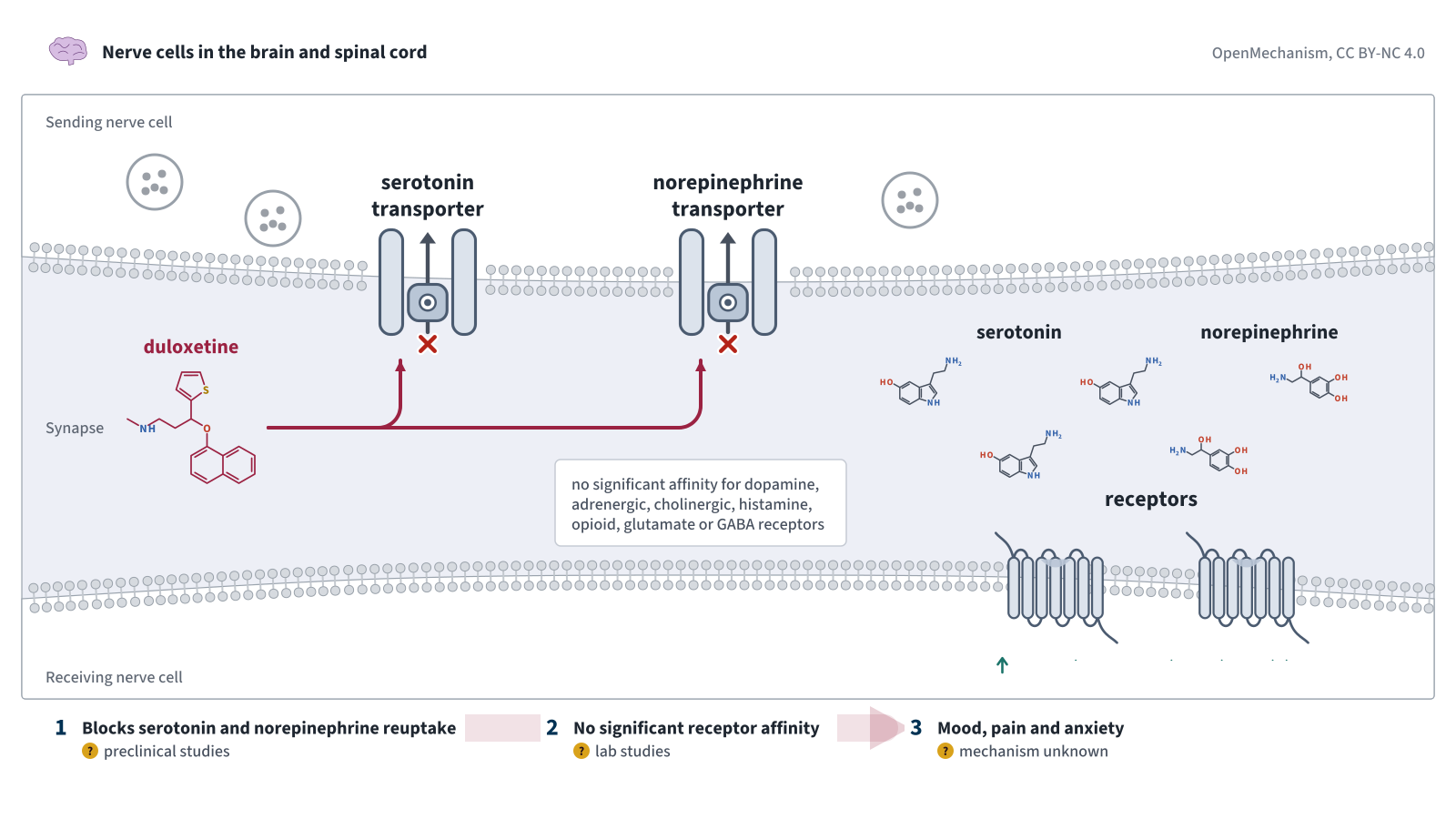
Step 1: preclinical studies
The duloxetine label says: Preclinical studies have shown that duloxetine is a potent inhibitor of neuronal serotonin and norepinephrine reuptake and a less potent inhibitor of dopamine reuptake.
Study: In Takano and colleagues' 2006 PET imaging study in people of how much of the serotonin transporter (5-HTT) duloxetine occupies after single doses of 5 to 60 mg, a test of the step in people (the norepinephrine transporter was not measured): 5-HTT occupancies by duloxetine were increased by 35.3 to 86.5% with dose and plasma concentration increments.
Takano A et al., Psychopharmacology (Berl) 2006 (PMID 16506079)
Step 2: lab studies
The duloxetine label says: Duloxetine has no significant affinity for dopaminergic, adrenergic, cholinergic, histaminergic, opioid, glutamate, and GABA receptors in vitro .
Step 3: mechanism unknown
The duloxetine label says: Although the exact mechanisms of the antidepressant, central pain inhibitory and anxiolytic actions of duloxetine in humans are unknown, these actions are believed to be related to its potentiation of serotonergic and noradrenergic activity in the CNS.
Clinical study: In Detke and colleagues' 2002 randomized, double-blind trial of duloxetine 60 mg a day or placebo for 9 weeks in 245 adults with major depressive disorder; the trial measured depression ratings, pain and side effects, not how duloxetine works: Duloxetine was significantly superior to placebo (p < .001) in reducing HAM-D-17 total scores, starting at week 2.
Detke MJ et al., J Clin Psychiatry 2002 (PMID 12000204)
Key terms in this drawing
- affinity
- Binding affinity. How strongly a molecule binds its target.
- GABA
- Gamma-aminobutyric acid. The main inhibitory messenger in the central nervous system.
How it works
Blocks serotonin and norepinephrine reuptake. In preclinical studies, duloxetine is a potent inhibitor of the reuptake of serotonin and norepinephrine by nerve cells, and a less potent inhibitor of dopamine reuptake.1
No significant receptor affinity. Duloxetine has no significant affinity for dopamine, adrenergic, cholinergic, histamine, opioid, glutamate or receptors in the laboratory, and it does not inhibit .1
Mood, pain and anxiety. The label says its antidepressant, pain-dampening (central pain inhibitory) and anti-anxiety actions are believed to be related to stronger serotonin and norepinephrine activity in the central nervous system, although the exact mechanisms in people are unknown.1
For teachers: download this drawing.
See also
Condition pages: anxiety disorders and depression.
Other serotonin reuptake inhibitors (SSRIs and related): amitriptyline, citalopram, desvenlafaxine, escitalopram, fluoxetine, nortriptyline, paroxetine, sertraline and 2 more.
Body system: brain & nerves.
Sources
- 1Duloxetine delayed-release capsules: FDA label1 Indications and Usage; 12.1 Mechanism of Action; 12.2 Pharmacodynamics
- 2ChEMBL CHEMBL1175Target and action classification: Norepinephrine transporter inhibitor; Serotonin transporter inhibitor
- 3A dose-finding study of duloxetine based on serotonin transporter occupancyTakano A et al. Psychopharmacology (Berl) 2006 (abstract)
- 4Duloxetine, 60 mg once daily, for major depressive disorder: a randomized double-blind placebo-controlled trialDetke MJ et al. J Clin Psychiatry 2002 (abstract)
Spotted a mistake? Report an error (hello@openmechanism.com). Since launch, every published error we fix is listed on the corrections page.
Notes and limits
- A schematic teaching drawing: not to scale, not exact structures, binding poses or a complete pathway, and not a guide to dosing, treatment or how a person will respond.
- The steps are in the order that explains them; one step is said to cause the next only where the source says so.
- The label says the exact mechanisms of duloxetine's antidepressant, central pain inhibitory and anxiolytic actions in humans are unknown.
All recorded limits are on the evidence page, and notes that apply to every page are on How to read a page. Version 1.0.1, medically reviewed by Daniel Tran, PharmD, on 6 November 2026.
Cite this page
Tran D. Duloxetine [Internet]. OpenMechanism; 2026 [updated 2026 Nov 6; cited 2026 Nov 6]. Available from: https://openmechanism.com/medicines/duloxetine