Mirtazapine
In preclinical studies mirtazapine blocks that act as brakes on norepinephrine and serotonin activity, and blocks and ; it has no significant for or . It also blocks , peripheral alpha-1 and . The Remeron label lists it for major depressive disorder in adults, and says how it works there is unclear, and that its effect could come from lifting those brakes.
- Acts on
- Alpha-2 adrenergic autoreceptors and heteroreceptors; 5-HT2, 5-HT3 and H1 receptors
- Where
- Nerve cells in the brain and spinal cord
- Medicine type
- Small molecule
- Used for
- Brain & nerves
Also called Remeron and RemeronSolTab (orally disintegrating tablets).
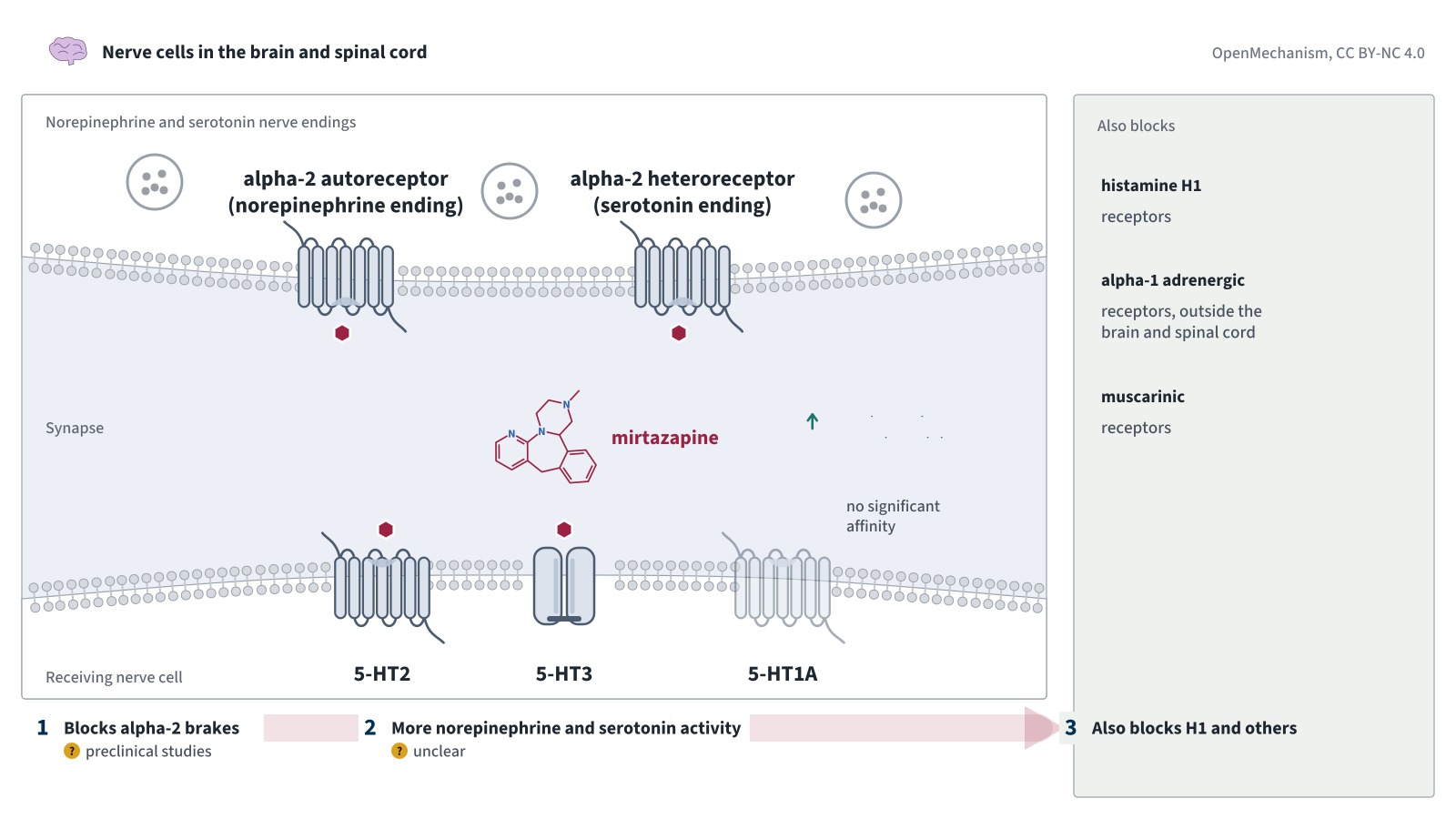
Step 1: preclinical studies
The Remeron label says: In preclinical studies, mirtazapine acts as an antagonist at α 2 -adrenergic inhibitory autoreceptors and heteroreceptors and as an antagonist at serotonin 5-HT 2 and 5-HT 3 receptors.
Clinical study: In Smith and colleagues' 1990 randomized, double-blind, 6-week trial of mirtazapine, amitriptyline or placebo in 150 people with major depressive disorder (average daily modal doses: mirtazapine 18 mg, amitriptyline 111 mg); the trial measured depression ratings and side effects, not receptors: Results of this study indicate that mirtazapine is more effective than placebo in the treatment of these patients …
Smith WT et al., Psychopharmacol Bull 1990 (PMID 2236455)
Step 2: unclear
The Remeron label says: The mechanism of action of mirtazapine for the treatment of major depressive disorder, is unclear. However, its efficacy could be mediated through its activity as an antagonist at central presynaptic α 2 -adrenergic inhibitory autoreceptors and heteroreceptors and enhancing central noradrenergic and serotonergic activity.
Clinical study: In Cipriani and colleagues' 2018 network meta-analysis of 522 double-blind, randomized trials of 21 antidepressants, mirtazapine among them, for the acute treatment of adults with major depressive disorder; the trials measured response to treatment, not how the medicines work, and the review rated the certainty of its evidence moderate to very low: All antidepressants were more efficacious than placebo in adults with major depressive disorder.
Cipriani A et al., Lancet 2018 (PMID 29477251)
Key terms in this drawing (6)
- 5-HT receptors
- Serotonin (5-hydroxytryptamine, 5-HT) receptors. Receptors that serotonin acts on; they come in several subtypes, such as 5-HT1A and 5-HT2A.
- 5-HT1A receptor
- Serotonin 1A receptor. One of the serotonin receptors; in lab studies, buspirone binds it strongly.
- 5-HT3 receptor
- Serotonin 3 receptor. A serotonin receptor on vagus nerve endings and in the brain's vomiting trigger zone; ondansetron blocks it.
- affinity
- Binding affinity. How strongly a molecule binds its target.
- alpha-1 receptor
- Alpha-1 adrenergic receptor. Alpha-1 adrenergic receptors come in at least three subtypes, A, B and D; alpha-1A may have a main role in prostate obstruction, alpha-1B in tightening arteries.
- H1 receptor
- Histamine H1 receptor. A histamine receptor; medicines that block it (antihistamines) treat allergies and often make people sleepy.
How it works
Blocks alpha-2 brakes. In preclinical studies, mirtazapine blocks alpha-2 adrenergic inhibitory autoreceptors and heteroreceptors and serotonin 5-HT2 and 5-HT3 receptors; it has no significant affinity for 5-HT1A and 5-HT1B receptors.1
More norepinephrine and serotonin activity. The label says how it works in major depressive disorder is unclear, and that its efficacy could come from blocking central presynaptic alpha-2 autoreceptors and heteroreceptors, enhancing central norepinephrine and serotonin activity.1
Also blocks H1 and others. It also blocks histamine H1 receptors, peripheral receptors and muscarinic receptors. The label says blocking H1 receptors may explain its prominent sleepiness, and blocking peripheral alpha-1 receptors its orthostatic hypotension.1
For teachers: download this drawing.
See also
Condition pages: depression.
Body system: brain & nerves.
Sources
- 1Remeron (mirtazapine): FDA label1 Indications and Usage; 12.1 Mechanism of Action; 12.2 Pharmacodynamics; Boxed Warning
- 2ChEMBL CHEMBL654Target and action classification: Adrenergic receptor alpha-2 antagonist; Serotonin 2a (5-HT2a) receptor antagonist; Serotonin 2c (5-HT2c) receptor antagonist
- 3Mirtazapine vs. amitriptyline vs. placebo in the treatment of major depressive disorderSmith WT et al. Psychopharmacol Bull 1990 (abstract)
- 4
Also used for the drawing
The drawing shows the 5-HT3 receptor as a channel: this label, for another medicine that blocks it, calls 5-HT3 receptors ligand-gated cation channels.
- 5Lotronex (alosetron): FDA label12.1 Mechanism of Action
Spotted a mistake? Report an error (hello@openmechanism.com). Since launch, every published error we fix is listed on the corrections page.
Notes and limits
- A schematic teaching drawing: not to scale, not exact structures, binding poses or a complete pathway, and not a guide to dosing, treatment or how a person will respond.
- The Remeron label has a boxed warning: antidepressants increased the risk of suicidal thoughts and behaviors in pediatric and young adult patients in short-term studies.
- The label says the mechanism of action of mirtazapine for major depressive disorder is unclear, and that its efficacy could be mediated through blocking central presynaptic alpha-2 autoreceptors and heteroreceptors.
All recorded limits are on the evidence page, and notes that apply to every page are on How to read a page. Version 1.0.1, medically reviewed by Daniel Tran, PharmD, on 7 November 2026.
Cite this page
Tran D. Mirtazapine [Internet]. OpenMechanism; 2026 [updated 2026 Nov 7; cited 2026 Nov 7]. Available from: https://openmechanism.com/medicines/mirtazapine