Ropinirole
Ropinirole is a non-ergoline dopamine . How it works in Parkinson's disease is not known precisely; it is thought to act by stimulating dopamine in the caudate-putamen, and in restless legs syndrome by stimulating . About half of each dose is lost to first-pass metabolism; its is about 6 hours.
- Acts on
- Dopamine D2 receptors (thought to)
- Where
- The caudate-putamen (striatum)
- Medicine type
- Small molecule
- Used for
- Brain & nerves
- Drug class
- Dopamine agonists
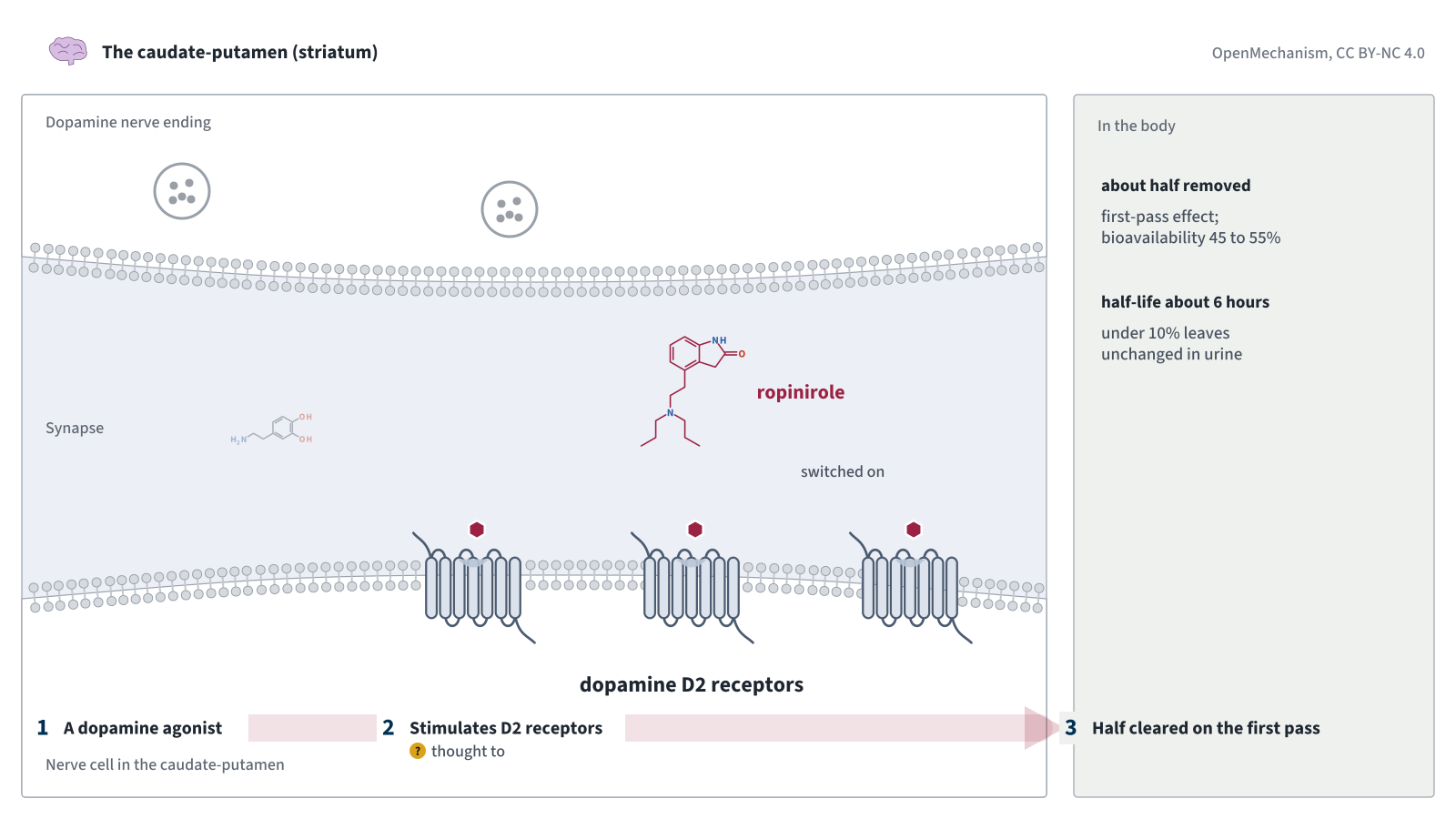
Step 2: thought to
The ropinirole label says: The precise mechanism of action of ropinirole as a treatment for Parkinson's disease is unknown, although it is thought to be related to its ability to stimulate dopamine D 2 receptors within the caudate-putamen in the brain.
Source 1: Ropinirole tablets: FDA label, 12.1 Mechanism of Action; 12.3 Pharmacokinetics
Clinical study: In a 12-month, double-blind, placebo-controlled study of ropinirole alone in early Parkinson disease; the study measured whether people needed levodopa, not how ropinirole works: Significantly more ropinirole-treated patients (51 [44.0%] of 116) successfully completed the 12-month study and did not require supplemental levodopa compared with placebo-treated patients (28 [22.4%] of 125).
Sethi KD et al., Arch Neurol 1998 (PMID 9740115)
This study was picked with a literature search and is not yet checked by our reviewer.
Key terms in this drawing
- D2 receptor
- Dopamine D2 receptor. A dopamine receptor; in Parkinson disease, ropinirole's effect is thought to be related to its ability to stimulate D2 receptors in the caudate-putamen of the brain.
- half-life
- Half-life. The time it takes for the amount in the blood to fall by half.
How it works
A dopamine agonist. Ropinirole is a non-ergoline dopamine agonist.1
Stimulates D2 receptors. Its precise mechanism in Parkinson's disease is unknown, but is thought to relate to stimulating dopamine D2 receptors within the caudate-putamen of the brain; in restless legs syndrome it is thought to relate to stimulating dopamine receptors.1
Half cleared on the first pass. About half of an oral dose is removed on the first pass (absolute bioavailability 45 to 55%); the half-life is about 6 hours, and under 10% leaves unchanged in the urine.1
For teachers: download this drawing.
See also
Condition pages: Parkinson disease.
Explained: why ropinirole can bring on compulsive urges.
Body system: brain & nerves.
Sources
- 1Ropinirole tablets: FDA label12.1 Mechanism of Action; 12.3 Pharmacokinetics
- 2ChEMBL CHEMBL589Target and action classification: D2-like dopamine receptor agonist
- 3Ropinirole for the treatment of early Parkinson disease: a 12-month experience. Ropinirole Study GroupSethi KD et al. Arch Neurol 1998 (abstract)
Spotted a mistake? Report an error (hello@openmechanism.com). Since launch, every published error we fix is listed on the corrections page.
Notes and limits
- A schematic teaching drawing: not to scale, not exact structures, binding poses or a complete pathway, and not a guide to dosing, treatment or how a person will respond.
- The label says the precise mechanism is unknown in both Parkinson's disease and restless legs syndrome, and is thought to relate to stimulating dopamine (D2) receptors.
All recorded limits are on the evidence page, and notes that apply to every page are on How to read a page. Version 1.0.0, not yet medically reviewed.
Cite this page
Tran D. Ropinirole [Internet]. OpenMechanism; 2026 [updated 2026 Oct 21; cited 2026 Oct 21]. Available from: https://openmechanism.com/medicines/ropinirole