Opioid overdose
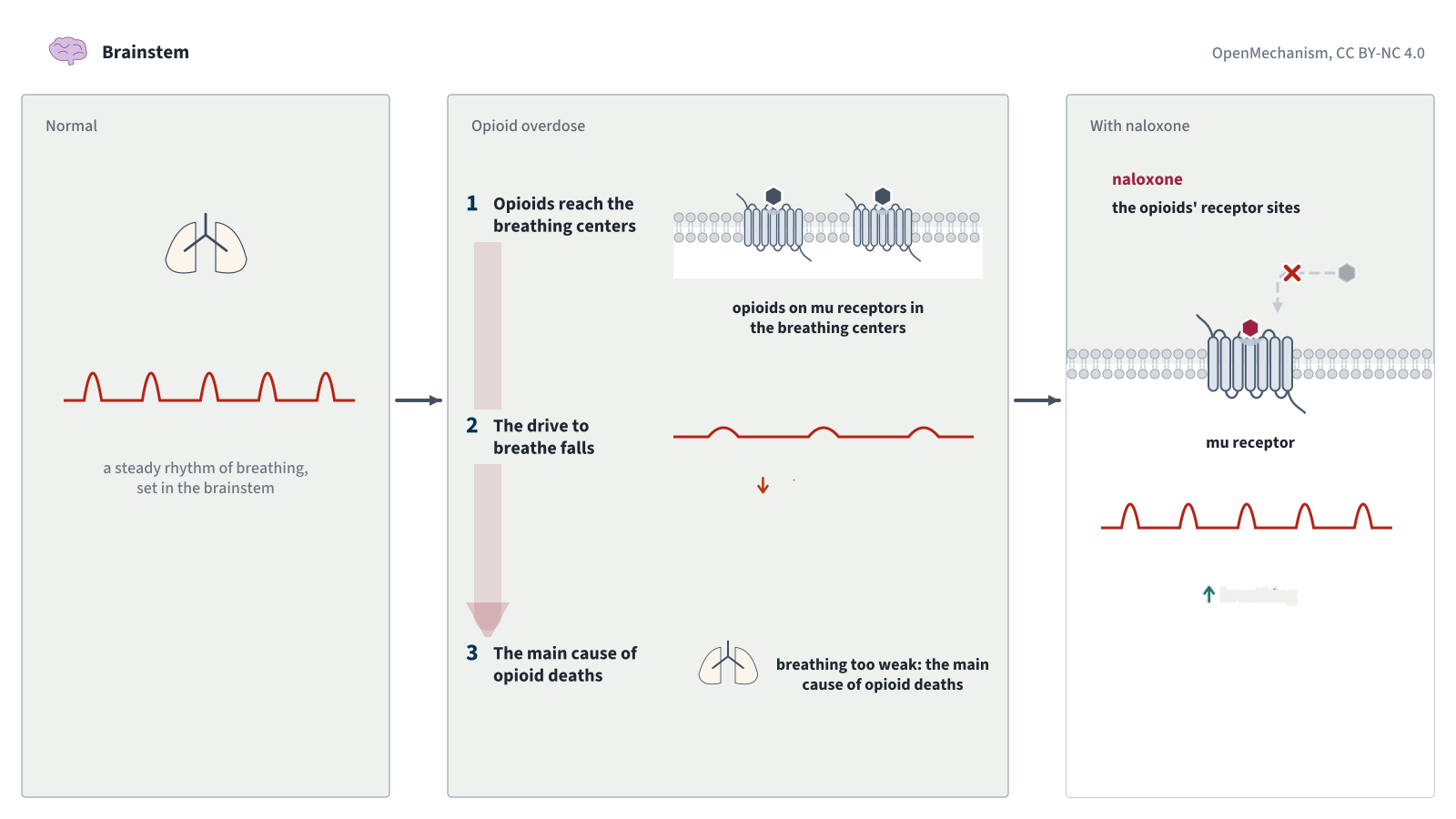
Opioids act on mu opioid receptors in the brainstem's breathing centers, including the preBötzinger complex, which sets the rhythm of breathing in. They depress the drive to breathe and, with lowered consciousness, leave breathing too weak: the main cause of death from opioids. Naloxone competes with opioids at the same receptors and reverses their effects, including the depressed breathing.
- Where
- Brainstem
- Body systems
- Brain & nerves, Lungs & airways
- Medicines
- 1 medicine
For teachers: download this drawing.
What goes wrong
Opioids reach the breathing centers. The rhythm of breathing in is set by the preBötzinger complex in the medulla; with another center in the pons, it takes part in opioid-induced breathing depression through mu opioid receptors.1
The drive to breathe falls. Opioids depress the brain's drive to breathe; with lowered consciousness and blocked airways in sleep, breathing becomes too weak.1
What the source says
“is the neural depression of respiratory drive which, together with a decreased level of consciousness and obstructive sleep apnea, cause ventilatory insufficiency.”
Source 1The main cause of opioid deaths. Opioid-induced breathing depression is the main cause of death from opioids.1
What the source says
“Opioid-induced respiratory depression (OIRD), the primary cause of opioid-induced death”
Source 1
Where medicines act
- A
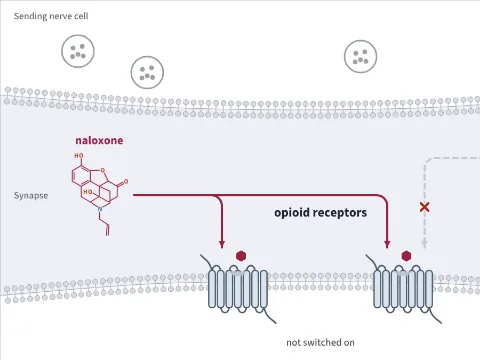
Naloxone: opioids pushed off their receptor
Naloxone competes with opioids for the same receptor sites and reverses their effects, including depressed breathing, sedation and low blood pressure. It reverses opioid depression, including breathing depression.2,3
What the source says
“Naloxone hydrochloride is an opioid antagonist that antagonizes opioid effects by competing for the same receptor sites.”
Source 2“Naloxone hydrochloride reverses the effects of opioids, including respiratory depression, sedation, and hypotension.”
Source 2“Naloxone Hydrochloride Injection is indicated for the complete or partial reversal of opioid depression, including respiratory depression, induced by natural and synthetic opioids”
Source 3
See also
Body systems: brain & nerves and lungs & airways.
Can raise or cause it: buprenorphine (“Buprenorphine produces respiratory depression by direct action on brainstem respiratory centers.”4) and fentanyl (“Fentanyl produces respiratory depression by direct action on brain stem respiratory centers.”5).
Other conditions: severe and persistent pain; and opioid use disorder.
The medicine in the body: codeine, tramadol and the CYP2D6 gene.
Side effects: why morphine slows the gut and breathing; and why naloxone can bring on opioid withdrawal.
Interactions: opioids and benzodiazepines.
Sources
- 1Mechanisms of opioid-induced respiratory depressionBaldo BA, Rose MA. Arch Toxicol 2022 (abstract). Saved copy
- 2Narcan (naloxone): FDA label12.1 Mechanism of Action. Saved copy
- 3Naloxone hydrochloride injection: FDA labelIndications and Usage. Saved copy
- 4Butrans (buprenorphine): FDA label12.2 Pharmacodynamics. Saved copy
- 5Fentanyl citrate injection (Hospira): FDA label12.2 Pharmacodynamics. Saved copy
Notes and limits
- Naloxone can wear off before the opioid does, which makes overdose hard to manage safely.1
- Several brain sites can each depress breathing, and which ones are necessary is unclear.1
Notes that apply to every page are on How to read a page.
Spotted a mistake? Report an error (hello@openmechanism.com). Since launch, every published error we fix is listed on the corrections page.
Cite this page
Tran D. Opioid overdose [Internet]. OpenMechanism; 2026 [updated 2026 Oct 20; cited 2026 Oct 20]. Available from: https://openmechanism.com/conditions/opioid-overdose