Paroxetine
Paroxetine blocks the serotonin transporter; in people it blocks serotonin uptake into platelets, and laboratory studies in animals suggest it is a potent and highly selective serotonin inhibitor with only very weak effects on norepinephrine and dopamine reuptake. The label for its extended-release tablets lists it for adults with major depressive disorder, panic disorder, social anxiety disorder and premenstrual dysphoric disorder (PMDD), and says how it works in them is unknown, but is presumed to be linked to stronger serotonin activity.
- Acts on
- The serotonin transporter (SERT)
- Where
- Nerve cells in the brain and spinal cord
- Medicine type
- Small molecule
- Used for
- Brain & nerves
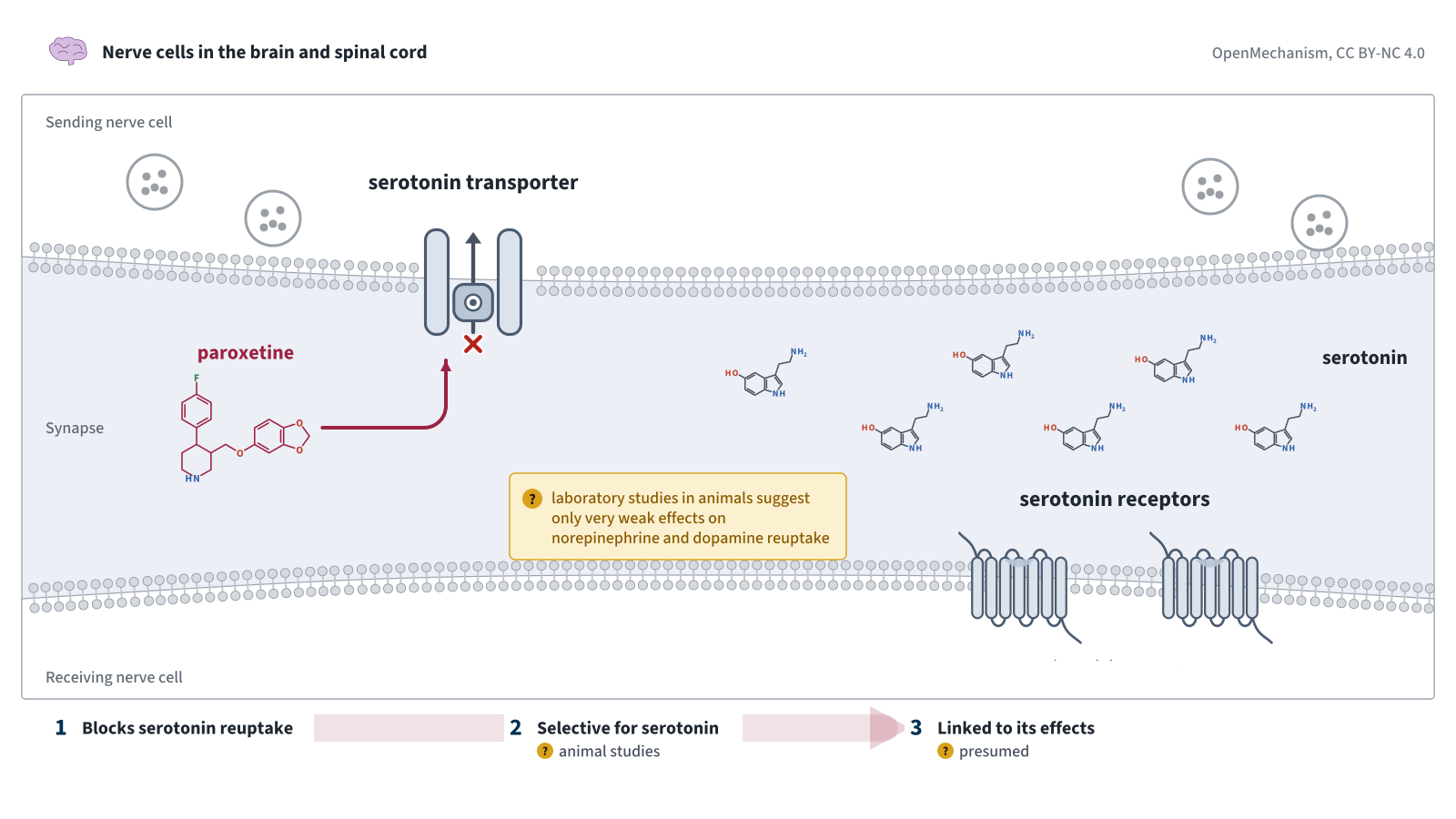
Laboratory studies in animals suggest only very weak effects on norepinephrine and dopamine reuptake
The paroxetine label says: In vitro studies in animals also suggest that paroxetine is a potent and highly selective inhibitor of neuronal serotonin reuptake (SSRI) and has only very weak effects on norepinephrine and dopamine neuronal reuptake.
Clinical study: In Owens and colleagues' 2008 randomized, double-blind, 8-week trial in 86 outpatients with major depression given controlled-release paroxetine (12.5 to 75 mg a day) or extended-release venlafaxine (75 to 375 mg a day), in doses raised on a fixed schedule, a new blood test estimated how much of the serotonin and norepinephrine transporters (SERT and NET) in the brain and spinal cord each blocked; a test of the step in people (dopamine was not measured): Maximal SERT inhibition at week 8 for paroxetine and venlafaxine was 90% (SD 7) and 85% (SD 10), respectively. Maximal NET inhibition for paroxetine and venlafaxine at week 8 was 36% (SD 19) and 60% (SD 13), respectively. … The results clearly demonstrate that paroxetine and venlafaxine are potent SERT antagonists and less potent NET antagonists in vivo.
Owens MJ et al., Neuropsychopharmacology 2008 (PMID 18418363)
Step 2: animal studies
The paroxetine label says: In vitro studies in animals also suggest that paroxetine is a potent and highly selective inhibitor of neuronal serotonin reuptake (SSRI) and has only very weak effects on norepinephrine and dopamine neuronal reuptake.
Clinical study: In Owens and colleagues' 2008 randomized, double-blind, 8-week trial in 86 outpatients with major depression given controlled-release paroxetine (12.5 to 75 mg a day) or extended-release venlafaxine (75 to 375 mg a day), in doses raised on a fixed schedule, a new blood test estimated how much of the serotonin and norepinephrine transporters (SERT and NET) in the brain and spinal cord each blocked; a test of the step in people (dopamine was not measured): Maximal SERT inhibition at week 8 for paroxetine and venlafaxine was 90% (SD 7) and 85% (SD 10), respectively. Maximal NET inhibition for paroxetine and venlafaxine at week 8 was 36% (SD 19) and 60% (SD 13), respectively. … The results clearly demonstrate that paroxetine and venlafaxine are potent SERT antagonists and less potent NET antagonists in vivo.
Owens MJ et al., Neuropsychopharmacology 2008 (PMID 18418363)
Step 3: presumed
The paroxetine label says: The mechanism of action of paroxetine in the treatment of major depressive disorder (MDD), panic disorder (PD), social anxiety disorder (SAD), and premenstrual dysphoric disorder (PMDD) is unknown, but is presumed to be linked to potentiation of serotonergic activity in the central nervous system resulting from inhibition of neuronal reuptake of serotonin (5-HT).
Clinical study: In Cipriani and colleagues' 2018 network meta-analysis of 522 double-blind, randomized trials of 21 antidepressants, paroxetine among them, for the acute treatment of adults with major depressive disorder; the trials measured response to treatment, not how the medicines work, and the review rated the certainty of its evidence moderate to very low: All antidepressants were more efficacious than placebo in adults with major depressive disorder.
Cipriani A et al., Lancet 2018 (PMID 29477251)
Key terms in this drawing
- 5-HT receptors
- Serotonin (5-hydroxytryptamine, 5-HT) receptors. Receptors that serotonin acts on; they come in several subtypes, such as 5-HT1A and 5-HT2A.
- reuptake
- Reuptake. Nerve cells taking a messenger such as serotonin back up, which helps end its signal.
How it works
Blocks serotonin reuptake. At clinical doses in humans, paroxetine blocks serotonin uptake into platelets; laboratory studies in animals suggest it is a potent and highly selective inhibitor of serotonin reuptake (SSRI) in nerve cells.1
Selective for serotonin. Laboratory studies in animals also suggest it has only very weak effects on norepinephrine and dopamine reuptake.1
Linked to its effects. The label says its mechanism in major depressive disorder, panic disorder, social anxiety disorder and premenstrual dysphoric disorder is unknown, but is presumed to be linked to stronger serotonin activity in the central nervous system from blocking serotonin reuptake.1
For teachers: download this drawing.
See also
Condition pages: anxiety disorders and depression.
Other serotonin reuptake inhibitors (SSRIs and related): amitriptyline, citalopram, desvenlafaxine, duloxetine, escitalopram, fluoxetine, nortriptyline, sertraline and 2 more.
Explained: tamoxifen and CYP2D6 blockers.
Body system: brain & nerves.
Sources
- 1Paroxetine extended-release tablets: FDA label1 Indications and Usage; 12.1 Mechanism of Action; 12.2 Pharmacodynamics; Boxed Warning
- 2ChEMBL CHEMBL490Target and action classification: Serotonin transporter inhibitor
- 3Estimates of serotonin and norepinephrine transporter inhibition in depressed patients treated with paroxetine or venlafaxineOwens MJ et al. Neuropsychopharmacology 2008 (abstract)
- 4
Spotted a mistake? Report an error (hello@openmechanism.com). Since launch, every published error we fix is listed on the corrections page.
Notes and limits
- A schematic teaching drawing: not to scale, not exact structures, binding poses or a complete pathway, and not a guide to dosing, treatment or how a person will respond.
- The paroxetine label has a boxed warning: antidepressants increased the risk of suicidal thoughts and behaviors in pediatric and young adult patients in short-term studies.
- The label says the mechanism of action of paroxetine in the treatment of major depressive disorder, panic disorder, social anxiety disorder and premenstrual dysphoric disorder is unknown and is presumed to be linked to stronger serotonin activity.
All recorded limits are on the evidence page, and notes that apply to every page are on How to read a page. Version 1.0.1, medically reviewed by Daniel Tran, PharmD, on 7 November 2026.
Cite this page
Tran D. Paroxetine [Internet]. OpenMechanism; 2026 [updated 2026 Nov 7; cited 2026 Nov 7]. Available from: https://openmechanism.com/medicines/paroxetine