Herpes infections
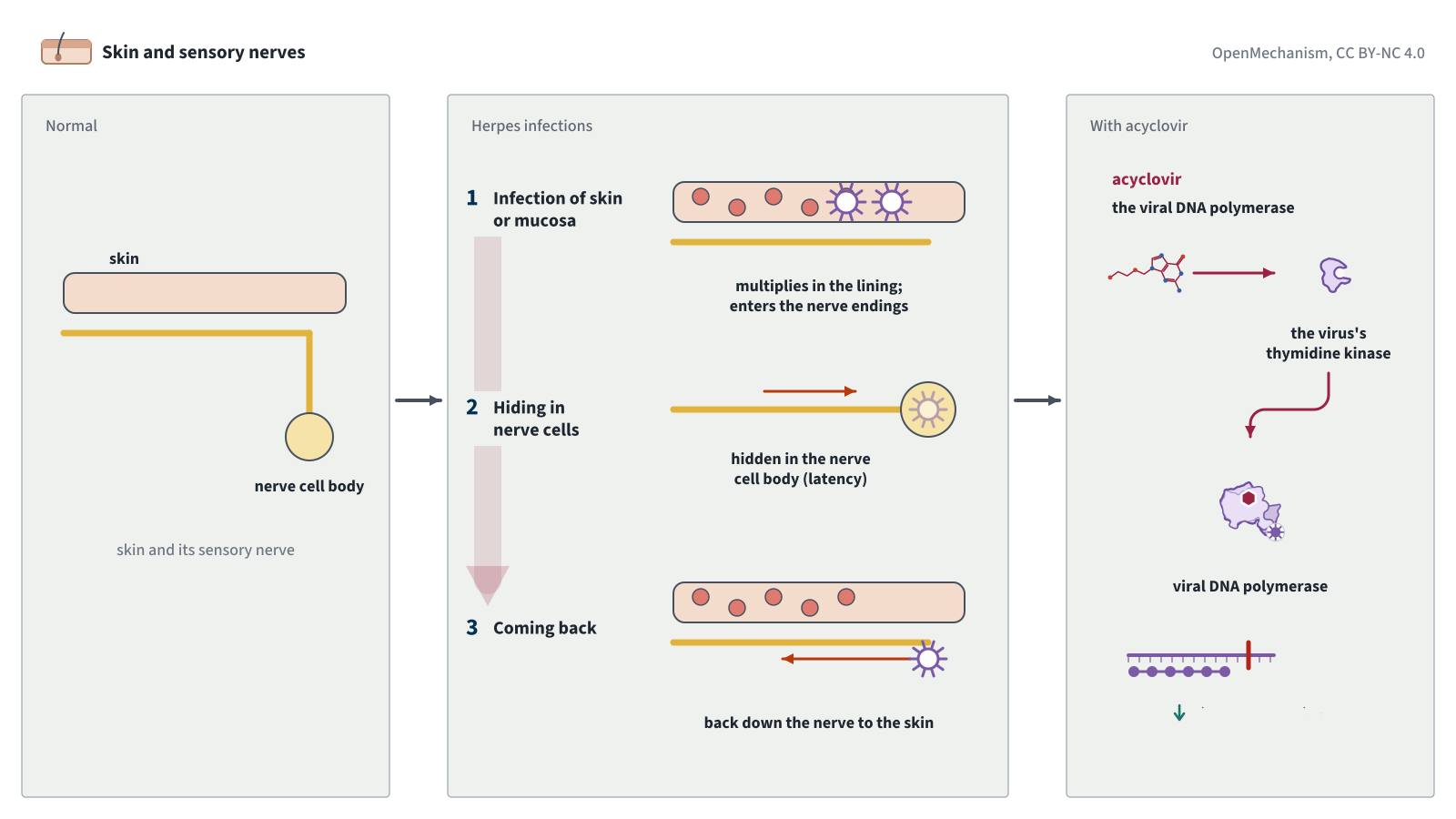
Herpes simplex virus multiplies in the skin or mucosa, then travels up sensory nerves to the nerve cell body, where it can hide (latency). From time to time it reactivates and travels back down to the skin. Acyclovir is switched on by the virus's own thymidine kinase and then stops viral DNA copying; it treats shingles, genital herpes and chickenpox.
- Where
- Skin and sensory nerves
- Body systems
- Infections; Skin, hair & nails; Brain & nerves
- Medicines
- 1 medicine
For teachers: download this drawing.
Key terms in this drawing
- DNA
- Deoxyribonucleic acid. The molecule that stores genes.
What goes wrong
Infection of skin or mucosa. After first infection, the virus multiplies in the lining cells of the skin or mucosa and enters sensory nerve endings.1
What the source says
“Following primary infection, the virus replicates productively within mucosal epithelial cells and enters sensory neurones via nerve termini.”
Source 1Hiding in nerve cells. It travels to the nerve cell body, where it can stay hidden (latency).1
What the source says
“The virus is then transported to neuronal cell bodies where latency can be established.”
Source 1Coming back. From time to time it reactivates, and new virus travels back down the nerve to the skin.1
What the source says
“Periodically, the virus can reactivate to resume its normal lytic cycle gene expression programme and result in the generation of new virus progeny that are transported axonally back to the periphery.”
Source 1
Where medicines act
- A
Acyclovir: viral DNA copying stopped
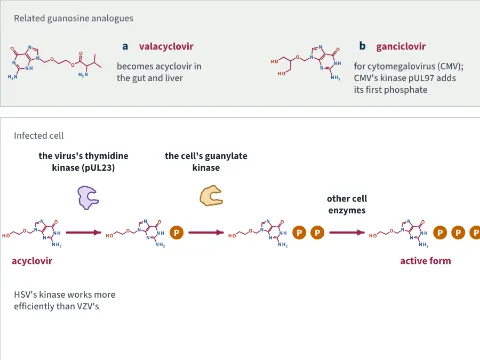
Acyclovir is switched on by the thymidine kinase of herpes simplex and varicella-zoster viruses; its active form stops viral copying. It treats shingles and genital herpes.2
What the source says
“The inhibitory activity of acyclovir is highly selective due to its affinity for the enzyme thymidine kinase (TK) encoded by HSV and VZV. This viral enzyme converts acyclovir into acyclovir monophosphate, a nucleotide analogue.”
Source 2“acyclovir triphosphate stops replication of herpes viral DNA.”
Source 2“Acyclovir tablets are indicated for the acute treatment of herpes zoster (shingles).”
Source 2“Acyclovir tablets are indicated for the treatment of initial episodes and the management of recurrent episodes of genital herpes.”
Source 2
See also
Body systems: infections; skin, hair & nails; and brain & nerves.
Related medicines: valacyclovir.
Other conditions: nerve pain after shingles.
Sources
- 1The molecular basis of herpes simplex virus latencyNicoll MP et al. FEMS Microbiol Rev 2012 (abstract). Saved copy
- 2Acyclovir tablets: FDA labelIndications and Usage; Virology. Saved copy
- 3Herpes simplex virus infectionsWhitley RJ, Roizman B. Lancet 2001 (abstract). Saved copy
- 4Herpes simplex virus 1 thymidine kinase with acyclovirPDB 2KI5; Bennett, M.S. et al. FEBS Lett. 1999;443:121-125. The thymidine kinase outline in the drawing is traced from this structure. Saved copy
- 5Herpes simplex virus 1 DNA polymerase with its processivity factor, on DNA, with acyclovir triphosphatePDB 8V1T; Shankar, S. et al. Cell 2024;187:5572-5586.e15. The viral DNA polymerase outline in the drawing is traced from this structure. Saved copy
Notes and limits
- The latency steps shown are those described for herpes simplex virus type 1.1
- Herpes simplex ranges from mild skin and mucosal infection to life-threatening disease.3
Notes that apply to every page are on How to read a page.
Spotted a mistake? Report an error (hello@openmechanism.com). Since launch, every published error we fix is listed on the corrections page.
Cite this page
Tran D. Herpes infections [Internet]. OpenMechanism; 2026 [updated 2026 Oct 18; cited 2026 Oct 18]. Available from: https://openmechanism.com/conditions/herpes-infections