Citalopram
Citalopram blocks the serotonin transporter and with it the of serotonin into nerve cells; animal studies suggest it barely touches norepinephrine and dopamine reuptake, and it has no or very low for a range of other receptors. The Celexa label lists it for major depressive disorder in adults, and says its mechanism is unclear, but the antidepressant effect is presumed to be related to stronger serotonin activity from blocking serotonin reuptake.
- Acts on
- The serotonin transporter (SERT)
- Where
- Nerve cells in the brain and spinal cord
- Medicine type
- Small molecule
- Used for
- Brain & nerves
Also called Celexa.
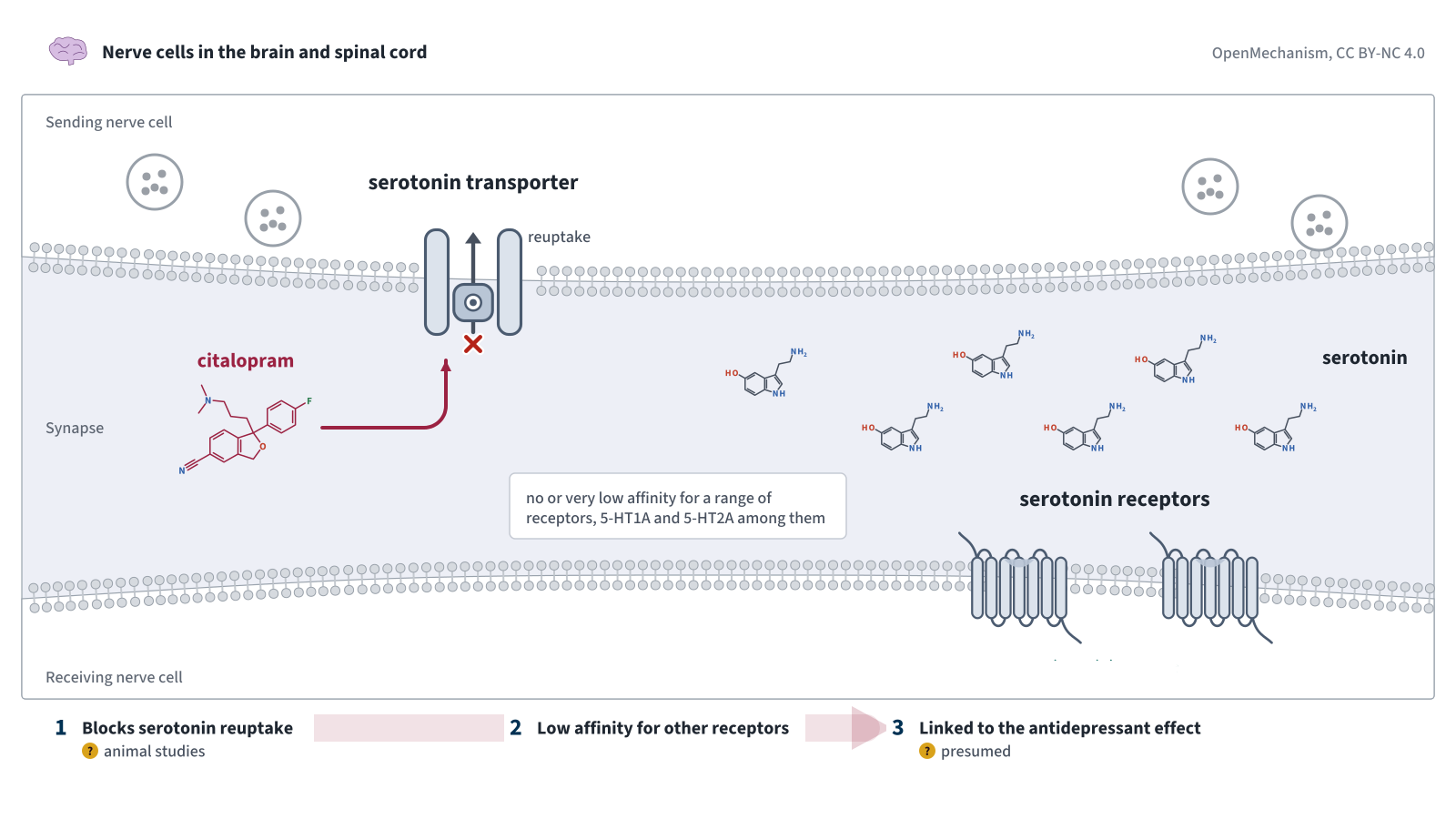
Step 1: animal studies
The Celexa label says: In vitro and in vivo studies in animals suggest that citalopram is a selective serotonin reuptake inhibitor (SSRI) with minimal effects on norepinephrine (NE) and dopamine (DA) neuronal reuptake.
Clinical study: In Meyer and colleagues' 2004 brain imaging (PET) study, 77 people took one of five medicines, citalopram among them, for 4 weeks: healthy people at doses below those used in treatment, and people with mood and anxiety disorders at treatment doses. It measured the blocking of the serotonin transporter in people, not effects on norepinephrine or dopamine: Subjects received citalopram, fluoxetine, sertraline, paroxetine, or extended-release venlafaxine. … Occupancy of 80% across five SSRIs occurs at minimum therapeutic doses.
Meyer JH et al., Am J Psychiatry 2004 (PMID 15121647)
Step 3: presumed
The Celexa label says: The mechanism of action of citalopram is unclear, but is presumed to be related to potentiation of serotonergic activity in the central nervous system (CNS) resulting from its inhibition of CNS neuronal reuptake of serotonin (5-HT).
Clinical study: In Cipriani and colleagues' 2018 network meta-analysis of 522 double-blind, randomized trials of 21 antidepressants, citalopram among them, for the acute treatment of adults with major depressive disorder; the trials measured response to treatment, not how the medicines work, and the review rated the certainty of its evidence moderate to very low: All antidepressants were more efficacious than placebo in adults with major depressive disorder.
Cipriani A et al., Lancet 2018 (PMID 29477251)
Key terms in this drawing (5)
- 5-HT receptors
- Serotonin (5-hydroxytryptamine, 5-HT) receptors. Receptors that serotonin acts on; they come in several subtypes, such as 5-HT1A and 5-HT2A.
- 5-HT1A receptor
- Serotonin 1A receptor. One of the serotonin receptors; in lab studies, buspirone binds it strongly.
- 5-HT2A receptor
- Serotonin 2A receptor. One of the serotonin receptors; olanzapine binds it strongly.
- affinity
- Binding affinity. How strongly a molecule binds its target.
- reuptake
- Reuptake. Nerve cells taking a messenger such as serotonin back up, which helps end its signal.
How it works
Blocks serotonin reuptake. Studies in animals suggest citalopram is a selective serotonin reuptake inhibitor (SSRI), with minimal effects on norepinephrine and dopamine reuptake.1
Low affinity for other receptors. It has no or very low affinity for , , dopamine D1 and D2, alpha-1, alpha-2 and beta-adrenergic, , , muscarinic and benzodiazepine receptors.1
Linked to the antidepressant effect. The label says its mechanism of action is unclear, but is presumed to relate to stronger serotonin activity in the central nervous system from blocking the reuptake of serotonin.1
For teachers: download this drawing.
See also
Condition pages: depression.
Other serotonin reuptake inhibitors (SSRIs and related): amitriptyline, desvenlafaxine, duloxetine, escitalopram, fluoxetine, nortriptyline, paroxetine, sertraline and 2 more.
Explained: why some medicines lengthen the QT interval.
Body system: brain & nerves.
Sources
- 1Celexa (citalopram): FDA label1 Indications and Usage; 12.1 Mechanism of Action; 12.2 Pharmacodynamics; Boxed Warning
- 2ChEMBL CHEMBL549Target and action classification: Serotonin transporter inhibitor
- 3Serotonin transporter occupancy of five selective serotonin reuptake inhibitors at different doses: an [11C]DASB positron emission tomography studyMeyer JH et al. Am J Psychiatry 2004 (abstract)
- 4
Spotted a mistake? Report an error (hello@openmechanism.com). Since launch, every published error we fix is listed on the corrections page.
Notes and limits
- A schematic teaching drawing: not to scale, not exact structures, binding poses or a complete pathway, and not a guide to dosing, treatment or how a person will respond.
- The Celexa label has a boxed warning: antidepressants increased the risk of suicidal thoughts and behaviors in pediatric and young adult patients in short-term studies.
- The label says the mechanism of action of citalopram is unclear and is presumed to be related to stronger serotonin activity.
All recorded limits are on the evidence page, and notes that apply to every page are on How to read a page. Version 1.0.1, medically reviewed by Daniel Tran, PharmD, on 7 November 2026.
Cite this page
Tran D. Citalopram [Internet]. OpenMechanism; 2026 [updated 2026 Nov 7; cited 2026 Nov 7]. Available from: https://openmechanism.com/medicines/citalopram