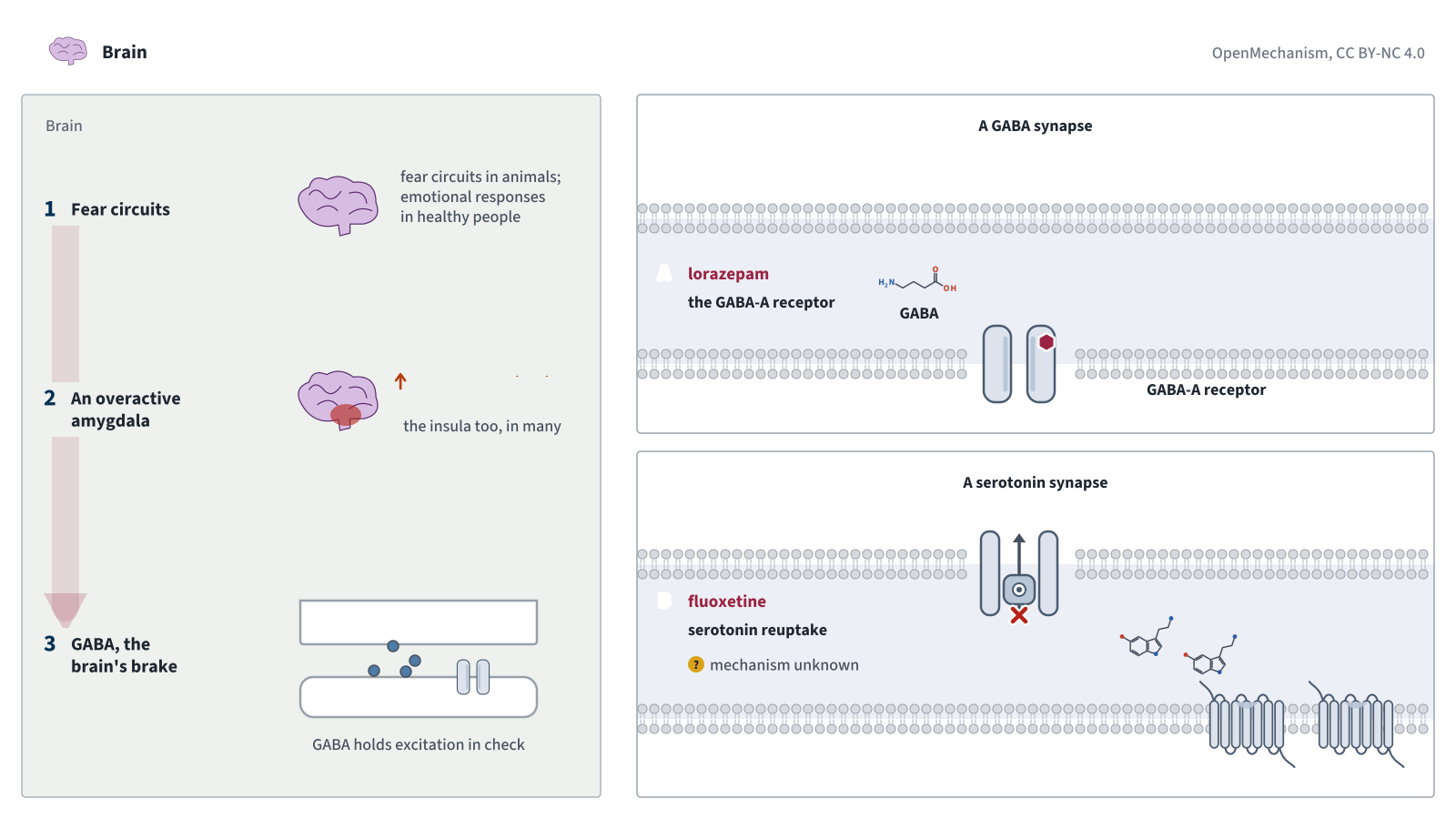
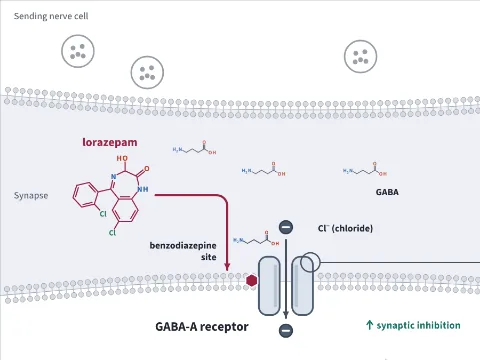
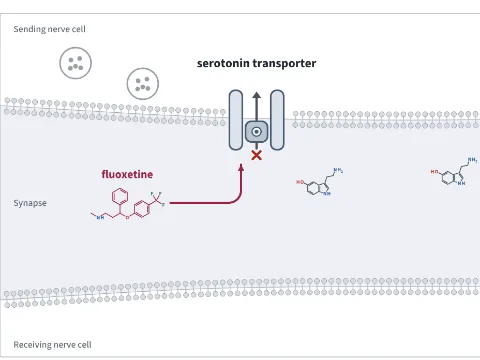
Anxiety disorders are studied through the brain's fear circuits: in general, brain scans show the amygdala more strongly activated by things linked to the disorder in several, and the insular cortex appears more active in many. GABA is the cortex's main brake. Lorazepam, a benzodiazepine, binds the benzodiazepine site of GABA-A receptors and strengthens GABA's inhibition, which the Loreev XR label says is how it acts in treating anxiety disorders; fluoxetine, which blocks serotonin , is used for the acute treatment of panic disorder.
What goes wrong in anxiety disorders, and where medicines act. Schematic, not to scale. License CC BY-NC 4.0.
?Mechanism unknown
The Prozac (fluoxetine) label says: Although the exact mechanism of PROZAC is unknown, it is presumed to be linked to its inhibition of CNS neuronal uptake of serotonin.
Clinical study: In Michelson and colleagues' 1998 randomized trial, 243 people with panic disorder took fluoxetine (10 or 20 mg a day) or placebo; the trial measured panic attacks and other symptoms, not how fluoxetine works: Fluoxetine, particularly the 20-mg/day dose, was associated with more improvement than was placebo in patients with panic disorder across multiple symptom measures, including global improvement, total panic attack frequency, phobic symptoms, and functional impairment.Michelson D et al., Am J Psychiatry 1998 (PMID 9812120)
Gamma-aminobutyric acid. The main inhibitory messenger in the central nervous system.
GABA-A receptor
Gamma-aminobutyric acid type A receptor. A receptor channel on nerve cells that GABA switches on; benzodiazepines also bind it.
reuptake
Reuptake. Nerve cells taking a messenger such as serotonin back up, which helps end its signal.
What goes wrong
Fear circuits. Research on the brain circuits of anxiety disorders builds on the study of fear circuits in animals and of brain responses to emotional stimuli in healthy people.1
What the source says
“Research on the neurocircuitry of anxiety disorders has its roots in the study of fear circuits in animal models and the study of brain responses to emotional stimuli in healthy humans.”
An overactive amygdala. A 2010 review reports that, in general, brain scans show the amygdala more strongly activated by things linked to the disorder in post-traumatic stress disorder, social phobia and specific phobia, and the insular cortex appears more active in many anxiety disorders.1
What the source says
“In general, these studies have reported relatively heightened amygdala activation in response to disorder-relevant stimuli in post-traumatic stress disorder, social phobia, and specific phobia.”
GABA, the brain's brake. , the main inhibitory messenger of the cerebral cortex, holds nerve cell excitation in check. This is the brake lorazepam acts on; the sources here do not say it is weaker in anxiety disorders.2
What the source says
“gamma-Aminobutyric acid (GABA), the principal inhibitory neurotransmitter in the cerebral cortex, maintains the inhibitory tone that counterbalances neuronal excitation.”
Lorazepam binds the benzodiazepine site of in the brain and strengthens GABA's inhibition at synapses; its effects include less anxiety. As tablets, it is used for anxiety disorders and the short-term relief of the symptoms of anxiety; the Ativan label says its effectiveness in long-term use, more than 4 months, has not been assessed by systematic clinical studies.3,4,5
What the source says
“Lorazepam exerts its effect for the treatment of anxiety disorders through binding to the benzodiazepine site of the gamma-aminobutyric acid-A (GABA A ) receptors in the brain and enhances GABA-mediated synaptic inhibition.”
“Ativan (lorazepam) is indicated for the management of anxiety disorders or for the short-term relief of the symptoms of anxiety or anxiety associated with depressive symptoms.”
Fluoxetine blocks nerve cells from taking back serotonin; the label says exactly how it works is unknown, though it is presumed to be linked to this. It is used for the acute treatment of panic disorder, with or without agoraphobia.6
What the source says
“Although the exact mechanism of PROZAC is unknown, it is presumed to be linked to its inhibition of CNS neuronal uptake of serotonin.”
Also used for it: alprazolam (“acute treatment of generalized anxiety disorder (GAD) in adults”, and “treatment of panic disorder (PD), with or without agoraphobia in adults”7).
text 79771229b736…; drawings 9a8d7572fd56…; notes 95ea81eb9086…
AI source check
Claude Opus 5.5 (AI source check), 4 November 2026: 32 statements compared with their sources, 10 flagged for the reviewer. An automated check, not a medical review.
Next review due
5 May 2028
Cite this page
Tran D. Anxiety disorders [Internet]. OpenMechanism; 2026 [updated 2026 Nov 4; cited 2026 Nov 4]. Available from: https://openmechanism.com/conditions/anxiety-disorders