Nicotine dependence
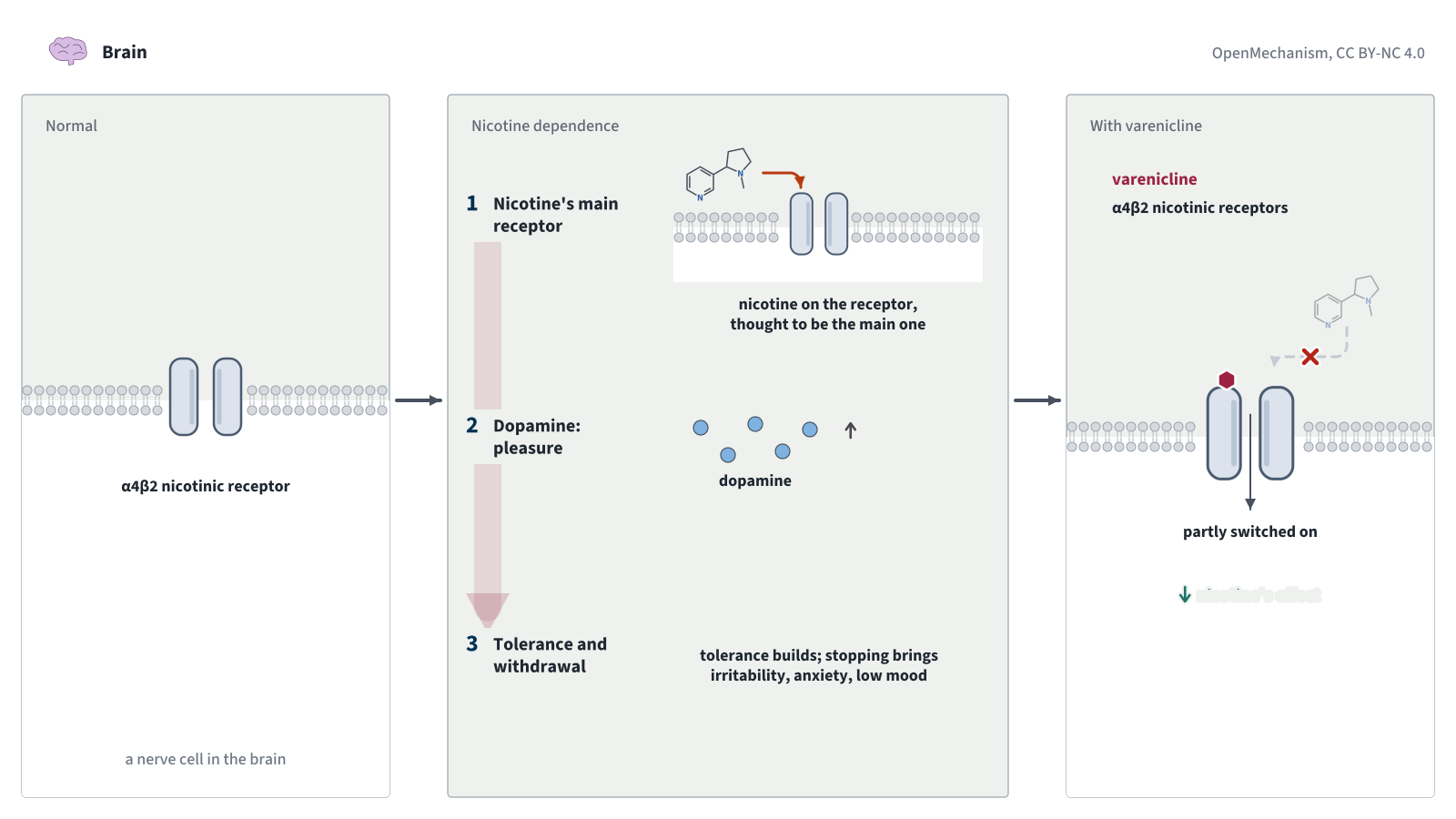
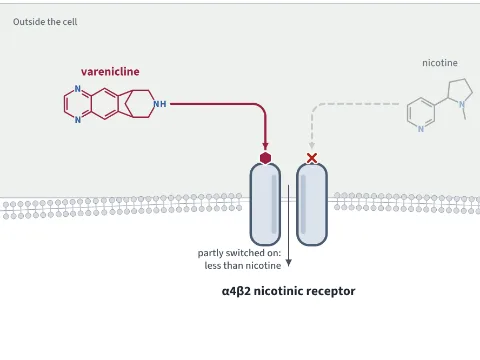
Nicotine keeps people smoking, which causes much early disability and death. It acts mainly on alpha-4 beta-2 nicotinic receptors in the brain, releasing dopamine and other messengers, which brings pleasure and lifts mood. With repeated use the brain adapts: tolerance builds and stopping brings withdrawal. Varenicline, the medicine drawn here, partly switches on the same receptors while keeping nicotine from binding; bupropion and nicotine patches are labeled as aids to stopping smoking too.
- Where
- Brain
- Body system
- Brain & nerves
- Medicines
- 1 medicine
For teachers: download this drawing.
Key terms in this drawing
- α4β2 receptor
- Alpha-4 beta-2 nicotinic acetylcholine receptor. A nicotine receptor on nerve cells in the brain.
What goes wrong
Nicotine's main receptor. The alpha-4 beta-2 nicotinic acetylcholine receptor is thought to be the main receptor behind nicotine dependence.1
What the source says
“Molecular biology studies suggest that the alpha(4)beta(2) nicotinic acetylcholine receptor subtype is the main receptor mediating nicotine dependence.”
Source 1Dopamine: pleasure. Acting on these receptors, nicotine releases dopamine and other messengers, bringing pleasure, stimulation and changes in mood.1
What the source says
“Nicotine acts on these brain nicotinic cholinergic receptors to facilitate neurotransmitter release (dopamine and others), producing pleasure, stimulation, and mood modulation.”
Source 1Tolerance and withdrawal. With repeated nicotine the brain adapts and tolerance builds; stopping smoking brings withdrawal, with irritability, anxiety and low mood.1
What the source says
“Neuroadaptation develops with repeated exposure to nicotine, resulting in tolerance to many of the effects of nicotine. When a smoker stops smoking, a nicotine withdrawal syndrome ensues, characterized by irritability, anxiety, increased eating, dysphoria, and hedonic dysregulation, among other symptoms.”
Source 1
Where medicines act
- A
Varenicline: a partial switch that blocks nicotine
Varenicline binds alpha-4 beta-2 nicotinic receptors strongly and selectively; it partly switches them on while keeping nicotine from binding. It is an aid to stopping smoking.2
What the source says
“Varenicline binds with high affinity and selectivity at α4β2 neuronal nicotinic acetylcholine receptors.”
Source 2“The efficacy of CHANTIX in smoking cessation is believed to be the result of varenicline's activity at α4β2 sub-type of the nicotinic receptor where its binding produces agonist activity, while simultaneously preventing nicotine binding to these receptors.”
Source 2“CHANTIX is indicated for use as an aid to smoking-cessation treatment.”
Source 2
See also
Body system: brain & nerves.
Also used for it: bupropion (SR extended-release tablets: “aid to smoking cessation treatment”3).
Other conditions: chronic obstructive pulmonary disease (COPD), alcohol use disorder and depression.
Side effects: why bupropion carries a risk of seizures.
Sources
- 1Neurobiology of nicotine addiction: implications for smoking cessation treatmentBenowitz NL. Am J Med 2008 (abstract). Saved copy
- 2Chantix (varenicline): FDA label1 Indications and Usage; 12.1 Mechanism of Action. Saved copy
- 3Bupropion hydrochloride extended-release tablets (SR): FDA label1 Indications and Usage; 12.1 Mechanism of Action. Saved copy
- 4NicoDerm CQ (nicotine patch): labelPurpose; Use. Saved copy
Notes and limits
- Smoking is also kept up by learned cues, and counseling and behavioral therapy add a lot to medicines.1
- This page draws varenicline only. Bupropion's extended-release (SR) tablets are labeled as an aid to stopping smoking, though the exact way they help is not known, their label says; a nicotine patch's label calls it a stop-smoking aid that reduces withdrawal symptoms, including nicotine craving.3,4
Notes that apply to every page are on How to read a page.
Spotted a mistake? Report an error (hello@openmechanism.com). Since launch, every published error we fix is listed on the corrections page.
Cite this page
Tran D. Nicotine dependence [Internet]. OpenMechanism; 2026 [updated 2026 Nov 18; cited 2026 Nov 18]. Available from: https://openmechanism.com/conditions/nicotine-dependence