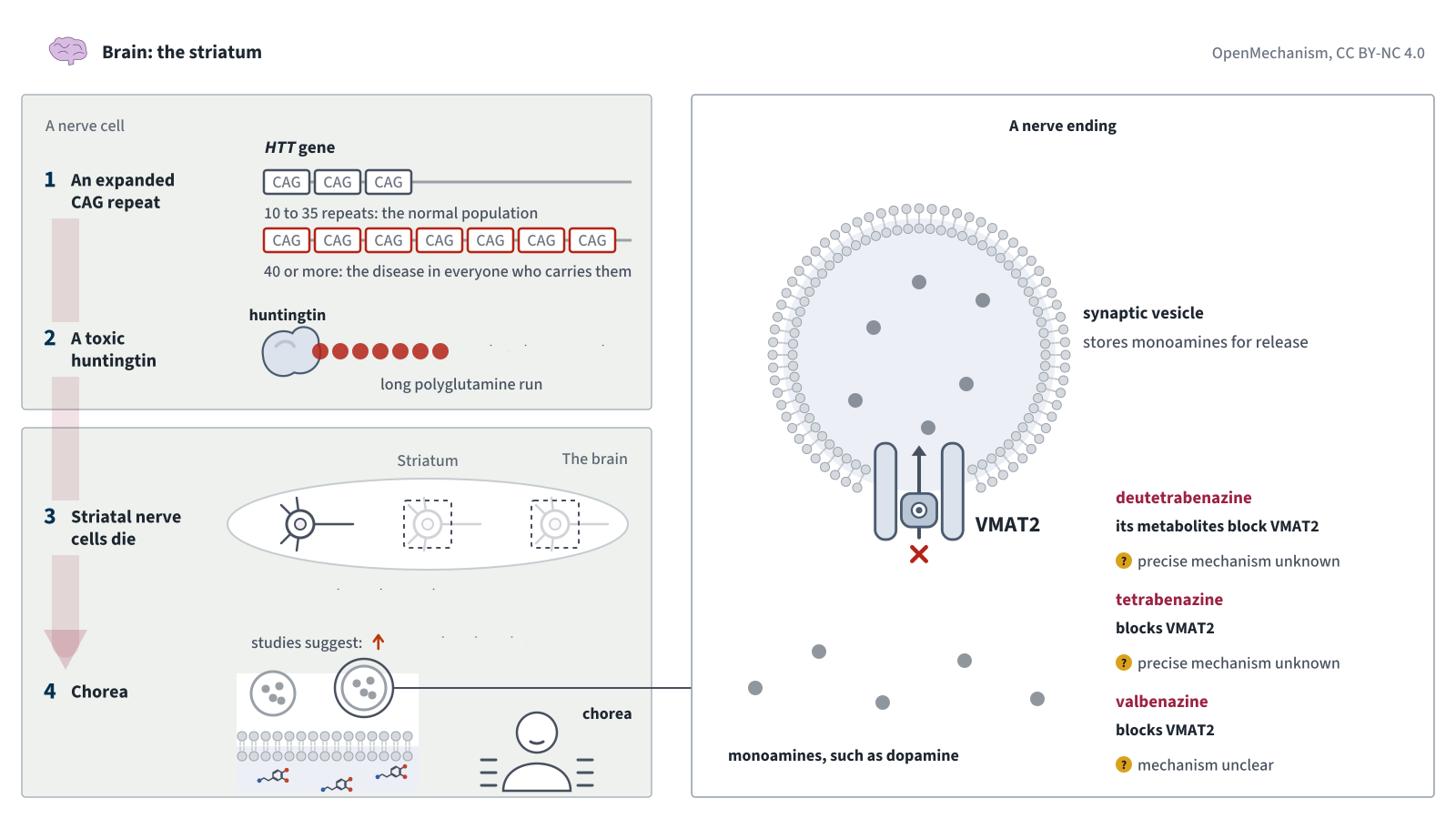
Huntington disease is inherited: an expanded CAG repeat in the HTT gene gives the protein huntingtin a toxic gain of function, and nerve cells in the striatum die. Its classic sign is chorea, unwanted movements that gradually spread to all muscles. There is no cure. Deutetrabenazine, tetrabenazine and valbenazine act on VMAT2, which takes monoamines, such as dopamine, up into synaptic vesicles; their labels list them for the chorea, in adults for deutetrabenazine and valbenazine.
What goes wrong in Huntington disease, and where medicines act. Schematic, not to scale. License CC BY-NC 4.0.
?Precise mechanism unknown
The Austedo label says: The precise mechanism by which deutetrabenazine exerts its effects in the treatment of tardive dyskinesia and chorea in patients with Huntington’s disease is unknown but is believed to be related to its effect as a reversible depletor of monoamines (such as dopamine, serotonin, norepinephrine, and histamine) from nerve terminals.
Clinical study: In the Huntington Study Group's 2016 randomized, double-blind trial, 90 adults with Huntington disease and chorea (a chorea score of 8 or higher) who could walk were assigned to deutetrabenazine (45 people) or placebo (45 people), the dose adjusted over 8 weeks to an optimal level and kept there for 4 more (its abstract gives no doses; the Austedo label's account of this trial, its Study 1, gives at most 48 mg a day and p<0.0001); the trial measured chorea scores, not how deutetrabenazine works: In the deutetrabenazine group, the mean total maximal chorea scores improved from 12.1 (95% CI, 11.2-12.9) to 7.7 (95% CI, 6.5-8.9), whereas in the placebo group, scores improved from 13.2 (95% CI, 12.2-14.3) to 11.3 (95% CI, 10.0-12.5); the mean between-group difference was -2.5 units (95% CI, -3.7 to -1.3) (P < .001).Huntington Study Group et al., JAMA 2016 (PMID 27380342)
?Precise mechanism unknown
The Xenazine label says: The precise mechanism by which XENAZINE (tetrabenazine) exerts its anti-chorea effects is unknown but is believed to be related to its effect as a reversible depletor of monoamines (such as dopamine, serotonin, norepinephrine, and histamine) from nerve terminals.
Clinical study: In the Huntington Study Group's 2006 randomized, double-blind, placebo-controlled trial (as the Xenazine label describes this trial, its Study 1), 84 people with Huntington disease who could walk were assigned to tetrabenazine (TBZ; 54 people; raised over 7 weeks to at most 100 mg a day) or placebo (30 people) for 12 weeks; the trial measured chorea scores on the Unified Huntington's Disease Rating Scale (UHDRS), not how tetrabenazine works: TBZ treatment resulted in a reduction of 5.0 units in chorea severity compared with a reduction of 1.5 units on placebo treatment (adjusted mean effect size = -3.5 +/- 0.8 UHDRS units [mean +/- SE]; 95% CI: -5.2, -1.9; p < 0.0001).Huntington Study Group, Neurology 2006 (PMID 16476934)
?Mechanism unclear
The Ingrezza label says: The mechanism of action of valbenazine for the treatment of tardive dyskinesia and chorea in patients with Huntington’s disease is unclear, but is thought to be mediated through the reversible inhibition of vesicular monoamine transporter 2 (VMAT2), a transporter that regulates monoamine uptake from the cytoplasm to the synaptic vesicle for storage and release.
Clinical study: In Furr Stimming and colleagues' 2023 randomized, double-blind trial (KINECT-HD), 128 adults with genetically confirmed Huntington disease and chorea (a chorea score of 8 or higher) were assigned to valbenazine (up to 80 mg by mouth, as tolerated) or placebo for 12 weeks, and 125 were analyzed; the trial measured chorea scores (the Total Maximal Chorea score of the Unified Huntington's Disease Rating Scale, UHDRS TMC), not how valbenazine works: Least-squares mean changes from the screening and baseline period to the maintenance period in the UHDRS TMC score were -4·6 for valbenazine and -1·4 for placebo (least-squares mean difference -3·2, 95% CI -4·4 to -2·0; p<0·0001).Furr Stimming E et al., Lancet Neurol 2023 (PMID 37210099)
An expanded CAG repeat. Huntington disease is inherited in an autosomal dominant way. It is caused by an expanded CAG repeat in HTT, the gene for the protein huntingtin. In the normal population there are 10 to 35 repeats; 36 to 39 repeats cause the disease in some people who carry them, and 40 or more in everyone who carries them. The longer the repeat, the earlier the disease begins.1,2,3
What the source says
“Huntington disease is devastating to patients and their families - with autosomal dominant inheritance, onset typically in the prime of adult life, progressive course, and a combination of motor, cognitive and behavioural features.”
“The Huntingtin gene (HTT) has a unique feature of a DNA trinucleotide (triplet) repeat, with repeat length ranging from 10 to 35 in the normal population. Repeat lengths between 36 and 39 cause HD at reduced penetrance (some will get the disease, others won't) and when expanded to 40 or more repeats (mHTT), causes HD at full penetrance (every person with this length or beyond will definitely develop the disease).”
A toxic huntingtin. In people who carry the mutation, the expanded CAG repeat leads to an abnormally long run of glutamines (polyglutamine) in huntingtin. This gives it toxic new functions (a toxic gain of function) and makes it prone to breaking into fragments, so that nerve cells malfunction and die. The precise mechanisms are poorly understood.1,4
What the source says
“The mutant protein in Huntington's disease--huntingtin--results from an expanded CAG repeat leading to a polyglutamine strand of variable length at the N-terminus.”
“In mutation carriers, huntingtin is produced with abnormally long polyglutamine sequences that confer toxic gains of function and predispose the protein to fragmentation, resulting in neuronal dysfunction and death.”
Striatal nerve cells die. The disease starts in the striatum. The mutant protein, made everywhere and throughout life, first impairs and then kills one group of nerve cells there, the medium-sized spiny neurons. Nerve cells are also lost, to a lesser degree, in the cortex, thalamus, hippocampus and hypothalamus, and in time every area of the brain is affected.2,5
What the source says
“Huntington disease (HD) is an autosomal dominant, neurodegenerative disorder with a primary etiology of striatal pathology.”
“Expressed ubiquitously and throughout the entire life cycle (development through adulthood), mHTT causes initial dysfunction and eventual death of a specific cell population within the striatum. Although all areas of the brain are eventually affected, the primary pathology of the disease is regionally specific.”
“The principal histopathology of HD is the loss of medium-sized spiny neurons (MSNs) and, to a lesser degree, neuronal loss in cerebral cortex, thalamus, hippocampus, and hypothalamus.”
Chorea. The classic sign is chorea, unwanted movements that gradually spread to all muscles. The disease is also marked by behavioral and psychiatric problems and dementia. Studies in patients and in mouse models suggest that in the early stages dopamine signaling is increased, leading to excess movements that can be eased by depleting dopamine stores.3,5
What the source says
“Huntington disease (HD) is a rare neurodegenerative disorder of the central nervous system characterized by unwanted choreatic movements, behavioral and psychiatric disturbances and dementia.”
“Neurochemical, electrophysiological, and behavioral studies in HD patients and genetic mouse models suggest biphasic changes in DA neurotransmission. In the early stages, DA neurotransmission is increased leading to hyperkinetic movements that can be alleviated by depleting DA stores.”
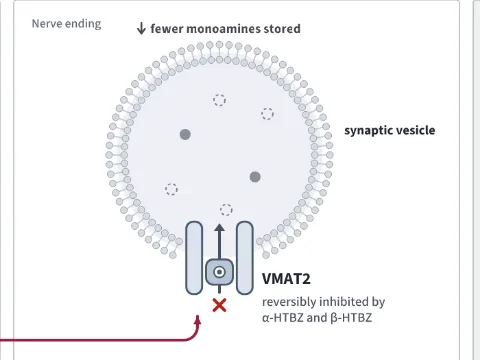
Its metabolites block VMAT2, so fewer monoamines are stored; the label calls the precise mechanism unknown.6
Used forChorea associated with Huntington's disease: in adults
What the label says
“AUSTEDO XR® and AUSTEDO® are indicated in adults for the treatment of: chorea associated with Huntington’s disease [see Clinical Studies (14.1)] tardive dyskinesia”
“The precise mechanism by which deutetrabenazine exerts its effects in the treatment of tardive dyskinesia and chorea in patients with Huntington’s disease is unknown but is believed to be related to its effect as a reversible depletor of monoamines (such as dopamine, serotonin, norepinephrine, and histamine) from nerve terminals.”
“The major circulating metabolites (α-dihydrotetrabenazine [HTBZ] and β-HTBZ) of deutetrabenazine, are reversible inhibitors of VMAT2, resulting in decreased uptake of monoamines into synaptic vesicles and depletion of monoamine stores.”
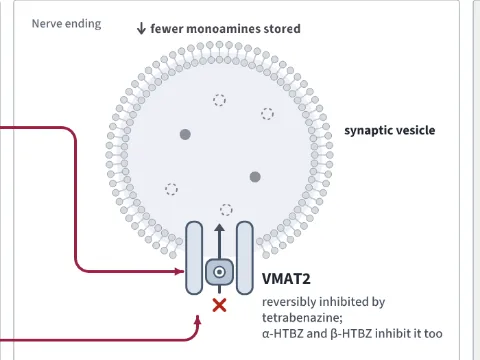
“The precise mechanism by which XENAZINE (tetrabenazine) exerts its anti-chorea effects is unknown but is believed to be related to its effect as a reversible depletor of monoamines (such as dopamine, serotonin, norepinephrine, and histamine) from nerve terminals.”
“Tetrabenazine reversibly inhibits the human vesicular monoamine transporter type 2 (VMAT2) (Ki ≈ 100 nM), resulting in decreased uptake of monoamines into synaptic vesicles and depletion of monoamine stores.”
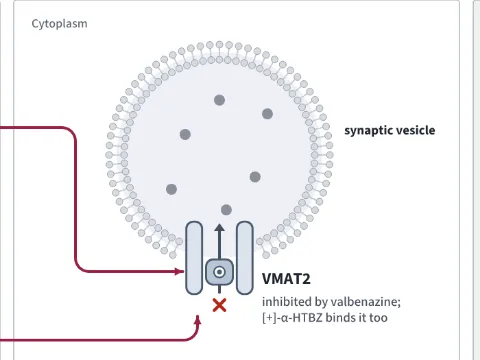
Blocks VMAT2; the label calls the mechanism unclear.8
Used forChorea associated with Huntington's disease: in adults
What the label says
“INGREZZA and INGREZZA SPRINKLE are indicated for the treatment of adults with: - tardive dyskinesia [see Clinical Studies ( 14.1 )]. - chorea associated with Huntington’s disease”
“The mechanism of action of valbenazine for the treatment of tardive dyskinesia and chorea in patients with Huntington’s disease is unclear, but is thought to be mediated through the reversible inhibition of vesicular monoamine transporter 2 (VMAT2), a transporter that regulates monoamine uptake from the cytoplasm to the synaptic vesicle for storage and release.”
Austedo (deutetrabenazine): FDA label1 Indications and Usage; Boxed Warning; 5.1 Depression and Suicidality in Patients with Huntington's Disease; 12.1 Mechanism of Action; 14 Clinical Studies. Saved copy
Ingrezza (valbenazine): FDA label1 Indications and Usage; Boxed Warning; 5.1 Depression and Suicidal Ideation and Behavior in Patients with Huntington's Disease; 12.1 Mechanism of Action; 12.2 Pharmacodynamics. Saved copy
All three labels have a boxed warning: these medicines can increase the risk of depression and suicidal thoughts and behavior in patients with Huntington's disease. Their warnings add that patients with Huntington's disease are at increased risk for depression and for suicidal thoughts or behaviors. The Austedo and Xenazine boxed warnings also rule those medicines out for patients who are suicidal (the Xenazine label says actively suicidal) and for patients with untreated or inadequately treated depression.6,7,8
All three labels hedge: the Austedo and Xenazine labels call the precise mechanism unknown, and the Ingrezza label calls the mechanism unclear.6,7,8
Each trial in the notes compared one medicine with placebo, in a different year and a different group of patients; none compared the three medicines with each other.9,10,11
The Xenazine and Ingrezza labels give binding figures (Ki) for their own medicines, the Austedo label gives none, and no label compares its figures with another medicine's.6,7,8
There is no cure, and a 2015 review notes the absence of effective treatments that change the course of the disease.1,3
A 2010 review says chorea is treated with medicines that block dopamine receptors or deplete dopamine.3
The dopamine changes are suggested by studies in patients and in mouse models. In the late stages, too little dopamine reduces movement instead (hypokinesia), and a 2014 review says the causes of these dopamine changes are presently unknown.5
text 0f80a6cf3a5f…; drawings 5795b212c19e…; notes d440f0cbb769…
AI source check
Claude Opus 5.5 (AI source check), 6 November 2026: 45 statements compared with their sources, 6 flagged for the reviewer. An automated check, not a medical review.
Next review due
7 May 2028
Cite this page
Tran D. Huntington disease [Internet]. OpenMechanism; 2026 [updated 2026 Nov 6; cited 2026 Nov 6]. Available from: https://openmechanism.com/conditions/huntington-disease