Acute pain and period pain
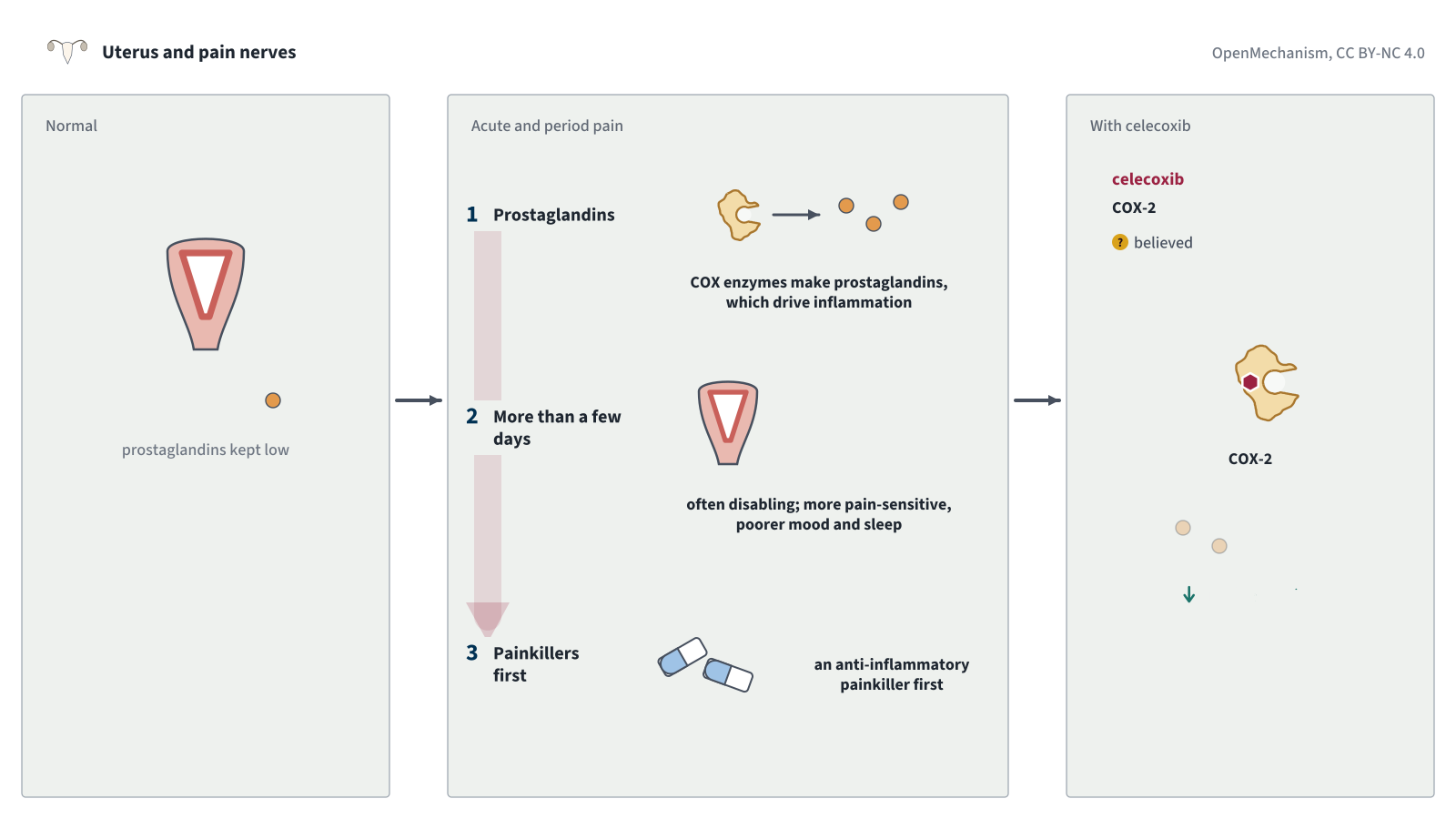
Prostaglandins, made from arachidonic acid by cyclooxygenase (COX) enzymes, help drive inflammation; anti-inflammatory painkillers block their making. Period pain without disease of the pelvis is common, affecting 45 to 95% of women who menstruate, and comes with greater pain sensitivity, poorer mood and sleep. Celecoxib blocks COX-2 and treats acute pain and period pain.
- Where
- Uterus and pain nerves
- Body systems
- Brain & nerves, Bladder & reproductive organs
- Medicines
- 1 medicine
Believed
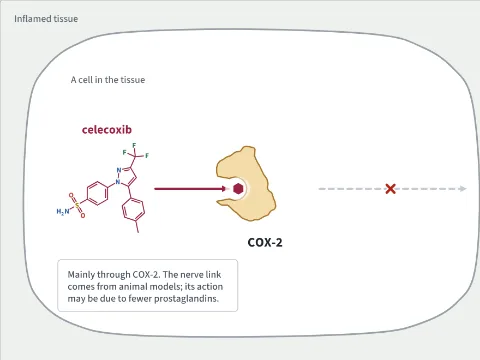
The Celebrex (celecoxib) label says: The mechanism of action of CELEBREX is believed to be due to inhibition of prostaglandin synthesis, primarily via inhibition of COX-2.
Source 3: Celebrex (celecoxib): FDA label, 1 Indications and Usage; 12.1 Mechanism of Action
Clinical study: In two randomized, double-blind crossover studies in women with primary dysmenorrhea (period pain), celecoxib, naproxen sodium and placebo were compared; the studies measured pain relief, not how celecoxib works: In these 2 identically designed studies in women aged 18 to 44 years, celecoxib 400 mg (followed by 200 mg q12h) was more effective, as measured using pain scores, in the treatment of primary dysmenorrhea compared with placebo.
Daniels S et al., Clin Ther 2009 (PMID 19695387)
This study was picked with a literature search and is not yet checked by our reviewer.
For teachers: download this drawing.
Key terms in this drawing
- COX
- Cyclooxygenase. The enzymes, COX-1 and COX-2, that make prostaglandins.
- COX-2
- Cyclooxygenase-2. An enzyme that makes prostaglandins.
What goes wrong
Prostaglandins. Prostaglandins are fat-based signals made from arachidonic acid by cyclooxygenase () enzymes. They help drive inflammation, and anti-inflammatory painkillers block their making.1
What the source says
“Prostaglandins are lipid autacoids derived from arachidonic acid. They both sustain homeostatic functions and mediate pathogenic mechanisms, including the inflammatory response.”
Source 1“They are generated from arachidonate by the action of cyclooxygenase isoenzymes, and their biosynthesis is blocked by nonsteroidal antiinflammatory drugs, including those selective for inhibition of cyclooxygenase-2.”
Source 1More than a few days. Painful periods without disease of the pelvis (primary dysmenorrhea) are often disabling. Women with period pain are more sensitive to pain even outside their periods, and during periods have poorer quality of life, mood and sleep.2
What the source says
“Primary dysmenorrhea, or painful menstruation in the absence of pelvic pathology”
Source 2“often debilitating”
Source 2“Women with dysmenorrhea, compared with women without dysmenorrhea, have greater sensitivity to experimental pain both within and outside areas of referred menstrual pain.”
Source 2“Women with primary dysmenorrhea have a significantly reduced quality of life, poorer mood and poorer sleep quality during menstruation”
Source 2Painkillers first. The first treatment for period pain is an anti-inflammatory painkiller, which eases daytime and night-time pain.2
What the source says
“The prescribed first-line therapy for menstrual pain remains non-steroidal anti-inflammatory drugs, which are effective in relieving daytime and night-time pain.”
Source 2
Where medicines act
- A
Celecoxib: COX-2 blocked
Celecoxib is believed to work by blocking prostaglandin synthesis, primarily through . It treats acute pain and painful periods.3
See also
Body systems: brain & nerves and bladder & reproductive organs.
Related medicines: ibuprofen, naproxen, acetaminophen and tramadol.
Other conditions: muscle spasm; severe and persistent pain; absent periods (secondary amenorrhea); ankylosing spondylitis; juvenile idiopathic arthritis; and osteoarthritis.
Side effects: why too much acetaminophen harms the liver.
Sources
- 1Prostaglandins and inflammationRicciotti E, FitzGerald GA. Arterioscler Thromb Vasc Biol 2011 (abstract). Saved copy
- 2What we know about primary dysmenorrhea today: a critical reviewIacovides S et al. Hum Reprod Update 2015 (abstract). Saved copy
- 3Celebrex (celecoxib): FDA label1 Indications and Usage; 12.1 Mechanism of Action. Saved copy
- 4Celecoxib in the treatment of primary dysmenorrhea: results from two randomized, double-blind, active- and placebo-controlled, crossover studiesDaniels S et al. Clin Ther 2009 (abstract). Saved copy
- 5Human cyclooxygenase-2 (COX-2) with mefenamic acidPDB 5IKR; Orlando, B.J., Malkowski, M.G. J.Biol.Chem. 2016;291:15069-15081. The COX-2 outline in the drawing is traced from this structure. Saved copy
Notes and limits
- Prostaglandins can also help inflammation settle, not only start it.1
- Whether treating period pain lowers the risk of chronic pain later is not known.2
Notes that apply to every page are on How to read a page.
Spotted a mistake? Report an error (hello@openmechanism.com). Since launch, every published error we fix is listed on the corrections page.
Cite this page
Tran D. Acute pain and period pain [Internet]. OpenMechanism; 2026 [updated 2026 Oct 20; cited 2026 Oct 20]. Available from: https://openmechanism.com/conditions/acute-and-menstrual-pain