Methylphenidate
Methylphenidate blocks the of dopamine and norepinephrine into nerve cells and increases their release. Of its two mirror-image forms, the d-threo form is the more active. The Ritalin label lists it for attention deficit hyperactivity disorder () in adults and children 6 years and older and for narcolepsy, and says how it helps in either is not known.
- Acts on
- Dopamine and norepinephrine transporters and release
- Where
- Nerve cells in the central nervous system
- Medicine type
- Small molecule
- Used for
- Brain & nerves
- Drug class
- Stimulants
Also called Ritalin.
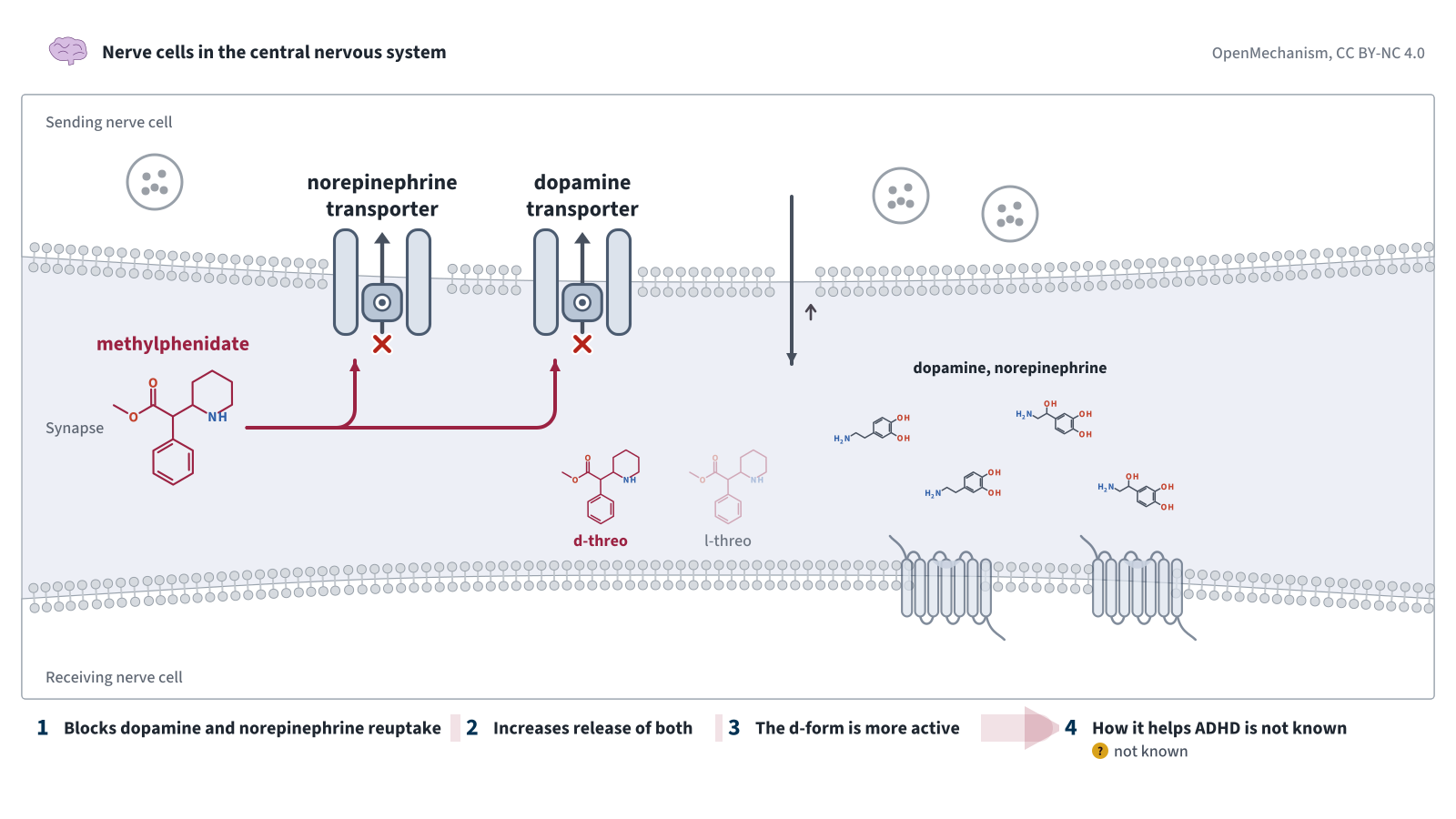
Step 4: not known
The Ritalin label says: Methylphenidate hydrochloride is a CNS stimulant. The mode of therapeutic action in ADHD and narcolepsy is not known.
Clinical study: In Storebø and colleagues' 2015 Cochrane review of 185 randomized trials comparing methylphenidate with placebo or no treatment in children and adolescents with ADHD (aged 3 to 18 in most trials; 75 days of treatment on average; every trial judged at high risk of bias), which measured ADHD symptoms, behavior, quality of life and harms, not how methylphenidate works: The results of meta-analyses suggest that methylphenidate may improve teacher-reported ADHD symptoms, teacher-reported general behaviour, and parent-reported quality of life among children and adolescents diagnosed with ADHD. However, the low quality of the underpinning evidence means that we cannot be certain of the magnitude of the effects.
Storebø OJ et al., Cochrane Database Syst Rev 2015 (PMID 26599576)
How it works
Blocks dopamine and norepinephrine reuptake. Methylphenidate blocks the reuptake of norepinephrine and dopamine into the sending nerve cell.1
Increases release of both. It also increases the release of these messengers into the space outside the nerve cells.1
The d-form is more active. Methylphenidate is a mix of two mirror-image forms, d-threo and l-threo; the d-threo form is the more pharmacologically active.1
How it helps ADHD is not known. Methylphenidate stimulates the central nervous system; the label says its mode of therapeutic action in ADHD and narcolepsy is not known.1
For teachers: download this drawing.
See also
Condition pages: ADHD.
Other stimulants: amphetamine and lisdexamfetamine.
Explained: why stimulants can raise heart rate and blood pressure.
Body system: brain & nerves.
Sources
- 1Ritalin (methylphenidate hydrochloride): FDA label1 Indications and Usage; 12.1 Mechanism of Action; 12.2 Pharmacodynamics
- 2ChEMBL CHEMBL796Target and action classification: Dopamine transporter inhibitor; Norepinephrine transporter inhibitor
- 3Methylphenidate for children and adolescents with attention deficit hyperactivity disorder (ADHD)Storebø OJ et al. Cochrane Database Syst Rev 2015 (abstract)
Spotted a mistake? Report an error (hello@openmechanism.com). Since launch, every published error we fix is listed on the corrections page.
Notes and limits
- A schematic teaching drawing: not to scale, not exact structures, binding poses or a complete pathway, and not a guide to dosing, treatment or how a person will respond.
- The label says the mode of therapeutic action of methylphenidate in ADHD and narcolepsy is not known.
All recorded limits are on the evidence page, and notes that apply to every page are on How to read a page. Version 1.0.1, medically reviewed by Daniel Tran, PharmD, on 6 November 2026.
Cite this page
Tran D. Methylphenidate [Internet]. OpenMechanism; 2026 [updated 2026 Nov 6; cited 2026 Nov 6]. Available from: https://openmechanism.com/medicines/methylphenidate