Memantine
Glutamate overactivating has been hypothesized to add to the symptoms of Alzheimer's disease. Memantine is postulated to work by blocking the open NMDA receptor channel, with low-to-moderate . There is no evidence that it prevents or slows the loss of nerve cells. About half leaves the body unchanged in the urine; its is 60 to 80 hours.
- Acts on
- NMDA receptor-operated cation channels (uncompetitive, open-channel block)
- Where
- Nerve cells in the brain
- Medicine type
- Small molecule
- Used for
- Brain & nerves
- Drug class
- Anti-dementia medicines
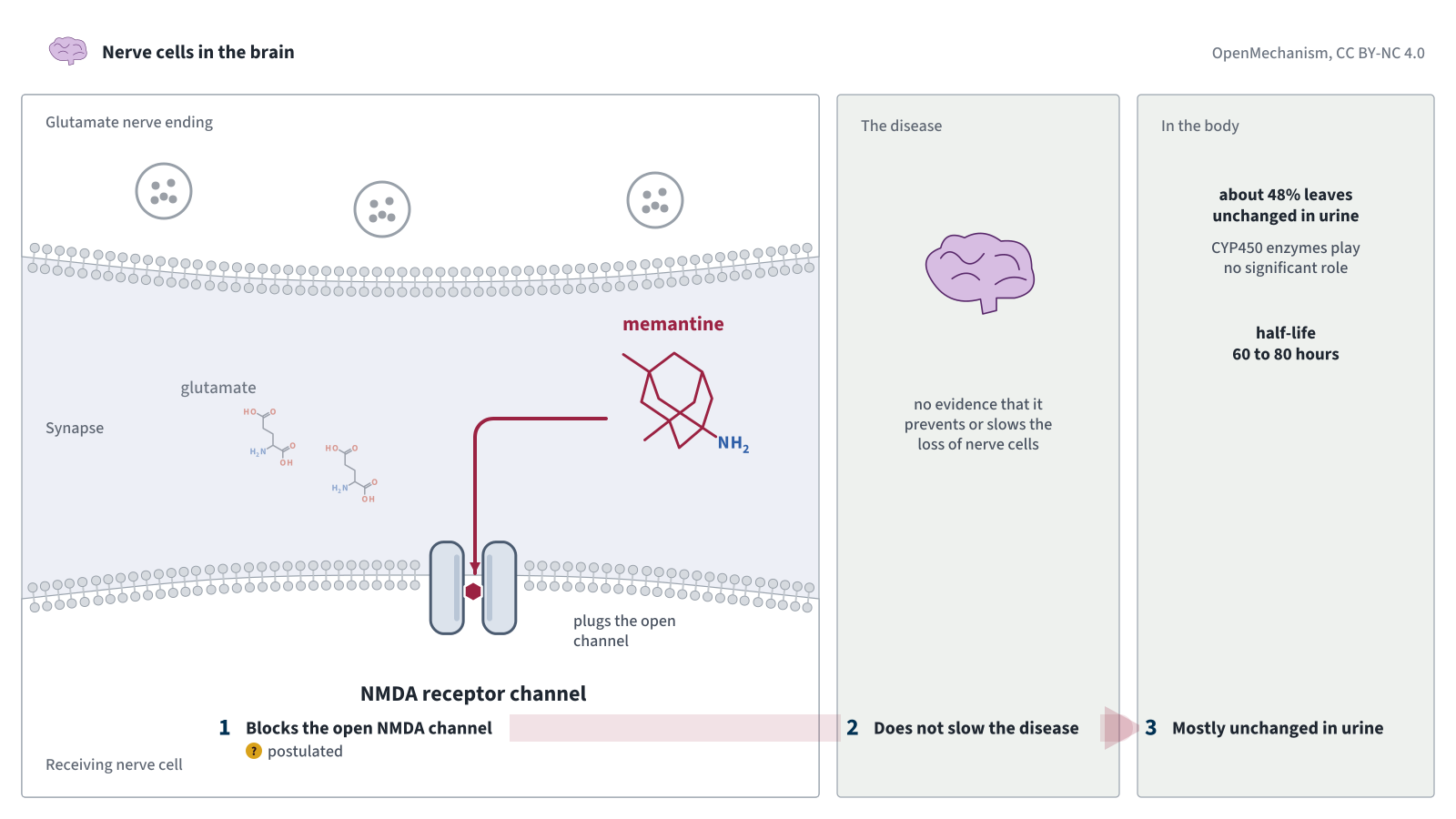
Step 1: postulated
The memantine label says: Persistent activation of central nervous system N-methyl-D-aspartate (NMDA) receptors by the excitatory amino acid glutamate has been hypothesized to contribute to the symptomatology of Alzheimer's disease. Memantine is postulated to exert its therapeutic effect through its action as a low to moderate affinity uncompetitive (open-channel) NMDA receptor antagonist which binds preferentially to the NMDA receptor-operated cation channels.
Source 1: Memantine hydrochloride tablets: FDA label, 12.1 Mechanism of Action; 12.3 Pharmacokinetics
Clinical study: A Cochrane review of placebo-controlled trials of memantine in dementia, which measured thinking, daily activities, behavior and overall clinical ratings, not how memantine works: There is a small clinical benefit of memantine in people with moderate-to-severe AD … but no benefit in people with mild AD.
McShane R et al., Cochrane Database Syst Rev 2019 (PMID 30891742)
This study was picked with a literature search and is not yet checked by our reviewer.
Key terms in this drawing
- CYP450
- Cytochrome P450 enzymes. A family of enzymes, including CYP3A, CYP2D6, CYP2C9, CYP2C19 and CYP2B6, that break down many medicines.
- half-life
- Half-life. The time it takes for the amount in the blood to fall by half.
- NMDA receptor
- N-methyl-D-aspartate receptor. A glutamate receptor that works as an ion channel; ketamine blocks it.
How it works
Blocks the open NMDA channel. Persistent activation of NMDA receptors by glutamate has been hypothesized to contribute to the symptoms of Alzheimer's disease; memantine is postulated to work as a low-to-moderate affinity, uncompetitive (open-channel) NMDA receptor , binding preferentially to the receptor-operated cation channels.1
Does not slow the disease. There is no evidence that memantine prevents or slows neurodegeneration in Alzheimer's disease.1
Mostly unchanged in urine. Liver play no significant role in its metabolism; about 48% leaves unchanged in the urine, and the terminal half-life is about 60 to 80 hours.1
For teachers: download this drawing.
See also
Condition pages: Alzheimer disease.
Other anti-dementia medicines: donepezil and lecanemab.
Body system: brain & nerves.
Sources
- 1Memantine hydrochloride tablets: FDA label12.1 Mechanism of Action; 12.3 Pharmacokinetics
- 2ChEMBL CHEMBL807Target and action classification: Glutamate [NMDA] receptor negative allosteric modulator
- 3Memantine for dementiaMcShane R et al. Cochrane Database Syst Rev 2019 (abstract)
Spotted a mistake? Report an error (hello@openmechanism.com). Since launch, every published error we fix is listed on the corrections page.
Notes and limits
- A schematic teaching drawing: not to scale, not exact structures, binding poses or a complete pathway, and not a guide to dosing, treatment or how a person will respond.
- The label says glutamate's role is hypothesized and memantine's action is postulated.
All recorded limits are on the evidence page, and notes that apply to every page are on How to read a page. Version 1.0.0, not yet medically reviewed.
Cite this page
Tran D. Memantine [Internet]. OpenMechanism; 2026 [updated 2026 Oct 11; cited 2026 Oct 11]. Available from: https://openmechanism.com/medicines/memantine