Tapeworm larva infections
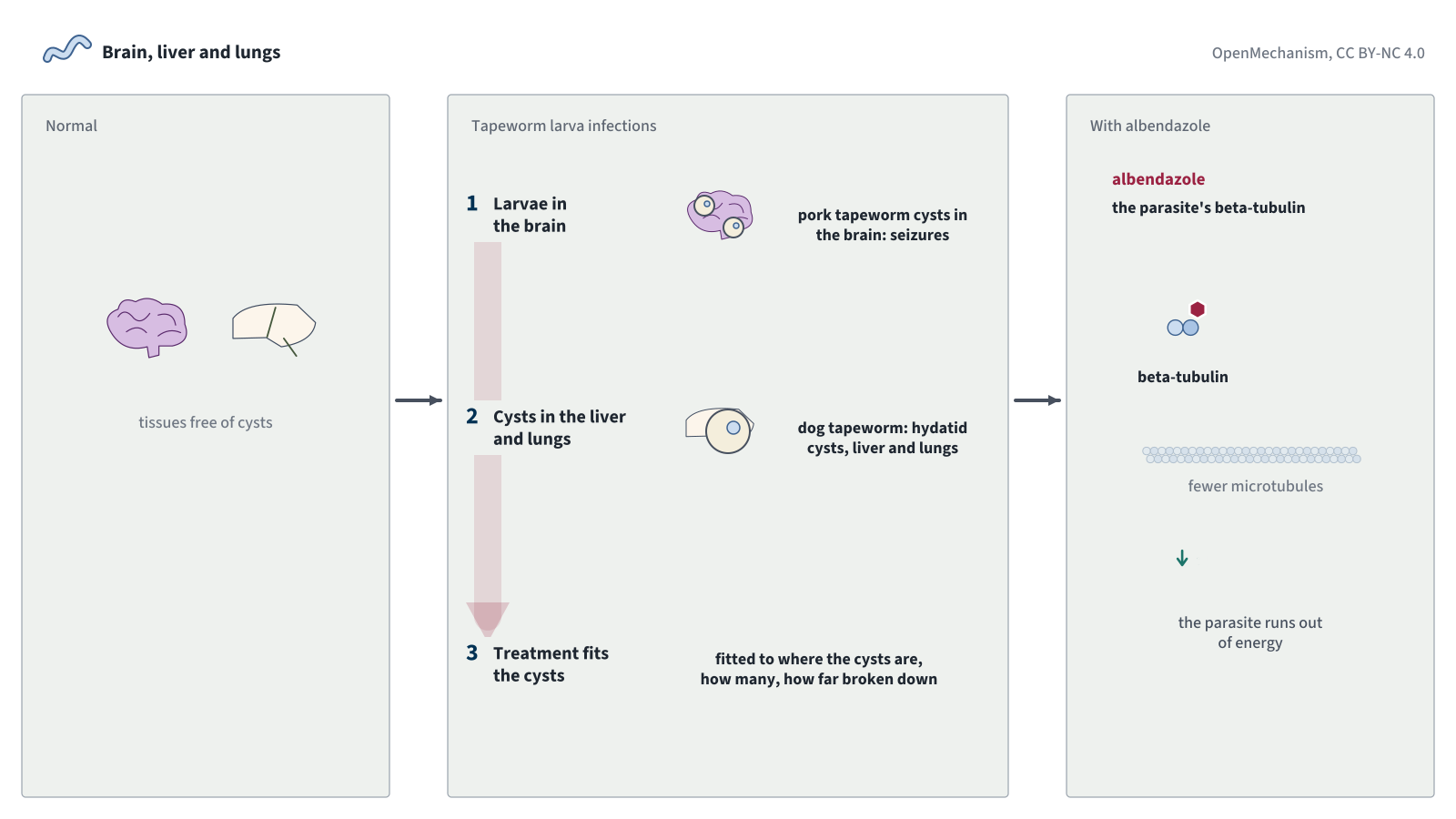
The larvae of some tapeworms form cysts in people. Pork tapeworm larvae in the brain (neurocysticercosis) are a frequent cause of seizures in many low-income countries; dog tapeworm larvae form hydatid cysts in the liver, lungs and abdomen. Treatment depends on where the cysts are and their state. Albendazole binds the parasite's tubulin and starves it of glucose.
- Where
- Brain, liver and lungs
- Body systems
- Infections; Brain & nerves; Stomach, gut & liver
- Medicines
- 1 medicine
For teachers: download this drawing.
Key terms in this drawing
- microtubule
- Microtubule. A structure inside the cell, built from the protein tubulin, that the cell needs for dividing and for other vital work.
What goes wrong
Larvae in the brain. Pork tapeworm larvae can form cysts in the nervous system (neurocysticercosis), a frequent cause of seizures in many low-income countries.1
Cysts in the liver and lungs. Dog tapeworm larvae form hydatid cysts in the liver, lungs and abdomen; this affects over 1 million people.2,3
Treatment fits the cysts. Treatment is tailored to where the cysts are, how many there are, and how far they have broken down and inflamed.1
What the source says
“individualised treatment approaches that account for the involvement of parenchymal or extraparenchymal spaces, the number and form of parasites, and the extent of degeneration and associated inflammation.”
Source 1
Where medicines act
- A
Albendazole: the parasite's tubulin blocked
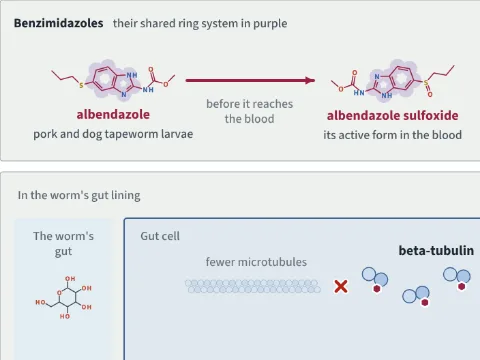
Albendazole binds the parasite's beta-tubulin so it cannot build ; its gut cells take up less glucose and it runs out of energy. It treats brain cysts of the pork tapeworm and hydatid cysts of the dog tapeworm.2
What the source says
“Albendazole binds to the colchicine-sensitive site of β-tubulin inhibiting their polymerization into microtubules.”
Source 2“The decrease in microtubules in the intestinal cells of the parasites decreases their absorptive function, especially the uptake of glucose by the adult and larval forms of the parasites”
Source 2“Treatment of parenchymal neurocysticercosis due to active lesions caused by larval forms of the pork tapeworm, Taenia solium .”
Source 2
See also
Body systems: infections; brain & nerves; and stomach, gut & liver.
Other conditions: worm infections.
Sources
- 1Clinical symptoms, diagnosis, and treatment of neurocysticercosisGarcia HH et al. Lancet Neurol 2014 (abstract). Saved copy
- 2Albendazole tablets: FDA label1 Indications and Usage; 12.4 Microbiology. Saved copy
- 3Cystic echinococcosisAgudelo Higuita NI et al. J Clin Microbiol 2016 (abstract). Saved copy
Notes and limits
- Treatment itself can cause seizures, fluid build-up in the brain and other harm; reducing these is a research focus.1
Notes that apply to every page are on How to read a page.
Spotted a mistake? Report an error (hello@openmechanism.com). Since launch, every published error we fix is listed on the corrections page.
Cite this page
Tran D. Tapeworm larva infections [Internet]. OpenMechanism; 2026 [updated 2026 Oct 18; cited 2026 Oct 18]. Available from: https://openmechanism.com/conditions/tapeworm-larva-infections