Risperidone
Risperidone binds serotonin , dopamine D2, adrenergic α1 and α2 and histamine strongly, and others less strongly or not at all. The liver turns it mainly into paliperidone, which has similar activity, so both give the effect. The Risperdal label lists it for schizophrenia in adults and adolescents aged 13 to 17; for acute manic or mixed episodes of bipolar I disorder, alone in adults and in children and adolescents aged 10 to 17, or with lithium or valproate in adults; and for irritability associated with autistic disorder in children and adolescents aged 5 to 17. The label says how it works in schizophrenia is unclear, and that its effect there could come from blocking D2 and 5-HT2 receptors together.
- Acts on
- Serotonin 5-HT2 and dopamine , among others
- Where
- Nerve cells in the brain
- Medicine type
- Small molecule
- Used for
- Brain & nerves
- Drug class
- Antipsychotics
Also called Risperdal.
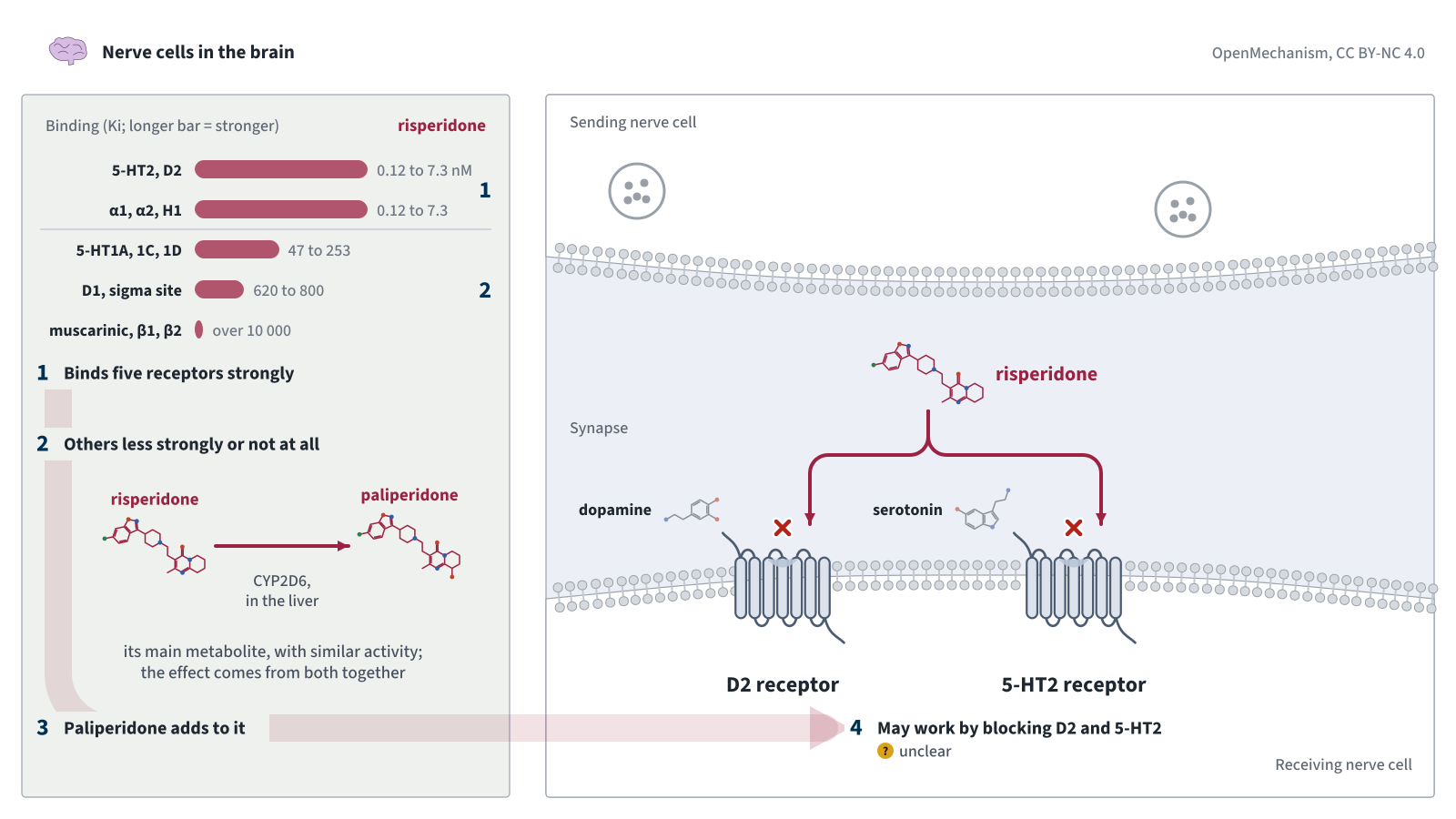
Step 4: unclear
The Risperdal label says: The mechanism of action of risperidone in schizophrenia is unclear. The drug's therapeutic activity in schizophrenia could be mediated through a combination of dopamine Type 2 (D 2 ) and serotonin Type 2 (5HT 2 ) receptor antagonism.
Clinical study: In Marder and Meibach's 1994 randomized, double-blind trial, 388 people with schizophrenia took placebo, risperidone (2, 6, 10 or 16 mg a day) or haloperidol (20 mg a day) for 8 weeks; the trial measured symptoms, not how risperidone works: Clinical improvement (20% reduction in total scores on the Positive and Negative Syndrome Scale for Schizophrenia) at the study end point was shown by 35% of the patients receiving 2 mg of risperidone, 57% receiving 6 mg, 40% receiving 10 mg, and 51% receiving 16 mg; and by 30% receiving haloperidol and 22% receiving placebo. Statistically significant differences in clinical improvement were found between 6 and 16 mg of risperidone versus placebo and versus haloperidol.
Marder SR, Meibach RC, Am J Psychiatry 1994 (PMID 7514366)
Key terms in this drawing
- 5-HT receptors
- Serotonin (5-hydroxytryptamine, 5-HT) receptors. Receptors that serotonin acts on; they come in several subtypes, such as 5-HT1A and 5-HT2A.
- 5-HT1A receptor
- Serotonin 1A receptor. One of the serotonin receptors; in lab studies, buspirone binds it strongly.
- CYP2D6
- Cytochrome P450 2D6. A liver enzyme that breaks down several medicines; for tramadol it makes the active metabolite M1.
- D2 receptor
- Dopamine D2 receptor. A dopamine receptor; in Parkinson disease, ropinirole's effect is thought to be related to its ability to stimulate D2 receptors in the caudate-putamen of the brain.
How it works
Binds five receptors strongly. Risperidone blocks monoamine receptors: it binds serotonin 5-HT2, dopamine D2, adrenergic α1 and α2, and histamine H1 receptors with high (Ki 0.12 to 7.3 nM).1
Others less strongly or not at all. It binds serotonin 5-HT1C, and with low to moderate affinity (Ki 47 to 253 nM), dopamine D1 receptors and the haloperidol-sensitive sigma site weakly (Ki 620 to 800 nM), and shows no affinity for muscarinic or β1 and β2 adrenergic receptors when tested at concentrations above 10⁻⁵ M (10 000 nM).1
Paliperidone adds to it. In the liver, the enzyme turns risperidone into its main metabolite, 9-hydroxyrisperidone (paliperidone), which has similar activity; the clinical effect comes from both together.1
May work by blocking D2 and 5-HT2. The label says how risperidone works in schizophrenia is unclear, and that its effect could come from a combination of blocking dopamine D2 and serotonin 5-HT2 receptors. The label adds that blocking receptors other than D2 and 5-HT2 may explain some of risperidone's other effects.1
For teachers: download this drawing.
See also
Condition pages: bipolar disorder and schizophrenia.
Side effects: tardive dyskinesia.
Other antipsychotics: aripiprazole, clozapine, haloperidol, olanzapine, quetiapine and ziprasidone.
Explained: why antipsychotics can cause movement problems and why antipsychotics can raise prolactin.
Body system: brain & nerves.
Sources
- 1Risperdal (risperidone): FDA label1 Indications and Usage; 12.1 Mechanism of Action; 12.2 Pharmacodynamics; 12.3 Pharmacokinetics
- 2ChEMBL CHEMBL85Target and action classification: Dopamine D2 receptor antagonist; Serotonin 2a (5-HT2a) receptor antagonist; Serotonin 2c (5-HT2c) receptor antagonist
- 3Risperidone in the treatment of schizophreniaMarder SR, Meibach RC. Am J Psychiatry 1994 (abstract)
Also used for the drawing
The drawing places risperidone's binding in the brain. The Risperdal label names the receptors it binds but not where they are; this PET study in three healthy men who took one 1 mg dose of risperidone measured its binding at serotonin 5-HT2 receptors in the neocortex and dopamine D2 receptors in the striatum.
- 45-HT2 and D2 dopamine receptor occupancy in the living human brain. A PET study with risperidoneNyberg S et al., Psychopharmacology (Berl) 1993 (abstract)
Spotted a mistake? Report an error (hello@openmechanism.com). Since launch, every published error we fix is listed on the corrections page.
Notes and limits
- A schematic teaching drawing: not to scale, not exact structures, binding poses or a complete pathway, and not a guide to dosing, treatment or how a person will respond.
- The steps are in the order that explains them; one step is said to cause the next only where the source says so.
- The label says the mechanism of action of risperidone in schizophrenia is unclear, and that its therapeutic activity in schizophrenia could be mediated through a combination of dopamine Type 2 (D2) and serotonin Type 2 (5HT2) receptor antagonism.
All recorded limits are on the evidence page, and notes that apply to every page are on How to read a page. Version 1.0.1, medically reviewed by Daniel Tran, PharmD, on 7 November 2026.
Cite this page
Tran D. Risperidone [Internet]. OpenMechanism; 2026 [updated 2026 Nov 7; cited 2026 Nov 7]. Available from: https://openmechanism.com/medicines/risperidone