Hereditary transthyretin amyloidosis
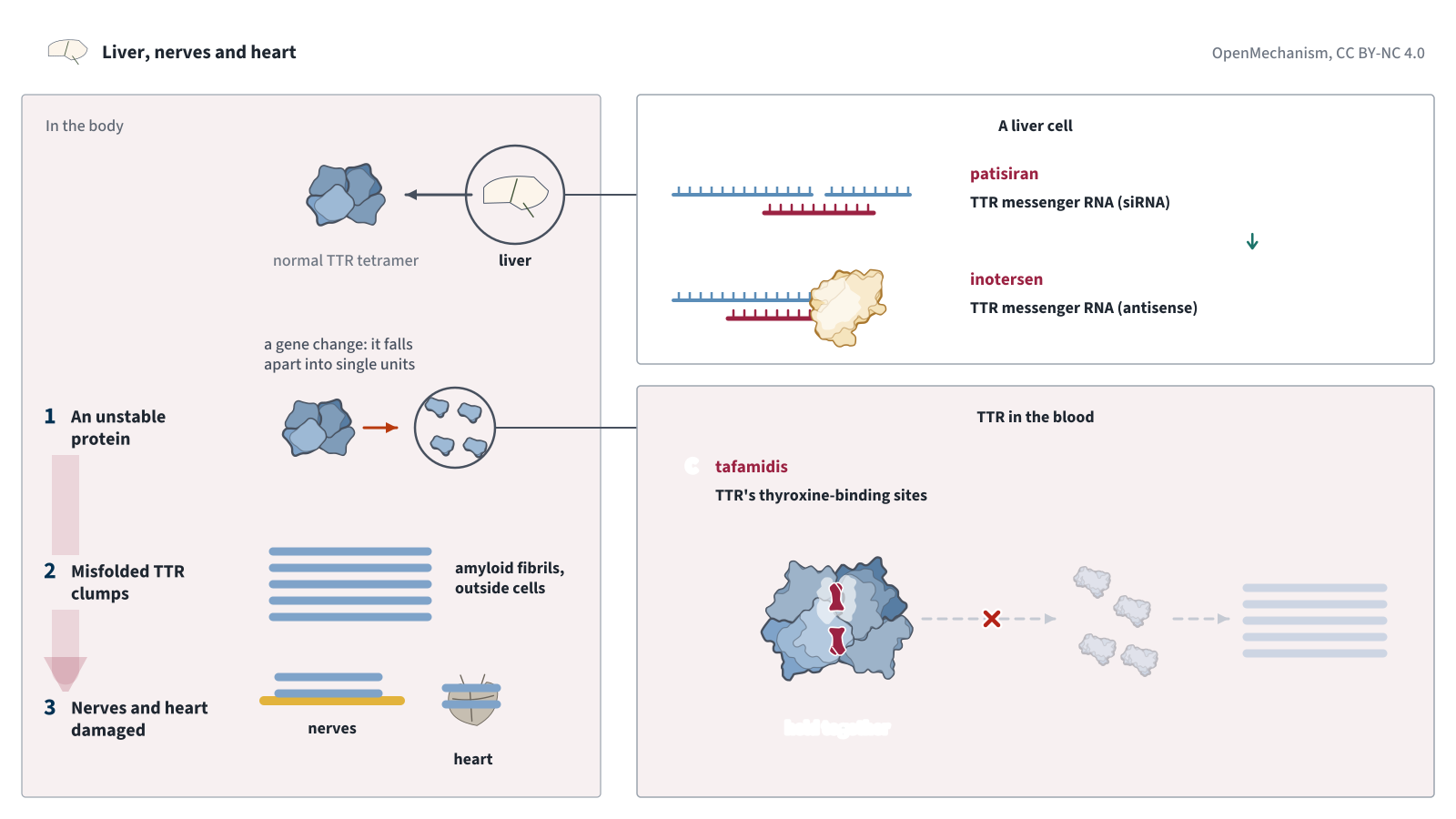
Transthyretin (TTR) normally travels in the blood as a four-part protein (a tetramer). A gene change makes it unstable: it falls apart into single units that misfold and clump into amyloid fibrils, deposited in nerves and the heart. Patisiran (an siRNA) and inotersen (an antisense oligonucleotide) make the liver produce less TTR; tafamidis binds the tetramer and keeps it together.
- Where
- Liver, nerves and heart
- Body systems
- Brain & nerves; Heart, vessels & cholesterol
- Medicines
- 3 medicines
For teachers: download this drawing.
Key terms in this drawing
- mRNA
- Messenger RNA. A copy of a gene that a cell reads to make a protein.
- RNA
- Ribonucleic acid. A molecule copied from DNA; messenger RNA carries a gene's instructions.
- siRNA
- Small interfering RNA. A short double-stranded RNA that guides the cell to destroy a matching messenger RNA.
- TTR
- Transthyretin. A blood protein that can misfold and build up as amyloid.
What goes wrong
An unstable protein. A gene change makes transthyretin () unstable, so the four-part protein tends to fall apart into single units.1
What the source says
“TTR protein destabilised by TTR gene mutation is prone to dissociate from its native tetramer to monomer”
Source 1Misfolded TTR clumps. The single units misfold and clump into amyloid fibrils, which are deposited outside cells.1
Nerves and heart damaged. It is inherited in a dominant way and includes amyloid disease of the nerves (polyneuropathy) and of the heart (cardiomyopathy).1
What the source says
“resulting in autosomal dominant hereditary amyloidosis, including familial amyloid polyneuropathy, familial amyloid cardiomyopathy and familial leptomeningeal amyloidosis.”
Source 1
Where medicines act
- A
Patisiran: less TTR made
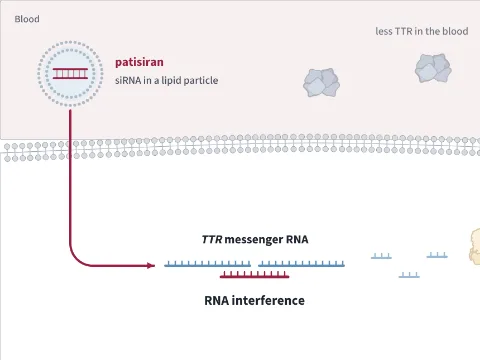
Patisiran is an that destroys the TTR , mutant and normal, so less TTR is in the blood and deposited in tissues. It treats the polyneuropathy of hereditary TTR amyloidosis.2
What the source says
“Patisiran is a double-stranded siRNA that causes degradation of mutant and wild-type TTR mRNA through RNA interference, which results in a reduction of serum TTR protein and TTR protein deposits in tissues.”
Source 2“ONPATTRO is indicated for the treatment of the polyneuropathy of hereditary transthyretin-mediated amyloidosis in adults.”
Source 2 - B
Inotersen: less TTR made
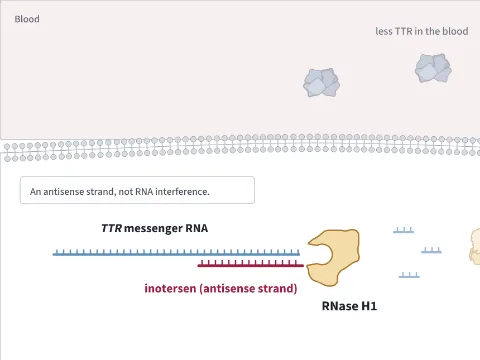
Inotersen is an antisense oligonucleotide that binds the TTR messenger RNA and has it destroyed, so less TTR is in the blood and deposited in tissues.3
What the source says
“Inotersen is an antisense oligonucleotide that causes degradation of mutant and wild-type TTR mRNA through binding to the TTR mRNA, which results in a reduction of serum TTR protein and TTR protein deposits in tissues.”
Source 3 - C
Tafamidis: the tetramer held together
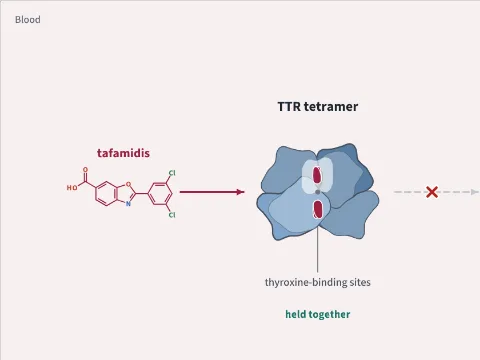
Tafamidis binds TTR at its thyroxine-binding sites, steadying the tetramer and slowing its breakup into single units, the slowest step in forming amyloid. It treats the cardiomyopathy of TTR amyloidosis.4
What the source says
“Tafamidis is a selective stabilizer of TTR. Tafamidis binds to TTR at the thyroxine binding sites, stabilizing the tetramer and slowing dissociation into monomers, the rate-limiting step in the amyloidogenic process.”
Source 4“VYNDAQEL and VYNDAMAX are indicated for the treatment of the cardiomyopathy of wild-type or hereditary transthyretin-mediated amyloidosis (ATTR-CM) in adults”
Source 4
See also
Body systems: brain & nerves; and heart, vessels & cholesterol.
Other conditions: transthyretin amyloid heart disease (ATTR-CM) and cyanide poisoning.
Sources
- 1Transthyretin (ATTR) amyloidosis: clinical spectrum, molecular pathogenesis and disease-modifying treatmentsSekijima Y. J Neurol Neurosurg Psychiatry 2015 (abstract). Saved copy
- 2Onpattro (patisiran): FDA label1 Indications and Usage; 12.1 Mechanism of Action. Saved copy
- 3Tegsedi (inotersen): FDA label12.1 Mechanism of Action. Saved copy
- 4Vyndaqel and Vyndamax (tafamidis): FDA label1 Indications and Usage; 12.1 Mechanism of Action. Saved copy
- 5Human transthyretin (TTR) tetramer with tafamidis in its two thyroxine-binding sitesPDB 3TCT; Bulawa, C.E. et al. Proc.Natl.Acad.Sci.USA 2012;109:9629-9634. The TTR outline in the drawing is traced from this structure. Saved copy
- 6The catalytic domain of human RNase H1 on an RNA/DNA hybridPDB 2QK9; Nowotny, M. et al. Mol.Cell 2007;28:264-276. The RNase H1 outline in the drawing is traced from this structure. Saved copy
Notes and limits
- Normal TTR can misfold too, causing wild-type ATTR amyloidosis in older people.1
- Misdiagnosis is still common, and the right diagnosis often takes a long time.1
Notes that apply to every page are on How to read a page.
Spotted a mistake? Report an error (hello@openmechanism.com). Since launch, every published error we fix is listed on the corrections page.
Cite this page
Tran D. Hereditary transthyretin amyloidosis [Internet]. OpenMechanism; 2026 [updated 2026 Oct 16; cited 2026 Oct 16]. Available from: https://openmechanism.com/conditions/hereditary-transthyretin-amyloidosis