Binge eating disorder
Binge eating disorder was recognized as a diagnosis only recently; it affects about 1.5% of women and 0.3% of men worldwide, and fewer than half are recognized in health care. It often comes with obesity, type 2 diabetes, high blood pressure and other mental health problems. Lisdexamfetamine treats moderate to severe disease, though how it works is not known.
- Where
- Brain
- Body systems
- Brain & nerves, Hormones & metabolism
- Medicines
- 1 medicine
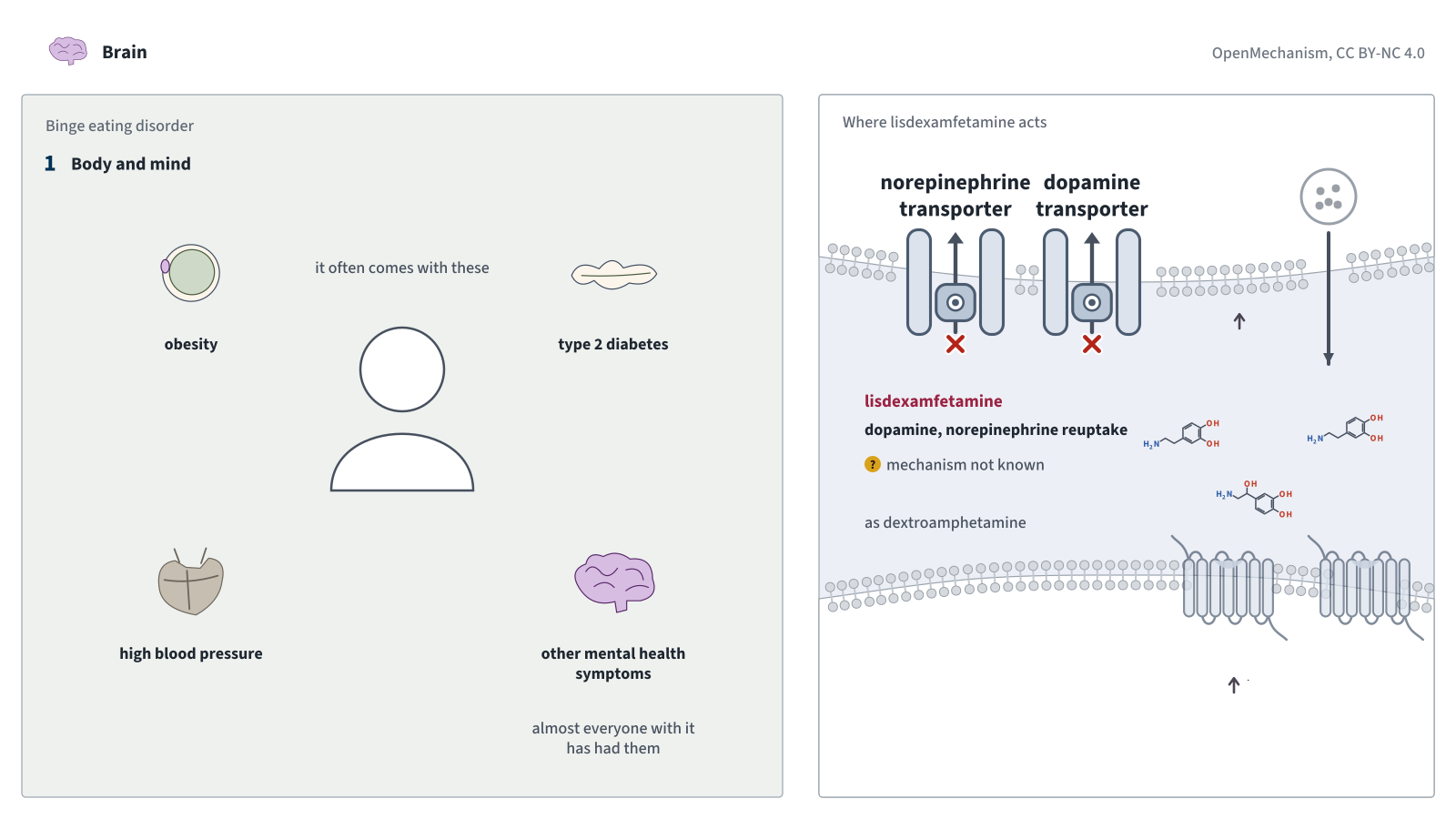
Mechanism not known
The Vyvanse (lisdexamfetamine) label says: The exact mode of therapeutic action in ADHD and BED is not known.
Source 2: Vyvanse (lisdexamfetamine): FDA label, 1 Indications and Usage; 12.1 Mechanism of Action
Clinical study: In two randomized, placebo-controlled trials in 773 adults with binge eating disorder, the trials measured the change in binge eating days per week, not how the medicine works: Change from baseline in binge eating days/week at weeks 11-12 (primary efficacy endpoint) was assessed with mixed-effects models for repeated measures. … LDX (50 and 70 mg/day) was superior to placebo in decreasing binge eating days/week from baseline and improving binge eating-related key secondary endpoints.
McElroy SL et al., Neuropsychopharmacology 2016 (PMID 26346638)
This study was picked with a literature search and is not yet checked by our reviewer.
For teachers: download this drawing.
Key terms in this drawing
- reuptake
- Reuptake. Nerve cells taking a messenger such as serotonin back up, which helps end its signal.
What goes wrong
Body and mind. It often comes with obesity, type 2 diabetes and high blood pressure; almost everyone with it (94%) has had other mental health symptoms.1
Where medicines act
- A
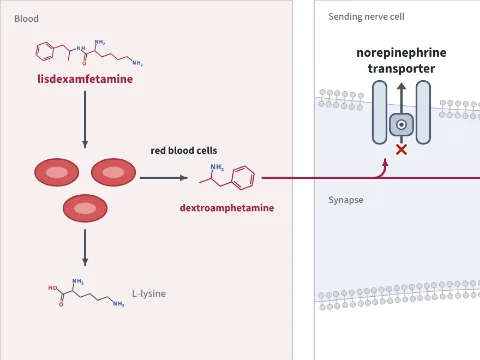
Lisdexamfetamine: a stimulant prodrug
Lisdexamfetamine is turned into dextroamphetamine, which blocks the of norepinephrine and dopamine and increases their release. It treats moderate to severe binge eating disorder in adults.2
What the source says
“Lisdexamfetamine is a prodrug of dextroamphetamine.”
Source 2“Amphetamines block the reuptake of norepinephrine and dopamine into the presynaptic neuron and increase the release of these monoamines into the extraneuronal space.”
Source 2“Moderate to severe binge eating disorder (BED) in adults”
Source 2
See also
Body systems: brain & nerves and hormones & metabolism.
Other conditions: ADHD.
Sources
- 1Epidemiology of binge eating disorder: prevalence, course, comorbidity, and risk factorsKeski-Rahkonen A. Curr Opin Psychiatry 2021 (abstract). Saved copy
- 2Vyvanse (lisdexamfetamine): FDA label1 Indications and Usage; 12.1 Mechanism of Action. Saved copy
- 3Lisdexamfetamine Dimesylate for Adults with Moderate to Severe Binge Eating Disorder: Results of Two Pivotal Phase 3 Randomized Controlled TrialsMcElroy SL et al. Neuropsychopharmacology 2016 (abstract). Saved copy
Notes and limits
- The lisdexamfetamine label says the exact way it works in binge eating disorder is not known, and that it is not for weight loss.2
Notes that apply to every page are on How to read a page.
Spotted a mistake? Report an error (hello@openmechanism.com). Since launch, every published error we fix is listed on the corrections page.
Cite this page
Tran D. Binge eating disorder [Internet]. OpenMechanism; 2026 [updated 2026 Nov 18; cited 2026 Nov 18]. Available from: https://openmechanism.com/conditions/binge-eating-disorder