Phenytoin
Phenytoin is thought to block sodium channels in nerve cells, depending on their voltage, which would reduce sustained bursts of rapid firing; the label says the precise mechanism has not been established. The liver breaks it down, mainly with , and this breakdown can be saturated: when blood levels are high, small increases in dose may raise them very substantially.
- Acts on
- Voltage-dependent sodium channels in nerve cell membranes (thought to be how it works)
- Where
- Nerve cells in the brain
- Medicine type
- Small molecule
- Used for
- Brain & nerves
- Drug class
- Sodium channel blockers (antiseizure)
Also called Dilantin Infatabs.
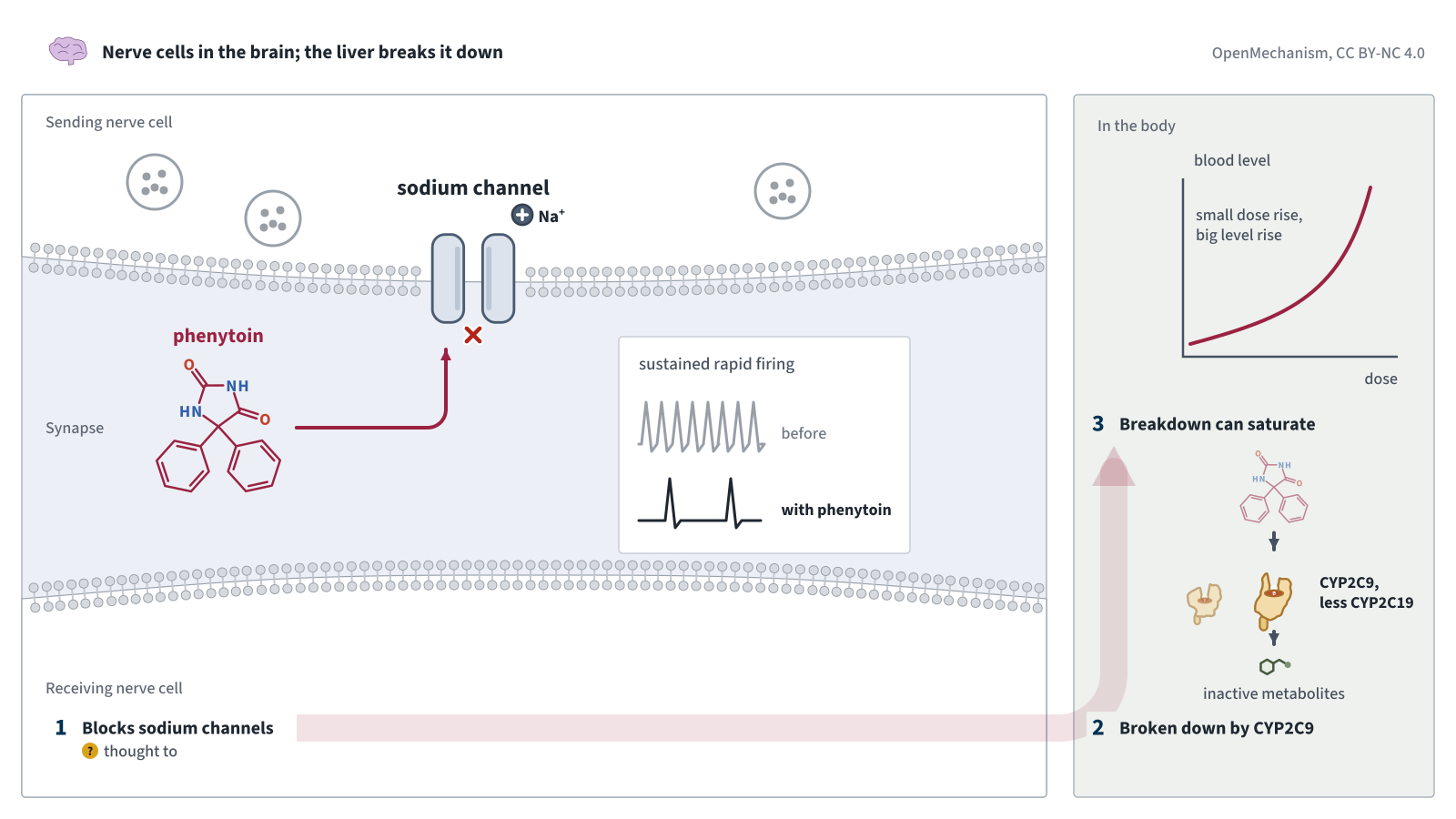
Step 1: thought to
The Dilantin Infatabs label says: The precise mechanism by which phenytoin exerts its therapeutic effect has not been established but is thought to involve the voltage-dependent blockade of membrane sodium channels resulting in a reduction in sustained high-frequency neuronal discharges.
Source 1: Dilantin Infatabs (phenytoin): FDA label, 12.1 Mechanism of Action; 12.3 Pharmacokinetics
Clinical study: In a double-blind randomized trial in 622 adults with partial and secondarily generalized tonic-clonic seizures, comparing four medicines over two years; the trial measured how often each controlled seizures without intolerable side effects, not how phenytoin works: Overall treatment success was highest with carbamazepine or phenytoin, intermediate with phenobarbital, and lowest with primidone (P less than 0.002).
Mattson RH et al., N Engl J Med 1985 (PMID 3925335)
This study was picked with a literature search and is not yet checked by our reviewer.
Key terms in this drawing
- CYP2C19
- Cytochrome P450 2C19. A liver enzyme that breaks down several medicines; for clopidogrel it makes most of the active metabolite.
- CYP2C9
- Cytochrome P450 2C9. One of the cytochrome P450 enzymes that break down medicines; it breaks down some rimegepant (most goes by CYP3A4).
How it works
Blocks sodium channels. How phenytoin works has not been established, but it is thought to block sodium channels in the membranes of nerve cells, depending on the membrane's voltage, and so to reduce the sustained bursts of rapid firing (high-frequency discharges) of nerve cells.1
Broken down by CYP2C9. The liver breaks phenytoin down, mainly with the enzyme CYP2C9 and less with . Most of it leaves in the bile as inactive metabolites, which are taken back up from the gut and leave in the urine.1
Breakdown can saturate. The liver's breakdown of phenytoin can be saturated at high blood levels. When levels are in the upper range, small increases in dose may lengthen its and raise blood levels very substantially.1
For teachers: download this drawing.
See also
Condition pages: epilepsy.
Other sodium channel blockers (antiseizure): carbamazepine, lamotrigine, oxcarbazepine and topiramate.
Explained: isoniazid and phenytoin; and why phenytoin levels can jump with small dose changes.
Body system: brain & nerves.
Sources
- 1Dilantin Infatabs (phenytoin): FDA label12.1 Mechanism of Action; 12.3 Pharmacokinetics
- 2ChEMBL CHEMBL16Target and action classification: Sodium channel alpha subunit blocker
- 3Comparison of carbamazepine, phenobarbital, phenytoin, and primidone in partial and secondarily generalized tonic-clonic seizuresMattson RH et al. N Engl J Med 1985 (abstract)
Also used for the drawing
The CYP2C19 and CYP2C9 outlines are traced from the crystal structures below.
- 4Human CYP2C19PDB 4GQS; Reynald, R.L. et al. J.Biol.Chem. 2012; 287:44581-44591
- 5Human CYP2C9 with S-warfarinPDB 1OG5; Williams, P.A. et al. Nature 2003; 424:464
Spotted a mistake? Report an error (hello@openmechanism.com). Since launch, every published error we fix is listed on the corrections page.
Notes and limits
- A schematic teaching drawing: not to scale, not exact structures, binding poses or a complete pathway, and not a guide to dosing, treatment or how a person will respond.
- The label says the precise mechanism by which phenytoin works has not been established but is thought to involve the voltage-dependent blockade of membrane sodium channels.
All recorded limits are on the evidence page, and notes that apply to every page are on How to read a page. Version 1.0.0, not yet medically reviewed.
Cite this page
Tran D. Phenytoin [Internet]. OpenMechanism; 2026 [updated 2026 Oct 17; cited 2026 Oct 17]. Available from: https://openmechanism.com/medicines/phenytoin