Organophosphate poisoning
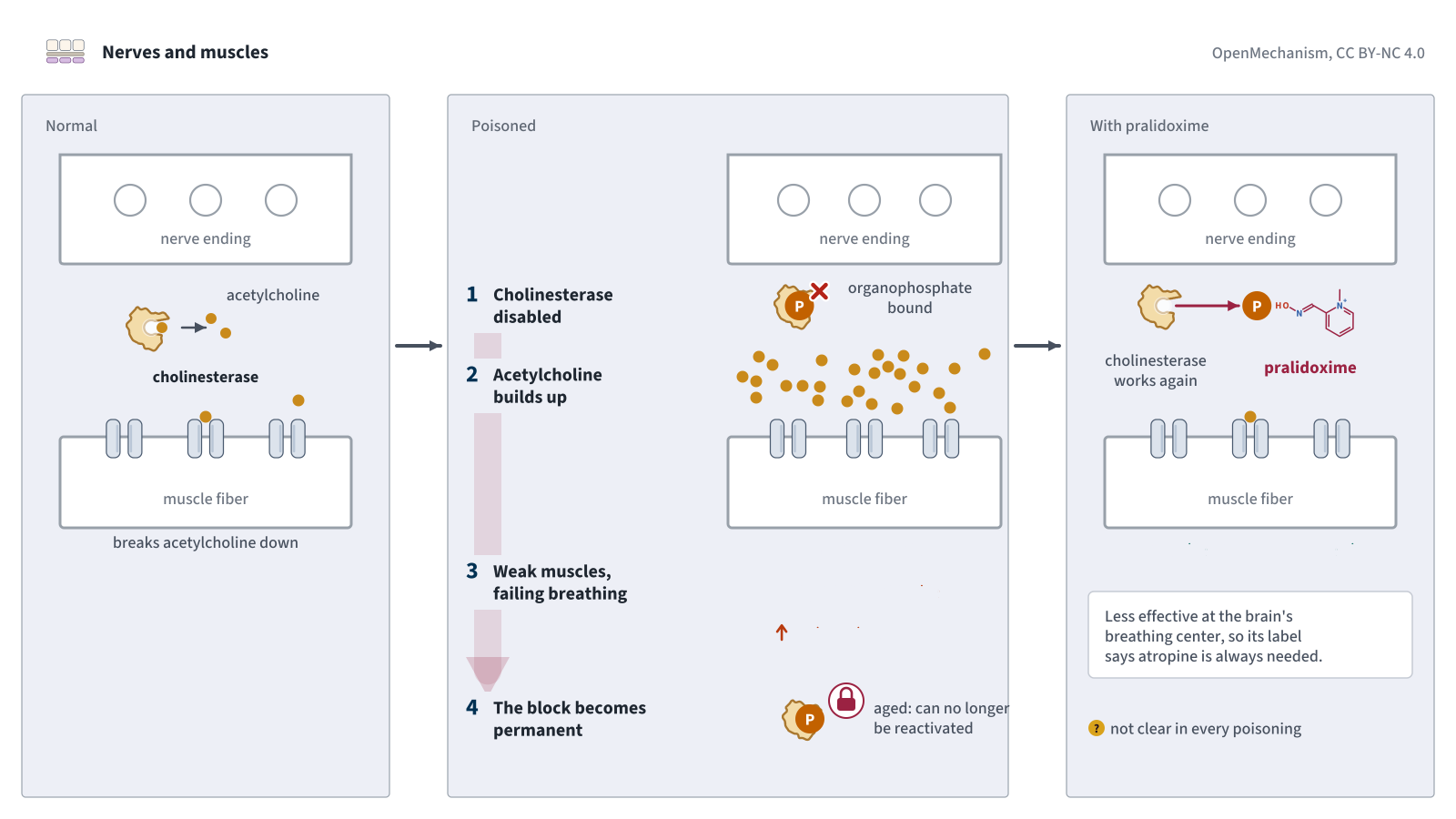
Self-poisoning with organophosphorus pesticides kills an estimated 200,000 people a year, mostly in rural areas of the developing world; generally more than 15% of patients die. The pesticide disables cholinesterase, so acetylcholine builds up at the nerve-muscle junction; muscles weaken and breathing fails. Pralidoxime reactivates the enzyme, and its label says atropine is always needed with it; whether it improves survival is not settled.
- Where
- Nerves and muscles
- Body systems
- Muscles, bones & joints; Brain & nerves
- Medicines
- 1 medicine
Not clear in every poisoning
The Eddleston 2008 review in the Lancet says: The role of oximes is not completely clear; they might benefit only patients poisoned by specific pesticides or patients with moderate poisoning.
Source 2: Management of acute organophosphorus pesticide poisoning, Eddleston M et al. Lancet 2008 (abstract)
Clinical study: In a randomized, placebo-controlled trial of 235 people with organophosphorus insecticide self-poisoning, pralidoxime added to atropine and supportive care did not improve survival: we found no evidence that this regimen improves survival
Eddleston M et al., PLoS Med 2009 (PMID 19564902)
This study was picked with a literature search and is not yet checked by our reviewer.
For teachers: download this drawing.
Key terms in this drawing
- cholinesterase
- Acetylcholinesterase (cholinesterase). The enzyme that breaks down acetylcholine; blocking it raises the amount of acetylcholine.
What goes wrong
Cholinesterase disabled. An organophosphate pesticide, or a related compound such as a nerve agent, inactivates by phosphorylating it.1
What the source says
“which has been inactivated by phosphorylation due to an organophosphate pesticide or related compound.”
Source 1Acetylcholine builds up. Acetylcholine accumulates, and the junctions between nerves and muscles stop working normally.1
What the source says
“The destruction of accumulated acetylcholine can then proceed, and neuromuscular junctions will again function normally.”
Source 1Weak muscles, failing breathing. Muscle weakness and depressed breathing follow; in severe poisoning, the depressed breathing may be due to muscle weakness.1
The block becomes permanent. Over time the phosphorylated enzyme “ages” into a form that cannot be reactivated.1
What the source says
“Pralidoxime chloride also slows the process of “aging” of phosphorylated cholinesterase to a nonreactivatable form”
Source 1
Where medicines act
- A
Pralidoxime targets cholinesterase
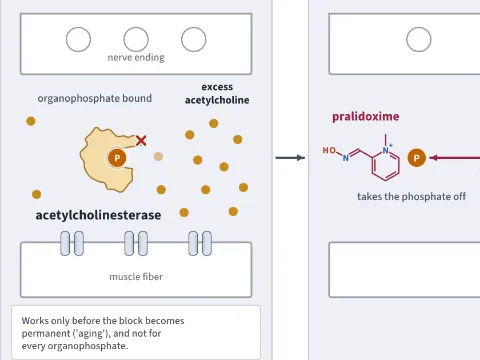
Pulls the phosphate off cholinesterase so it works again, mainly outside the brain, and slows the block becoming permanent; its label says atropine is always needed too, for the brain's breathing center.1
Used forPoisoning by organophosphate pesticides and nerve agentsOverdose of anticholinesterase medicines used in myasthenia gravis
What the label says
“The principal action of pralidoxime chloride is to reactivate cholinesterase (mainly outside of the central nervous system) which has been inactivated by phosphorylation due to an organophosphate pesticide or related compound.”
Source 1“The destruction of accumulated acetylcholine can then proceed, and neuromuscular junctions will again function normally.”
Source 1“The drug has its most critical effect in relieving paralysis of the muscles of respiration.”
Source 1“Because pralidoxime chloride is less effective in relieving depression of the respiratory center, atropine is always required concomitantly to block the effect of accumulated acetylcholine at this site.”
Source 1“Pralidoxime chloride also slows the process of “aging” of phosphorylated cholinesterase to a nonreactivatable form”
Source 1“(1) in the treatment of poisoning due to those pesticides and chemicals (e.g., nerve agents) of the organophosphate class which have anticholinesterase activity and (2) in the control of overdosage by anticholinesterase drugs used in the treatment of myasthenia gravis.”
Source 1
See also
Body systems: muscles, bones & joints; and brain & nerves.
Also used for it: atropine (“Atropine Sulfate Injection is indicated for temporary blockade of severe or life‑threatening muscarinic effects, e.g., as an antisialagogue, an antivagal agent, an antidote for organophosphorus or muscarinic mushroom poisoning, and to treat bradyasystolic cardiac arrest.”3).
Related medicines: diazepam (a core treatment, with atropine and oximes).
Other conditions: spasticity and dystonia; anxiety disorders; epilepsy; myasthenia gravis; and spinal muscular atrophy.
The medicine in the body: succinylcholine and the BCHE gene.
Sources
- 1Protopam (pralidoxime chloride): FDA labelIndications and Usage; Clinical Pharmacology. Saved copy
- 2Management of acute organophosphorus pesticide poisoningEddleston M et al. Lancet 2008 (abstract). Saved copy
- 3Atropine sulfate injection (Hospira): FDA label1 Indications and Usage. Saved copy
- 4Pralidoxime in acute organophosphorus insecticide poisoning--a randomised controlled trialEddleston M et al. PLoS Med 2009 (abstract). Saved copy
- 5Human acetylcholinesterase inhibited by paraoxon, an organophosphate, with pralidoxime (2-PAM)PDB 5HFA; Franklin, M.C. et al. Proteins 2016;84:1246-1256. The cholinesterase outline in the drawing is traced from this structure. Saved copy
Notes and limits
- Medical management is difficult, and generally more than 15% of patients die.2
- The role of oximes such as pralidoxime is not completely clear; they might help only with certain pesticides or moderate poisoning.2
- Early resuscitation with atropine, oxygen, breathing support and fluids comes first; the core treatments are atropine, oximes and diazepam, and how best to give them is still not known.2
Notes that apply to every page are on How to read a page.
Spotted a mistake? Report an error (hello@openmechanism.com). Since launch, every published error we fix is listed on the corrections page.
Cite this page
Tran D. Organophosphate poisoning [Internet]. OpenMechanism; 2026 [updated 2026 Nov 18; cited 2026 Nov 18]. Available from: https://openmechanism.com/conditions/organophosphate-poisoning