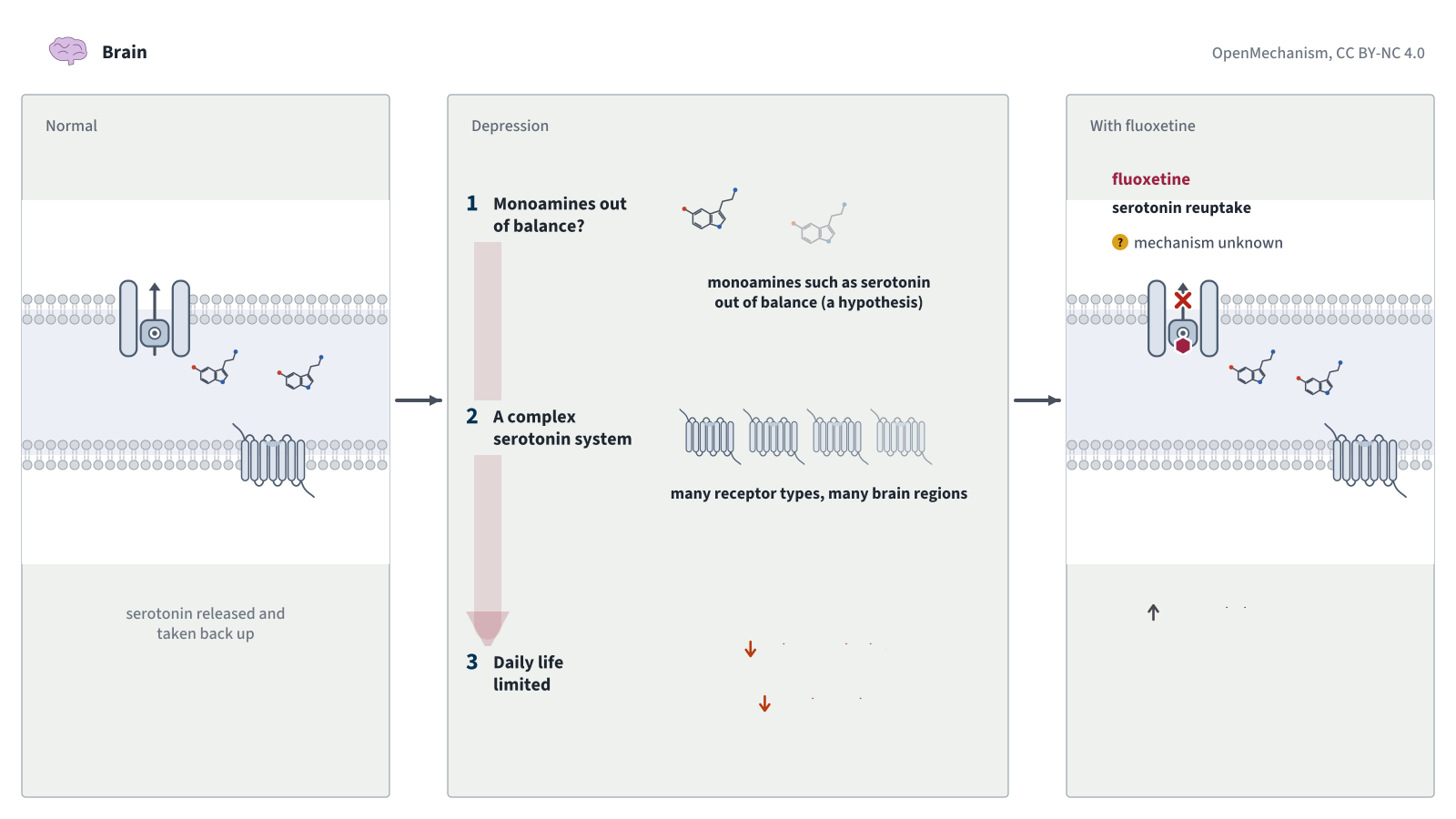
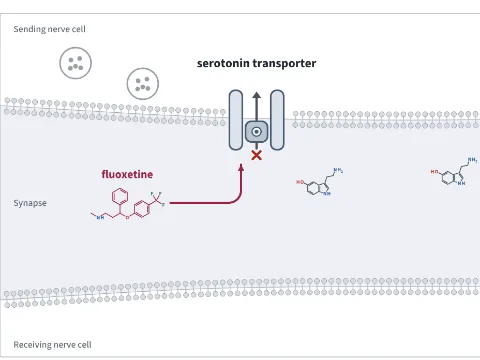
Major depression is a common illness that severely limits daily functioning and lowers quality of life. The monoamine hypothesis holds that an imbalance in messengers such as serotonin causes its features, but the serotonin system is complex, with many receptor types acting across the brain. Fluoxetine blocks the uptake of serotonin by nerve cells; exactly how it helps is not known.
What goes wrong in depression, and where medicines act. Schematic, not to scale. License CC BY-NC 4.0.
?Mechanism unknown
The Prozac (fluoxetine) label says: Although the exact mechanism of PROZAC is unknown, it is presumed to be linked to its inhibition of CNS neuronal uptake of serotonin.
Clinical study: In Meyer and colleagues' 2004 brain imaging (PET) study, 77 people took one of five medicines, fluoxetine among them, for 4 weeks: healthy people at doses below those used in treatment, and people with mood and anxiety disorders at treatment doses. It measured how much of the serotonin transporter (5-HTT) was blocked, not the treatment effect: Occupancy of 80% across five SSRIs occurs at minimum therapeutic doses. This suggests that 80% 5-HTT blockade is important for therapeutic effect.Meyer JH et al., Am J Psychiatry 2004 (PMID 15121647)
Reuptake. Nerve cells taking a messenger such as serotonin back up, which helps end its signal.
What goes wrong
Monoamines out of balance? The monoamine hypothesis holds that an imbalance in monoamine messengers, such as serotonin, causes the features of depression.1
What the source says
“The monoamine hypothesis of depression posits that an imbalance in monoaminergic neurotransmission is causally related to the clinical features of depression.”
A complex serotonin system. However, serotonin acts through many receptor types that affect other messengers in many brain regions.1
What the source says
“However, the serotonin system is multifaceted. Different serotonin receptor subtypes turn the serotonergic system into a complex neurochemical arrangement that influences diverse neurotransmitters in various brain regions.”
Fluoxetine is a selective serotonin inhibitor (SSRI). Its exact mechanism is unknown, but the label presumes it is linked to fluoxetine's blocking of serotonin uptake into nerve cells. The label lists it for the acute and maintenance treatment of major depressive disorder, and says fluoxetine alone is not indicated for treatment-resistant depression or for depressive episodes of bipolar I disorder.3
What the source says
“Although the exact mechanism of PROZAC is unknown, it is presumed to be linked to its inhibition of CNS neuronal uptake of serotonin.”
“PROZAC monotherapy is not indicated for the treatment of depressive episodes associated with Bipolar I Disorder or the treatment of treatment resistant depression.”
Also used for it: sertraline (“Major depressive disorder (MDD)”4); escitalopram (in adults and children 12 and older: “major depressive disorder (MDD) in adults and pediatric patients 12 years of age and older”5); bupropion (extended-release tablets: “treatment of major depressive disorder (MDD)”6); trazodone (in adults: “treatment of major depressive disorder (MDD) in adults”7); duloxetine (delayed-release capsules, in adults: “Major depressive disorder in adults”8); venlafaxine (extended-release capsules, in adults: “Major Depressive Disorder (MDD)”9); aripiprazole (as an add-on treatment: “Adjunctive Treatment of Major Depressive Disorder”10); citalopram (in adults: “major depressive disorder (MDD) in adults”11); paroxetine (extended-release tablets, in adults: “Major depressive disorder (MDD)”12); desvenlafaxine (extended-release tablets, in adults: “adults with major depressive disorder (MDD)”13); amitriptyline (“For the relief of symptoms of depression.”14); mirtazapine (in adults: “major depressive disorder (MDD) in adults”15); nortriptyline (“relief of symptoms of depression”16); and tranylcypromine (for major depression in adults that other antidepressants have not relieved enough: “Tranylcypromine sulfate tablets are indicated for the treatment of major depressive disorder (MDD) in adult patients who have not responded adequately to other antidepressants. Tranylcypromine sulfate tablets are not indicated for the initial treatment of MDD due to the potential for serious adverse reactions and drug interactions, and the need for dietary restrictions”17).
The steps are in the order that explains them; one step is said to cause the next only where the source says so.
The monoamine idea is a hypothesis; depression varies in how it shows and how it responds to treatment, and its course is unpredictable.1,2
A 2016 review says antidepressants that act on serotonin mainly aim to raise serotonin levels, increasing serotonin signaling at the synapse, for example by inhibiting the serotonin transporter.1
text 1da54fb4dbbd…; drawings 4b89a3175e80…; notes da0df3182a4f…
AI source check
Claude Opus 5.5 (AI source check), 3 November 2026: 42 statements compared with their sources, 4 flagged for the reviewer. An automated check, not a medical review.
Conflict of interest
Desvenlafaxine: Pfizer, the reviewer's former employer, makes or markets this medicine. Details
Next review due
4 May 2028
Cite this page
Tran D. Depression [Internet]. OpenMechanism; 2026 [updated 2026 Nov 3; cited 2026 Nov 3]. Available from: https://openmechanism.com/conditions/depression