Buspirone
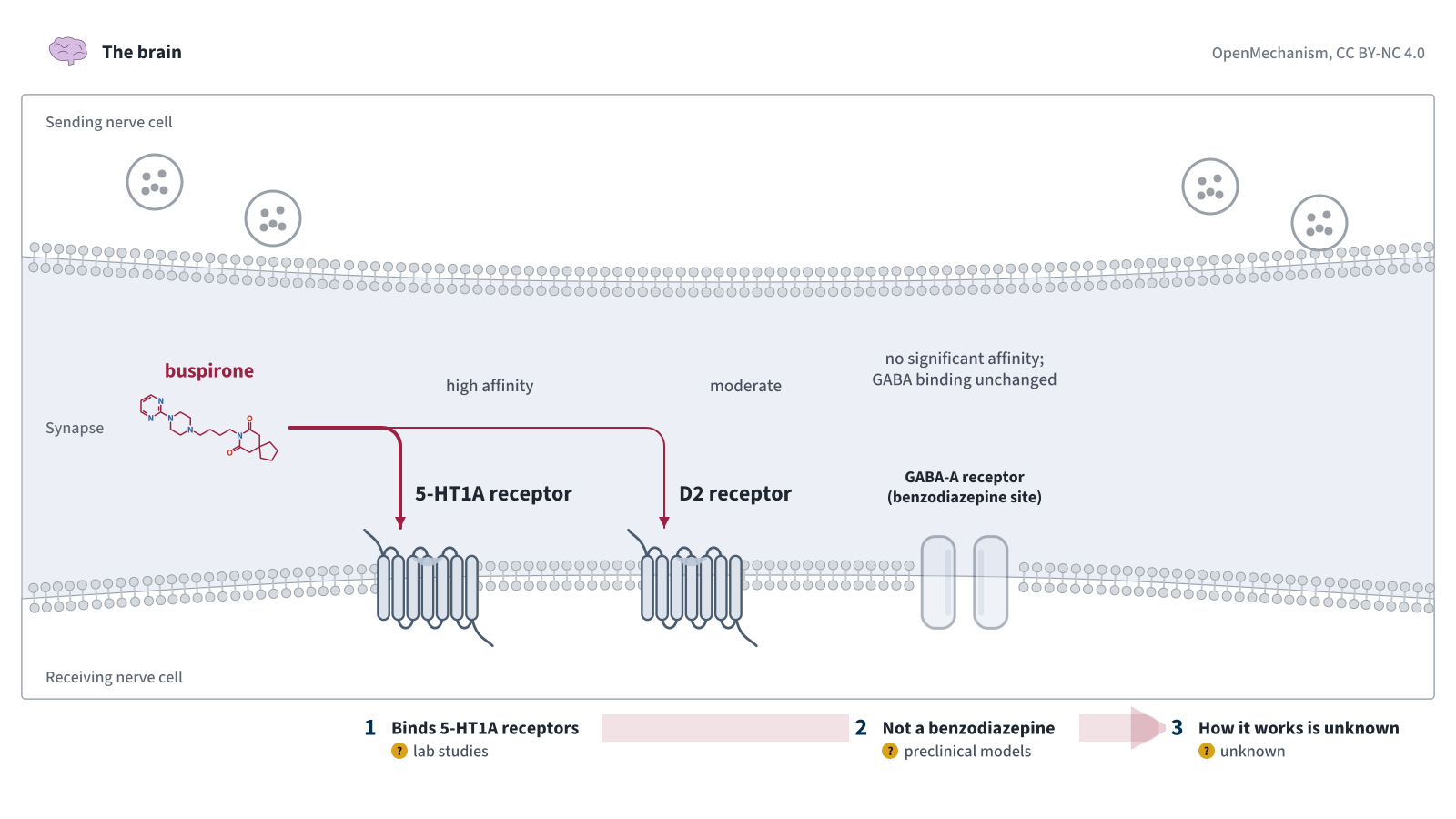
In laboratory studies, buspirone binds serotonin strongly and dopamine moderately; it has no significant for benzodiazepine receptors and does not affect binding. Unlike typical benzodiazepines, it does not relax muscles, and it lacks their prominent sedation. The label says how it works is unknown. It lists buspirone for managing anxiety disorders or for the short-term relief of anxiety symptoms, and says its effectiveness in use for more than 3 to 4 weeks has not been shown in controlled trials.
- Acts on
- Serotonin 5-HT1A receptors (and, moderately, dopamine D2)
- Where
- The brain
- Medicine type
- Small molecule
- Used for
- Brain & nerves
Step 1: lab studies
The buspirone label says: In vitro preclinical studies have shown that buspirone has a high affinity for serotonin (5-HT 1A ) receptors.
Source 1: Buspirone hydrochloride tablets: FDA label, Indications and Usage; Clinical Pharmacology
Clinical study: In Goldberg and Finnerty's 1979 double-blind trial, 56 adult outpatients with anxiety were randomly assigned to buspirone (18 people), diazepam (20) or placebo (18) for 4 weeks; the trial measured anxiety, not binding to receptors: A battery of tests administered weekly indicated that buspirone, a new agent not chemically related to any currently marketed drugs, was as effective an antianxiety agent as diazepam …
Goldberg HL, Finnerty RJ, Am J Psychiatry 1979 (PMID 382878)
Step 2: preclinical models
The buspirone label says: Buspirone has no significant affinity for benzodiazepine receptors and does not affect GABA binding in vitro or in vivo when tested in preclinical models.
Source 1: Buspirone hydrochloride tablets: FDA label, Indications and Usage; Clinical Pharmacology
Clinical study: In Rickels and colleagues' 1988 double-blind trial, anxious outpatients took clorazepate (a benzodiazepine, 15 to 60 mg a day) or buspirone (10 to 40 mg a day) for six months, then stopped abruptly; the buspirone group had a higher dropout rate. The trial measured withdrawal symptoms, not binding at benzodiazepine receptors: There was a significant increase in symptom severity consistent with a withdrawal reaction for the clorazepate group but not the buspirone group.
Rickels K et al., Arch Gen Psychiatry 1988 (PMID 2895993)
Step 3: unknown
The buspirone label says: The mechanism of action of buspirone is unknown. … Some studies do suggest that buspirone may have indirect effects on other neurotransmitter systems.
Source 1: Buspirone hydrochloride tablets: FDA label, Indications and Usage; Clinical Pharmacology
Clinical study: In Lader and Scotto's 1998 randomized, double-blind, 4-week trial of hydroxyzine, buspirone (5 mg in the morning and at midday, 10 mg in the evening) or placebo in 244 people with generalized anxiety disorder in primary care; the trial measured anxiety ratings, not how buspirone works: Intention-to-treat LOCF analyses on the primary variable showed a significant difference only between hydroxyzine and placebo with respect to improvement on the Hamilton Anxiety Scale (10.75 versus 7.23 points, respectively). Secondary variables such as CGI and self-ratings (HAD scale) showed both hydroxyzine and buspirone to be more efficacious than placebo.
Lader M, Scotto JC, Psychopharmacology (Berl) 1998 (PMID 9809861)
Key terms in this drawing (5)
- 5-HT1A receptor
- Serotonin 1A receptor. One of the serotonin receptors; in lab studies, buspirone binds it strongly.
- affinity
- Binding affinity. How strongly a molecule binds its target.
- D2 receptor
- Dopamine D2 receptor. A dopamine receptor; in Parkinson disease, ropinirole's effect is thought to be related to its ability to stimulate D2 receptors in the caudate-putamen of the brain.
- GABA
- Gamma-aminobutyric acid. The main inhibitory messenger in the central nervous system.
- GABA-A receptor
- Gamma-aminobutyric acid type A receptor. A receptor channel on nerve cells that GABA switches on; benzodiazepines also bind it.
How it works
Binds 5-HT1A receptors. In laboratory (preclinical) studies, buspirone has a high affinity for serotonin 5-HT1A receptors and a moderate affinity for dopamine D2 receptors in the brain.1
Not a benzodiazepine. It has no significant affinity for benzodiazepine receptors and does not affect GABA binding in preclinical models. Unlike typical benzodiazepines, it has no anticonvulsant or muscle-relaxing effect and lacks their prominent sedation.1
How it works is unknown. The label says the mechanism of action of buspirone is unknown, and that some studies suggest it may act indirectly on other messenger systems.1
For teachers: download this drawing.
See also
Condition pages: anxiety disorders.
Body system: brain & nerves.
Sources
- 1Buspirone hydrochloride tablets: FDA labelIndications and Usage; Clinical Pharmacology
- 2ChEMBL CHEMBL49Target and action classification: Serotonin 1a (5-HT1a) receptor partial agonist
- 3The comparative efficacy of buspirone and diazepam in the treatment of anxietyGoldberg HL, Finnerty RJ. Am J Psychiatry 1979 (abstract)
- 4Long-term treatment of anxiety and risk of withdrawal. Prospective comparison of clorazepate and buspironeRickels K et al. Arch Gen Psychiatry 1988 (abstract)
- 5A multicentre double-blind comparison of hydroxyzine, buspirone and placebo in patients with generalized anxiety disorderLader M, Scotto JC. Psychopharmacology (Berl) 1998 (abstract)
Also used for the drawing
The drawing shows the benzodiazepine site on the GABA-A receptor, for which the label says buspirone has no significant affinity. The label speaks of benzodiazepine receptors; this paper shows benzodiazepines bound to the GABA-A receptor.
- 6GABA-A receptor signalling mechanisms revealed by structural pharmacologyMasiulis S et al., Nature 2019 (abstract)
Spotted a mistake? Report an error (hello@openmechanism.com). Since launch, every published error we fix is listed on the corrections page.
Notes and limits
- A schematic teaching drawing: not to scale, not exact structures, binding poses or a complete pathway, and not a guide to dosing, treatment or how a person will respond.
- The steps are in the order that explains them; one step is said to cause the next only where the source says so.
- The label says the mechanism of action of buspirone is unknown, and that some studies suggest buspirone may have indirect effects on other neurotransmitter systems.
All recorded limits are on the evidence page, and notes that apply to every page are on How to read a page. Version 1.0.1, medically reviewed by Daniel Tran, PharmD, on 6 November 2026.
Cite this page
Tran D. Buspirone [Internet]. OpenMechanism; 2026 [updated 2026 Nov 6; cited 2026 Nov 6]. Available from: https://openmechanism.com/medicines/buspirone