Multiple sclerosis
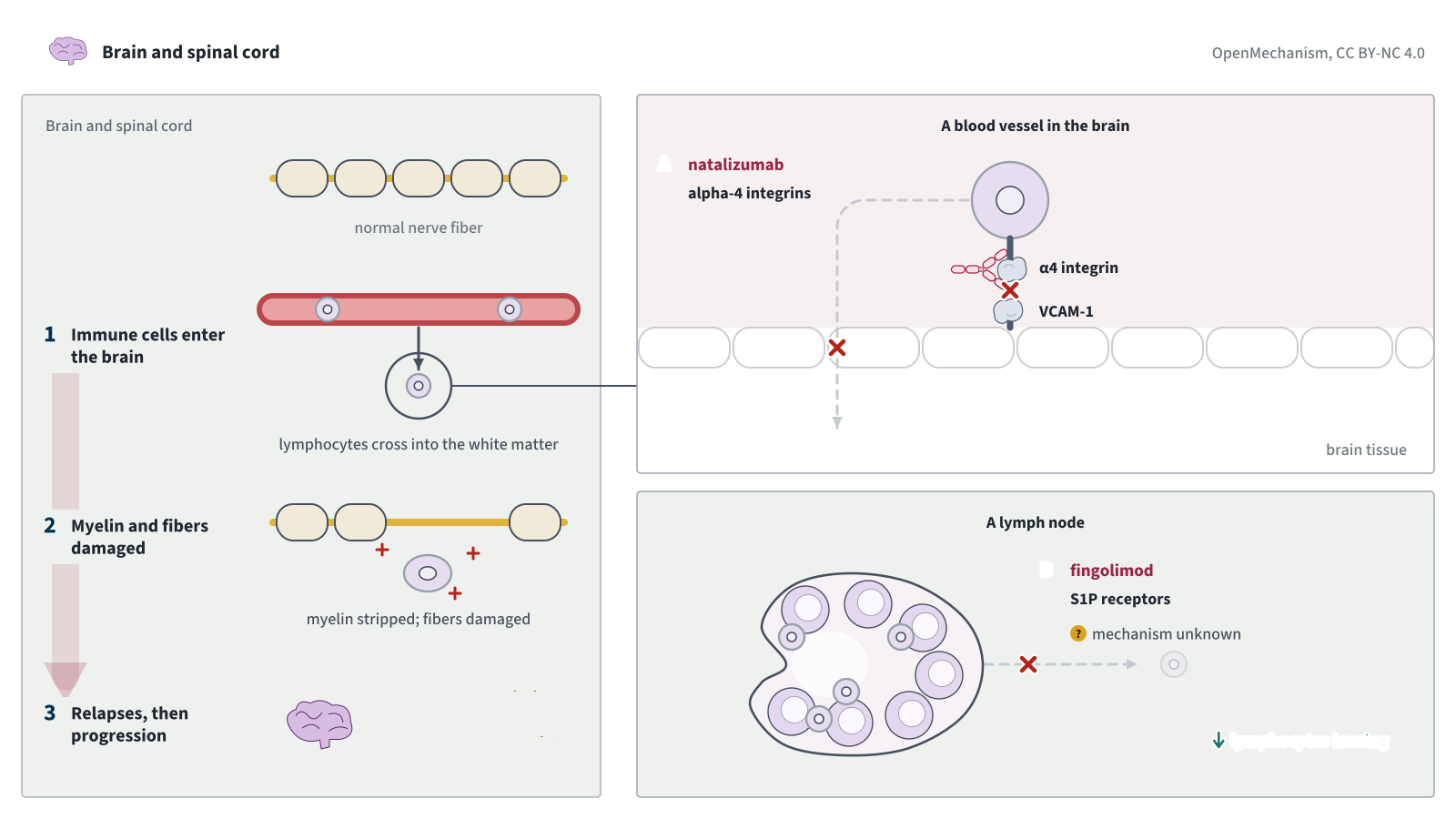
In multiple sclerosis, immune cells cross the blood-brain barrier, mainly into the white matter, and form plaques where myelin is lost; macrophages and microglia strip myelin and destroy nerve fibers. Most people start with relapses and remissions, which may later turn into steady worsening. Natalizumab keeps white cells from crossing blood vessel walls; fingolimod keeps lymphocytes in the lymph nodes.
- Where
- Brain and spinal cord
- Body systems
- Brain & nerves, Immune system
- Medicines
- 2 medicines
Mechanism unknown
The Gilenya (fingolimod) label says: The mechanism by which fingolimod exerts therapeutic effects in multiple sclerosis is unknown, but may involve reduction of lymphocyte migration into the central nervous system.
Source 4: Gilenya (fingolimod): FDA label, 1 Indications and Usage; 12.1 Mechanism of Action
Clinical study: In a 24-month double-blind trial of fingolimod (0.5 or 1.25 mg a day) or placebo in 1272 people with relapsing-remitting multiple sclerosis; the trial measured relapses, disability and MRI findings, not how fingolimod works: As compared with placebo, both doses of oral fingolimod improved the relapse rate, the risk of disability progression, and end points on MRI.
Kappos L et al., N Engl J Med 2010 (PMID 20089952)
This study was picked with a literature search and is not yet checked by our reviewer.
For teachers: download this drawing.
Key terms in this drawing
- S1P
- Sphingosine-1-phosphate. A signaling lipid; its receptors let lymphocytes leave lymph nodes.
- VCAM-1
- Vascular cell adhesion molecule 1. A protein on blood-vessel walls that white blood cells stick to.
What goes wrong
Immune cells enter the brain. Immune cells cross the blood-brain barrier: T and B lymphocytes invade, mainly in the white matter, where the barrier leaks, and form plaques where myelin is lost.1,2
What the source says
“Dendritic cells migrate across the blood-brain barrier and induce differentiation of memory T cells into pro-inflammatory T helper 1 (Th1) and Th17 lymphocytes.”
Source 1“The first is the focal bulk invasion of T- and B-lymphocytes with profound blood brain barrier leakage, which predominately affects the white matter, and which gives rise to classical active demyelinated plaques.”
Source 2Myelin and fibers damaged. Activated macrophages and microglia release inflammatory signals and oxygen and radicals that strip myelin and destroy nerve fibers.1
What the source says
“In turn, induction of macrophage and microglial activation produces other pro-inflammatory cytokines and oxygen and nitric oxide radicals responsible for the demyelination and axonal loss.”
Source 1Relapses, then progression. Most people start with relapses and remissions, which may later turn into steady worsening.2
What the source says
“In the majority of patients multiple sclerosis starts with a relapsing remitting course (RRMS), which may at later times transform into secondary progressive disease (SPMS).”
Source 2
Where medicines act
- A
Natalizumab: white cells kept out
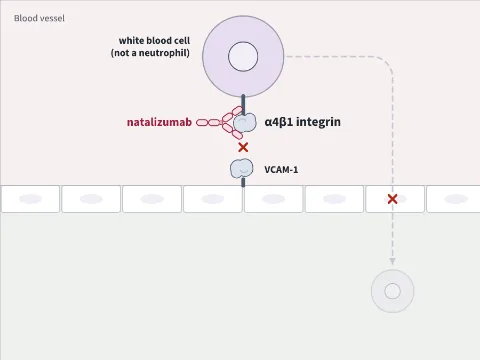
Natalizumab blocks alpha-4 integrins on white blood cells, so they cannot stick to on inflamed blood vessels and cross into the tissue. It treats relapsing forms of multiple sclerosis.3
What the source says
“Natalizumab binds to the α4-subunit of α4β1 and α4β7 integrins expressed on the surface of all leukocytes except neutrophils, and inhibits the α4-mediated adhesion of leukocytes to their counter-receptor(s).”
Source 3“The receptors for the α4 family of integrins include vascular cell adhesion molecule-1 (VCAM-1), which is expressed on activated vascular endothelium”
Source 3“TYSABRI is indicated as monotherapy for the treatment of relapsing forms of multiple sclerosis”
Source 3 - B
Fingolimod: lymphocytes held in the lymph nodes
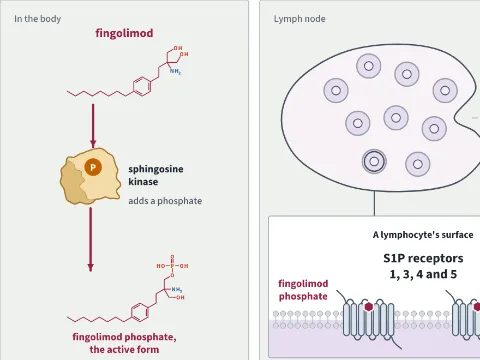
Fingolimod's active form acts on sphingosine 1-phosphate receptors and keeps lymphocytes from leaving the lymph nodes; how this helps in multiple sclerosis is unknown but may involve fewer lymphocytes reaching the brain. It treats relapsing forms of multiple sclerosis.4
What the source says
“Fingolimod-phosphate blocks the capacity of lymphocytes to egress from lymph nodes, reducing the number of lymphocytes in peripheral blood.”
Source 4“The mechanism by which fingolimod exerts therapeutic effects in multiple sclerosis is unknown, but may involve reduction of lymphocyte migration into the central nervous system.”
Source 4“GILENYA is indicated for the treatment of relapsing forms of multiple sclerosis (MS)”
Source 4
See also
Body systems: brain & nerves and immune system.
Also used for it: methylprednisolone (“Acute exacerbations of multiple sclerosis”5).
Related medicines: baclofen.
Other conditions: Crohn disease, ankylosing spondylitis, cutaneous T-cell lymphoma, juvenile idiopathic arthritis, lupus nephritis and pemphigus.
Side effects: why natalizumab raises the risk of PML, a brain infection.
Sources
- 1A basic overview of multiple sclerosis immunopathologyGrigoriadis N et al. Eur J Neurol 2015 (abstract). Saved copy
- 2Pathogenic mechanisms associated with different clinical courses of multiple sclerosisLassmann H. Front Immunol 2018 (abstract). Saved copy
- 3Tysabri (natalizumab): FDA label1 Indications and Usage; 12.1 Mechanism of Action. Saved copy
- 4Gilenya (fingolimod): FDA label1 Indications and Usage; 12.1 Mechanism of Action. Saved copy
- 5Solu-Medrol (methylprednisolone sodium succinate): FDA labelIndications and Usage. Saved copy
- 6A placebo-controlled trial of oral fingolimod in relapsing multiple sclerosisKappos L et al. N Engl J Med 2010 (abstract). Saved copy
Notes and limits
- The target that the immune cells recognize in the brain is still unknown.2
Notes that apply to every page are on How to read a page.
Spotted a mistake? Report an error (hello@openmechanism.com). Since launch, every published error we fix is listed on the corrections page.
Cite this page
Tran D. Multiple sclerosis [Internet]. OpenMechanism; 2026 [updated 2026 Oct 21; cited 2026 Oct 21]. Available from: https://openmechanism.com/conditions/multiple-sclerosis