Haloperidol
The label says how haloperidol works in schizophrenia is unclear, and that its effect could come from blocking dopamine in the brain. It binds adrenergic α1 receptors more weakly, and muscarinic and histamine only minimally. Its long-acting form, haloperidol decanoate, is injected into muscle in sesame oil and releases haloperidol slowly over weeks. The haloperidol decanoate label lists it for people with schizophrenia who need prolonged antipsychotic treatment by injection.
- Acts on
- Dopamine D2 receptors
- Where
- Nerve cells in the brain
- Medicine type
- Small molecule
- Used for
- Brain & nerves
- Drug class
- Antipsychotics
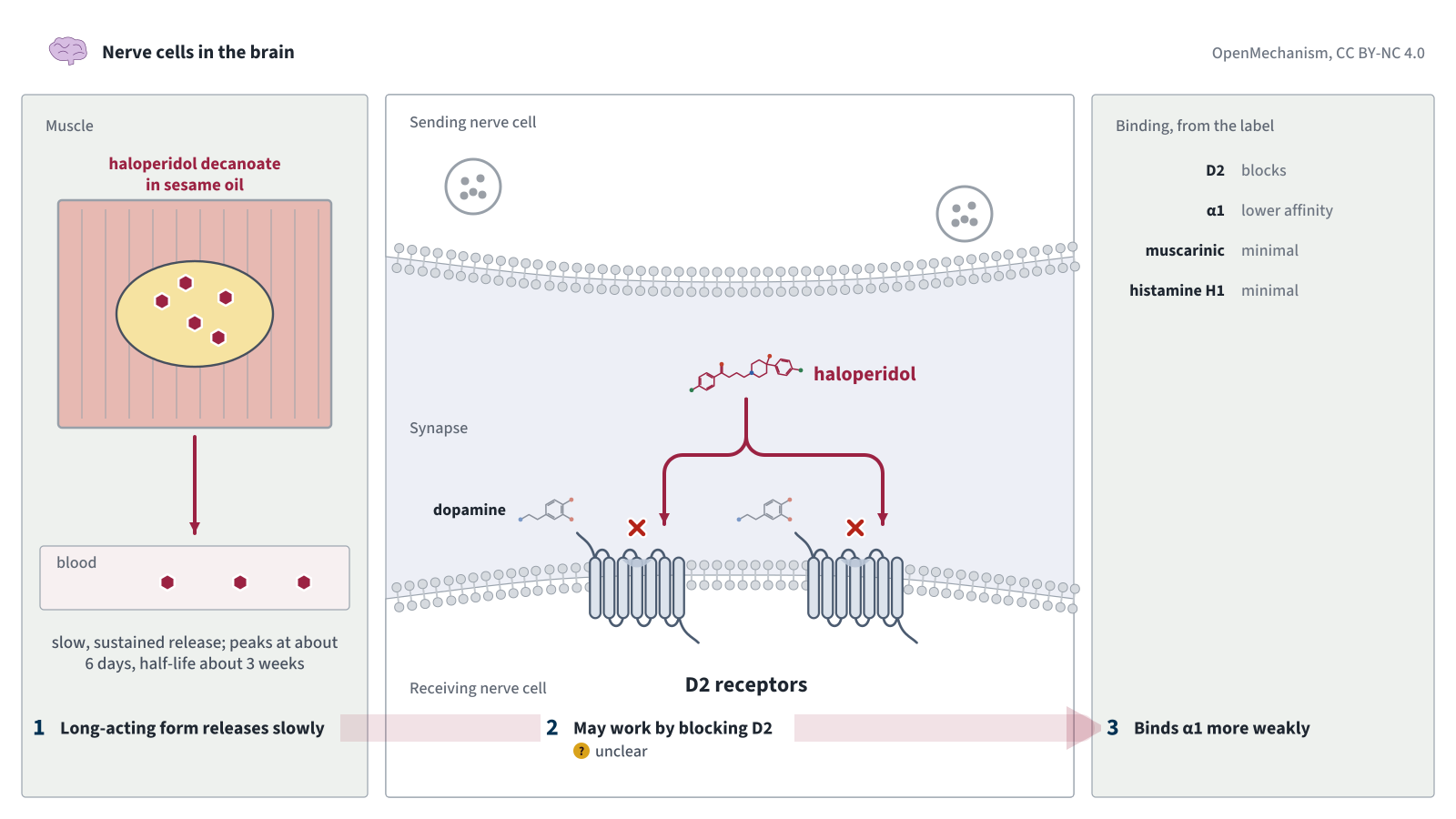
Step 2: unclear
The haloperidol decanoate label says: The mechanism of action of haloperidol for the treatment of schizophrenia is unclear. However, its efficacy could be mediated through its activity as an antagonist at central dopamine type 2 receptors.
Source 1: Haloperidol decanoate: FDA label, Indications and Usage; Clinical Pharmacology
Clinical study: In Kapur and colleagues' 2000 double-blind brain imaging (PET) study of 22 people with first-episode schizophrenia randomly assigned to haloperidol 1.0 or 2.5 mg a day (raised to 5.0 mg a day if they did not respond), measuring how many of their D2 receptors it occupied after 2 weeks and assessing everyone again at 4 weeks: The degree of receptor occupancy predicted clinical improvement, hyperprolactinemia, and extrapyramidal side effects.
Kapur S et al., Am J Psychiatry 2000 (PMID 10739409)
Key terms in this drawing
- affinity
- Binding affinity. How strongly a molecule binds its target.
- D2 receptor
- Dopamine D2 receptor. A dopamine receptor; in Parkinson disease, ropinirole's effect is thought to be related to its ability to stimulate D2 receptors in the caudate-putamen of the brain.
- H1 receptor
- Histamine H1 receptor. A histamine receptor; medicines that block it (antihistamines) treat allergies and often make people sleepy.
- half-life
- Half-life. The time it takes for the amount in the blood to fall by half.
How it works
Long-acting form releases slowly. Haloperidol decanoate, the long-acting form, is injected into muscle in sesame oil and gives a slow and sustained release of haloperidol: blood levels peak about 6 days after the injection and then fall, with an apparent of about 3 weeks. The label adds that these figures can be quite variable from person to person.1
May work by blocking D2. The label says how haloperidol works in schizophrenia is unclear, and that its effect could come from its action as a blocker () at dopamine D2 receptors in the brain.1
Binds α1 more weakly. Haloperidol also binds adrenergic α1 receptors, but with lower , and binds muscarinic (cholinergic) and histamine H1 receptors only minimally.1
For teachers: download this drawing.
See also
Condition pages: schizophrenia.
Side effects: tardive dyskinesia.
Other antipsychotics: aripiprazole, clozapine, olanzapine, quetiapine, risperidone and ziprasidone.
Explained: why antipsychotics can cause movement problems and why antipsychotics can raise prolactin.
Body system: brain & nerves.
Sources
- 1Haloperidol decanoate: FDA labelIndications and Usage; Clinical Pharmacology
- 2ChEMBL CHEMBL54Target and action classification: D2-like dopamine receptor inverse agonist; Serotonin 2a (5-HT2a) receptor antagonist
- 3Relationship between dopamine D(2) occupancy, clinical response, and side effects: a double-blind PET study of first-episode schizophreniaKapur S et al. Am J Psychiatry 2000 (abstract)
Spotted a mistake? Report an error (hello@openmechanism.com). Since launch, every published error we fix is listed on the corrections page.
Notes and limits
- A schematic teaching drawing: not to scale, not exact structures, binding poses or a complete pathway, and not a guide to dosing, treatment or how a person will respond.
- The steps are in the order that explains them; one step is said to cause the next only where the source says so.
- The label says the mechanism of action of haloperidol for the treatment of schizophrenia is unclear, and that its efficacy could be mediated through its activity as an antagonist at central dopamine type 2 receptors.
All recorded limits are on the evidence page, and notes that apply to every page are on How to read a page. Version 1.0.1, medically reviewed by Daniel Tran, PharmD, on 7 November 2026.
Cite this page
Tran D. Haloperidol [Internet]. OpenMechanism; 2026 [updated 2026 Nov 7; cited 2026 Nov 7]. Available from: https://openmechanism.com/medicines/haloperidol