How to read a page
What the parts of a page mean, and the notes that apply to every page.
The drawing
A schematic teaching drawing: not to scale, not exact structures, binding poses or a complete pathway, and not a guide to dosing, treatment or how a person will respond.
Numbers follow the steps on the page, in the order they are explained. On condition and body pages, letters mark where each medicine acts. A yellow question mark marks a qualifier, such as a finding from animal studies; tap it to see what the source says.
An enzyme’s shape says what it does, and its color says whose it is: amber for the body’s own, lilac for a virus, green for bacteria, olive for fungi and blue for parasites. The medicine is crimson, and a red X marks what it blocks.
 Kinasethe body’s own (amber)
 Pathway enzymethe body’s own (amber)
 Polymerasea virus’s (lilac)
 Proteasea virus’s (lilac)
 Gyrasea bacterium’s (green)
 Wall buildera bacterium’s (green)
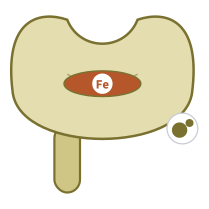 P450 enzymea fungus’s (olive)
 Cytochrome bc1a parasite’s (blue)
A change, such as “less cholesterol made”, is written in color with an arrow before it: the arrow gives the direction and the color gives the meaning: green for a desired or good effect, red for an undesired or bad one, gray when neutral or unclear, yellow when sensitive or uncertain. The body’s other proteins (receptors, channels, transporters) are slate, and a dark T-bar is the body’s own brake.
- Green: a desired or good effect
- Red: an undesired or bad effect
- Gray: neutral or unclear
- Yellow: sensitive or uncertain
The steps
The steps are in the order that explains them; one step is said to cause the next only where the source says so.
Each step is written to say only what its source says, with the same qualifiers. The medical review checks that it does, so a page that is not yet medically reviewed, or has changed since its review, may still have a step that needs correcting. The small numbers after a step link to its sources, and each medicine’s evidence page gives every statement in full.
A word with a dotted underline has a short explanation: tap or hover it. “Key terms in this drawing” explains the drawing’s abbreviations, and the glossary lists every term in one place.
Other medicines in the same family may not follow every step or share the same clinical endpoint.
Who wrote a page, and when it changed
Every page names its author. “Updated” is the day the page’s content last changed: its statements, its summary or its drawing. A change to the site’s design does not move it.
“Medically reviewed” appears only after a reviewer signs off one exact version of a page. How we review explains the process.
Using a page
Each page ends with a reference you can copy. The drawings and text are free for teaching and learning under CC BY-NC 4.0; the license page says how to credit them.
OpenMechanism is for learning and teaching how medicines work. It is not for clinical or prescribing decisions.
Spotted a mistake? Report an error (hello@openmechanism.com). Since launch, every published error we fix is listed on the corrections page.