Atomoxetine
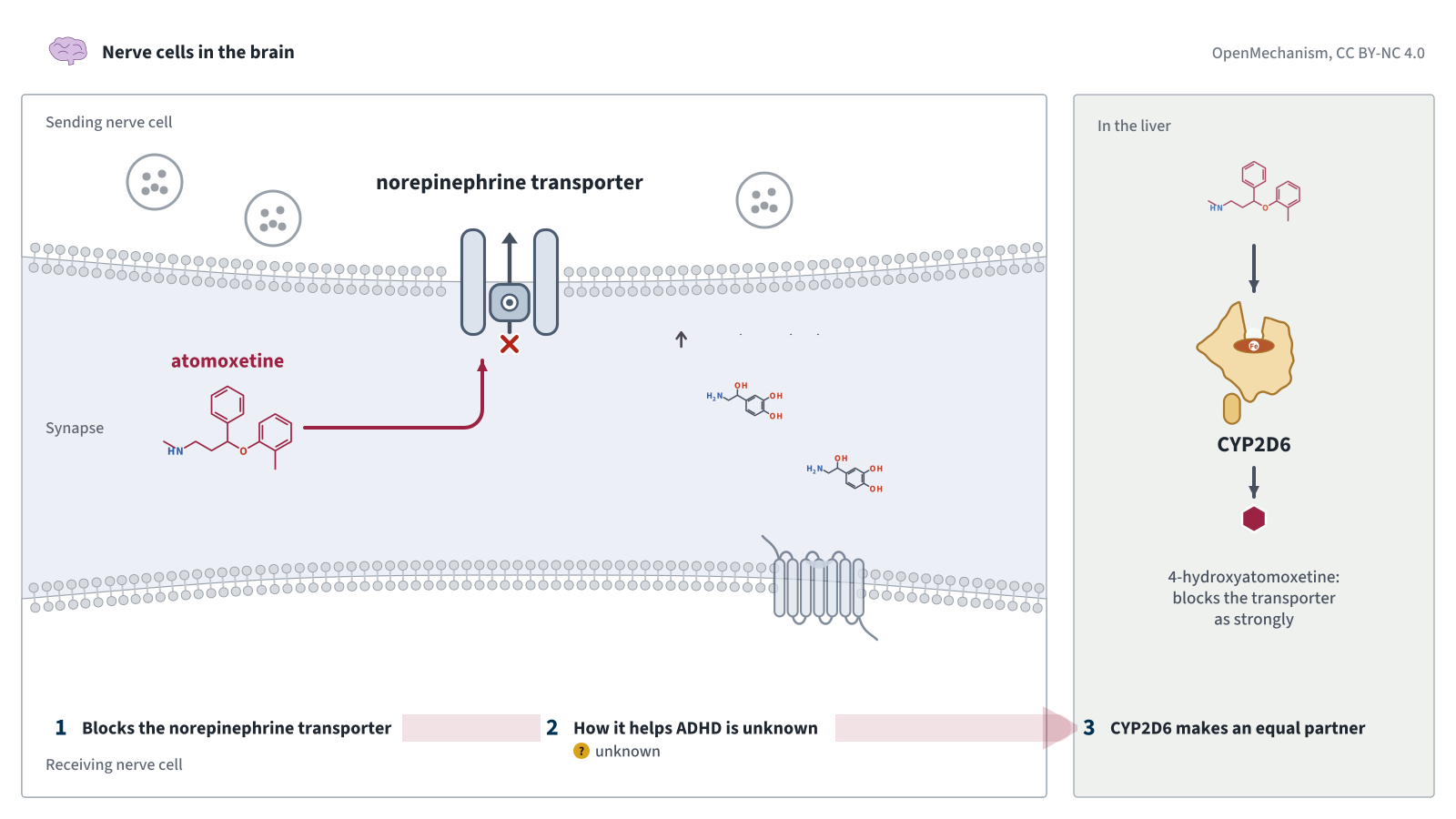
Atomoxetine selectively blocks the norepinephrine transporter of nerve cells; its main metabolite, made by , blocks it just as strongly. How it helps in is unknown, though it is thought to relate to this block.
- Acts on
- The norepinephrine transporter
- Where
- Nerve cells in the brain
- Medicine type
- Small molecule
- Used for
- Brain & nerves
Also called Strattera.
Step 2: unknown
The Strattera label says: The precise mechanism by which STRATTERA produces its therapeutic effects in ADHD is unknown, but is thought to be related to selective inhibition of the pre-synaptic norepinephrine transporter, as determined in ex vivo uptake and neurotransmitter depletion studies.
Source 1: Strattera (atomoxetine): FDA label, 12.1 Mechanism of Action; 12.3 Pharmacokinetics
Clinical study: In a randomized, placebo-controlled dose-response trial in children and adolescents with ADHD; the trial measured ADHD symptoms and functioning, not how atomoxetine works: Among children and adolescents aged 8 to 18, atomoxetine was superior to placebo in reducing ADHD symptoms and in improving social and family functioning symptoms.
Michelson D et al., Pediatrics 2001 (PMID 11694667)
This study was picked with a literature search and is not yet checked by our reviewer.
Key terms in this drawing
- CYP2D6
- Cytochrome P450 2D6. A liver enzyme that breaks down several medicines; for tramadol it makes the active metabolite M1.
How it works
Blocks the norepinephrine transporter. Atomoxetine is a selective norepinephrine inhibitor: in ex vivo uptake and messenger-depletion studies, it selectively blocks the norepinephrine transporter of sending nerve cells.1
How it helps ADHD is unknown. The precise mechanism of its effect in ADHD is unknown, but is thought to relate to the selective blocking of the norepinephrine transporter.1
CYP2D6 makes an equal partner. CYP2D6 mainly turns it into 4-hydroxyatomoxetine, which blocks the norepinephrine transporter as strongly as atomoxetine itself.1
For teachers: download this drawing.
See also
Condition pages: ADHD.
Body system: brain & nerves.
Sources
- 1Strattera (atomoxetine): FDA label12.1 Mechanism of Action; 12.3 Pharmacokinetics
- 2ChEMBL CHEMBL641Target and action classification: Norepinephrine transporter inhibitor
- 3Atomoxetine in the treatment of children and adolescents with attention-deficit/hyperactivity disorder: a randomized, placebo-controlled, dose-response studyMichelson D et al. Pediatrics 2001 (abstract)
Also used for the drawing
The CYP2D6 outline is traced from the crystal structure below.
- 4Human CYP2D6 with quinidinePDB 4WNU; Wang, A. et al. J.Biol.Chem. 2015; 290:5092-5104
Spotted a mistake? Report an error (hello@openmechanism.com). Since launch, every published error we fix is listed on the corrections page.
Notes and limits
- A schematic teaching drawing: not to scale, not exact structures, binding poses or a complete pathway, and not a guide to dosing, treatment or how a person will respond.
- The label says the precise mechanism by which atomoxetine produces its therapeutic effects in ADHD is unknown, but is thought to be related to selective inhibition of the pre-synaptic norepinephrine transporter.
All recorded limits are on the evidence page, and notes that apply to every page are on How to read a page. Version 1.0.0, not yet medically reviewed.
Cite this page
Tran D. Atomoxetine [Internet]. OpenMechanism; 2026 [updated 2026 Oct 21; cited 2026 Oct 21]. Available from: https://openmechanism.com/medicines/atomoxetine