Propofol
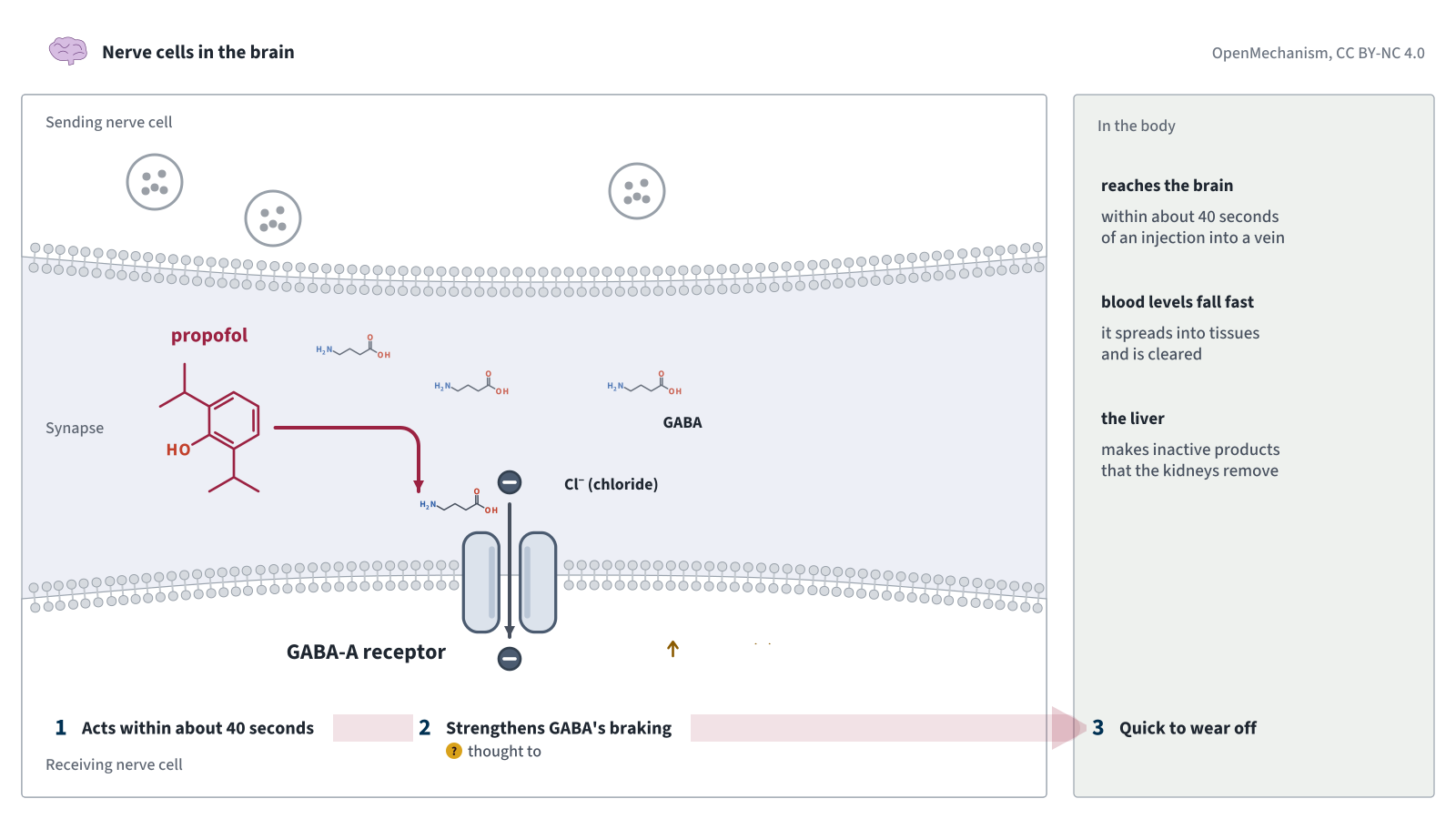
Injected into a vein, propofol brings on anesthesia within about 40 seconds. How it works, like all general anesthetics, is poorly understood; it is thought to strengthen the braking that the messenger brings, through . Blood levels fall quickly as it spreads into the body's tissues and is cleared, and the liver turns it into inactive products.
- Acts on
- GABA-A receptors (thought to)
- Where
- Nerve cells in the brain
- Medicine type
- Small molecule
- Used for
- Brain & nerves
Also called Diprivan.
Step 2: thought to
The Diprivan label says: The mechanism of action, like all general anesthetics, is poorly understood. … However, propofol is thought to produce its sedative/anesthetic effects by the positive modulation of the inhibitory function of the neurotransmitter GABA through the ligand-gated GABA A receptors.
Clinical study: In a meta-analysis of 36 randomized trials of moderate sedation for endoscopy in 3918 adults; it measured complications, patients' and doctors' assessments and the sedation, procedure and recovery times, not how propofol works: Procedure times were similar, but sedation and recovery times were shorter with propofol than midazolam-based regimens.
McQuaid KR, Laine L, Gastrointest Endosc 2008 (PMID 18440381)
This study was picked with a literature search and is not yet checked by our reviewer.
Key terms in this drawing
- GABA
- Gamma-aminobutyric acid. The main inhibitory messenger in the central nervous system.
- GABA-A receptor
- Gamma-aminobutyric acid type A receptor. A receptor channel on nerve cells that GABA switches on; benzodiazepines also bind it.
How it works
Acts within about 40 seconds. Injected into a vein, propofol brings on anesthesia with little excitement, usually within 40 seconds: the time blood takes to travel once from the arm to the brain. Levels in the blood and the brain even out quickly, which is why it starts so fast.1
Strengthens GABA's braking. How propofol works, like all general anesthetics, is poorly understood. It is thought to bring on sedation and anesthesia by strengthening the braking (inhibition) that the messenger GABA brings, through GABA-A receptors, channels that GABA opens.1
Quick to wear off. Blood levels fall quickly at first, as propofol spreads into the body's tissues and is cleared. The liver joins it to other molecules (conjugation), making inactive products that the kidneys remove. After about an hour of anesthesia, stopping propofol brings a prompt fall in blood levels and quick waking.1
For teachers: download this drawing.
See also
Side effects: low blood pressure during anesthesia.
Other GABA-A boosters, including benzodiazepines: alprazolam, clonazepam, diazepam, lorazepam, midazolam and zolpidem.
Other general anesthetics: fentanyl and ketamine.
Body system: brain & nerves.
Sources
- 1Diprivan (propofol) injectable emulsion: FDA label12 Clinical Pharmacology; 12.1 Mechanism of Action; 12.3 Pharmacokinetics
- 2ChEMBL CHEMBL526Target and action classification: GABA-A receptor; anion channel positive allosteric modulator
- 3A systematic review and meta-analysis of randomized, controlled trials of moderate sedation for routine endoscopic proceduresMcQuaid KR, Laine L. Gastrointest Endosc 2008 (abstract)
Also used for the drawing
The drawing shares its GABA-A synapse with the other medicines that act there: the receptor is a chloride channel, and chloride usually flows into the receiving nerve cell when GABA opens it. The label does not mention chloride; these two papers back it.
- 4GABA-A receptor signalling mechanisms revealed by structural pharmacologyMasiulis S et al., Nature 2019 (abstract)
- 5Anion transport and GABA signalingHübner CA, Holthoff K, Front Cell Neurosci 2013 (abstract)
Spotted a mistake? Report an error (hello@openmechanism.com). Since launch, every published error we fix is listed on the corrections page.
Notes and limits
- A schematic teaching drawing: not to scale, not exact structures, binding poses or a complete pathway, and not a guide to dosing, treatment or how a person will respond.
- The label says the mechanism of action, like that of all general anesthetics, is poorly understood, and that propofol is thought to act by positive modulation of GABA's inhibitory function through GABA-A receptors.
All recorded limits are on the evidence page, and notes that apply to every page are on How to read a page. Version 1.0.0, not yet medically reviewed.
Cite this page
Tran D. Propofol [Internet]. OpenMechanism; 2026 [updated 2026 Oct 16; cited 2026 Oct 16]. Available from: https://openmechanism.com/medicines/propofol