Sumatriptan
Sumatriptan binds strongly to the serotonin and . In migraine it presumably works by stimulating these receptors on blood vessels inside the head, which narrow, and on the trigeminal sensory nerves, which release fewer inflammatory neuropeptides. Only about 15% of a tablet reaches the blood, and it is short-lived ( about 2.5 hours).
- Acts on
- Serotonin 5-HT1B and 5-HT1D receptors
- Where
- Blood vessels and sensory nerves in the head
- Medicine type
- Small molecule
- Used for
- Brain & nerves
- Drug class
- Triptans
Also called Imitrex.
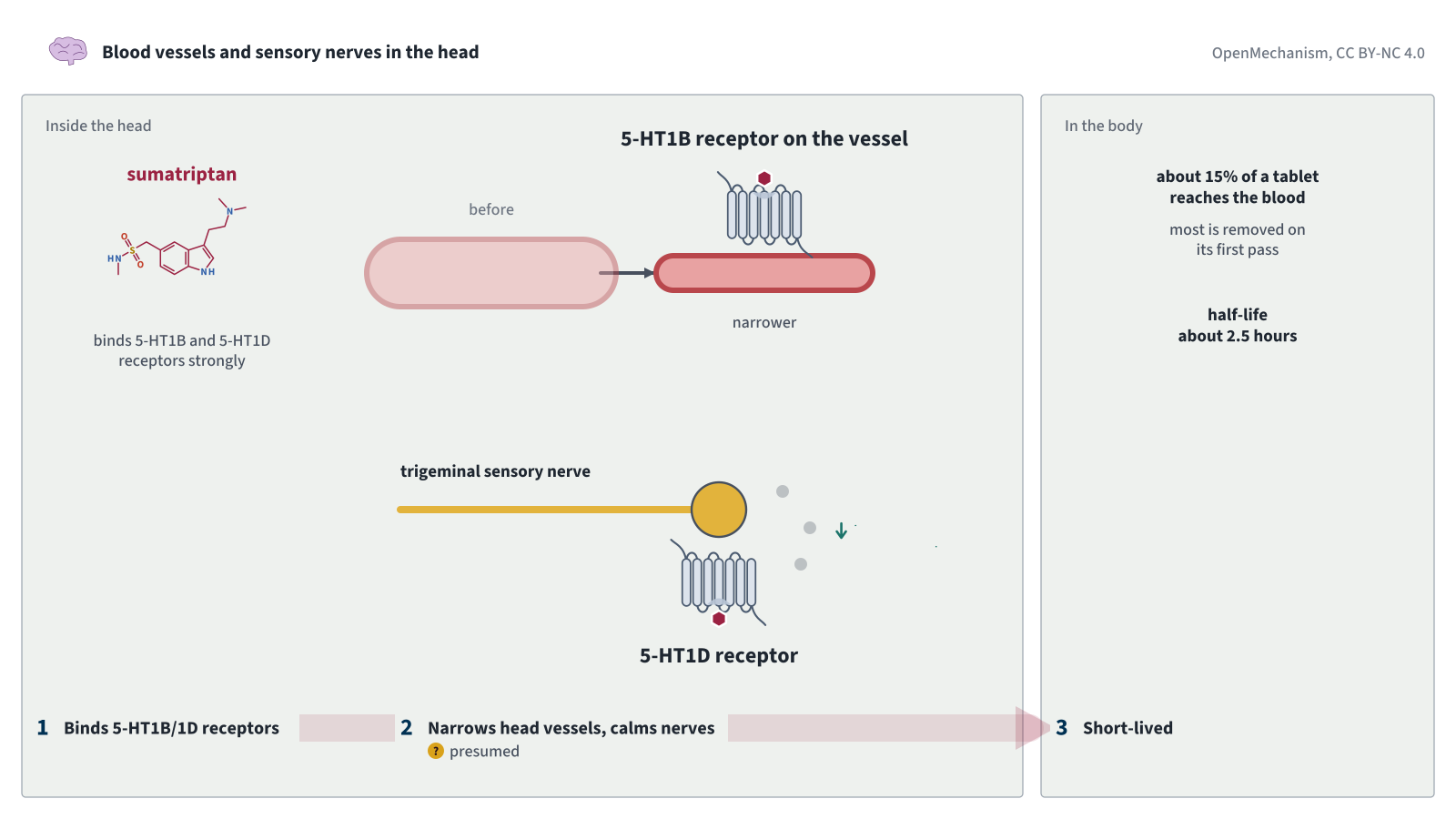
Step 2: presumed
The Imitrex label says: Sumatriptan presumably exerts its therapeutic effects in the treatment of migraine headache through agonist effects at the 5‑HT 1B/1D receptors on intracranial blood vessels and sensory nerves of the trigeminal system, which result in cranial vessel constriction and inhibition of pro‑inflammatory neuropeptide release.
Source 1: Imitrex (sumatriptan) tablets: FDA label, 12.1 Mechanism of Action; 12.3 Pharmacokinetics
Clinical study: A Cochrane review of 61 randomized studies (37,250 participants) of oral sumatriptan for migraine attacks, which measured freedom from pain and headache relief, not how sumatriptan works: Sumatriptan surpassed placebo for all efficacy outcomes.
Derry CJ et al., Cochrane Database Syst Rev 2012 (PMID 22336849)
This study was picked with a literature search and is not yet checked by our reviewer.
Key terms in this drawing
- 5-HT1B receptor
- Serotonin 1B receptor. A serotonin receptor; sumatriptan is presumed to work in migraine by switching on 5-HT1B and 5-HT1D receptors on blood vessels inside the skull and on trigeminal sensory nerves.
- 5-HT1D receptor
- Serotonin 1D receptor. A serotonin receptor; sumatriptan is presumed to work in migraine by switching on 5-HT1B and 5-HT1D receptors on blood vessels inside the skull and on trigeminal sensory nerves.
- half-life
- Half-life. The time it takes for the amount in the blood to fall by half.
How it works
Binds 5-HT1B/1D receptors. Sumatriptan binds with high to human 5-HT1B and 5-HT1D receptors.1
Narrows head vessels, calms nerves. It presumably works in migraine through effects at 5-HT1B/1D receptors on blood vessels inside the head and on sensory nerves of the trigeminal system, constricting cranial vessels and inhibiting the release of pro-inflammatory neuropeptides.1
Short-lived. Oral bioavailability is about 15%, mainly because of presystemic metabolism; the elimination half-life is about 2.5 hours.1
For teachers: download this drawing.
See also
Condition pages: migraine.
Body system: brain & nerves.
Sources
- 1Imitrex (sumatriptan) tablets: FDA label12.1 Mechanism of Action; 12.3 Pharmacokinetics
- 2ChEMBL CHEMBL128Target and action classification: Serotonin 1b (5-HT1b) receptor agonist; Serotonin 1d (5-HT1d) receptor agonist
- 3Sumatriptan (oral route of administration) for acute migraine attacks in adultsDerry CJ et al. Cochrane Database Syst Rev 2012 (abstract)
Spotted a mistake? Report an error (hello@openmechanism.com). Since launch, every published error we fix is listed on the corrections page.
Notes and limits
- A schematic teaching drawing: not to scale, not exact structures, binding poses or a complete pathway, and not a guide to dosing, treatment or how a person will respond.
- The label says sumatriptan presumably exerts its therapeutic effects in migraine through these actions.
All recorded limits are on the evidence page, and notes that apply to every page are on How to read a page. Version 1.0.0, not yet medically reviewed.
Cite this page
Tran D. Sumatriptan [Internet]. OpenMechanism; 2026 [updated 2026 Oct 11; cited 2026 Oct 11]. Available from: https://openmechanism.com/medicines/sumatriptan