Venlafaxine
Venlafaxine and its active metabolite block the of serotonin and norepinephrine by nerve cells; in laboratory studies they block dopamine reuptake only weakly and have few other targets. The Effexor XR label calls it a serotonin and norepinephrine reuptake inhibitor (SNRI) and lists it for adults with major depressive disorder, generalized anxiety disorder, social anxiety disorder and panic disorder. It says how venlafaxine works in these disorders is unclear, but is thought to relate to stronger serotonin and norepinephrine activity in the central nervous system, through blocking their reuptake.
- Acts on
- Serotonin and norepinephrine transporters
- Where
- Nerve cells in the brain and spinal cord
- Medicine type
- Small molecule
- Used for
- Brain & nerves
Also called Effexor XR (extended-release venlafaxine hydrochloride).
Step 1: lab studies
The Effexor XR label says: In vitro studies have demonstrated that venlafaxine and its active metabolite, O-desmethylvenlafaxine (ODV), are potent and selective inhibitors of neuronal serotonin and norepinephrine reuptake and weak inhibitors of dopamine reuptake.
Clinical study: In Owens and colleagues' 2008 randomized, double-blind, 8-week trial in 86 outpatients with major depression given controlled-release paroxetine (12.5 to 75 mg a day) or extended-release venlafaxine (75 to 375 mg a day), in doses raised on a fixed schedule, a blood test estimated how much of the serotonin and norepinephrine transporters (SERT and NET) each blocked; a test of the step in people: The results clearly demonstrate that paroxetine and venlafaxine are potent SERT antagonists and less potent NET antagonists in vivo.
Owens MJ et al., Neuropsychopharmacology 2008 (PMID 18418363)
Step 2: lab studies
The Effexor XR label says: Venlafaxine and ODV have no significant affinity for muscarinic-cholinergic, H 1 -histaminergic, or α 1 -adrenergic receptors in vitro . Pharmacologic activity at these receptors is hypothesized to be associated with the various anticholinergic, sedative, and cardiovascular effects seen with other psychotropic drugs.
Clinical study: Rudolph and colleagues' 1998 randomized, double-blind trial gave venlafaxine (75, 225 or 375 mg a day) or placebo to 358 outpatients aged 18 to 65 with major depression (194 completed); it measured depression ratings and side effects, not binding to receptors: Nausea, dizziness, somnolence, and anorexia were the most common adverse events attributable to venlafaxine.
Rudolph RL et al., J Clin Psychiatry 1998 (PMID 9541154)
Step 3: unclear
The Effexor XR label says: The mechanism of action of venlafaxine in the treatment of MDD, GAD, SAD, and PD is unclear, but is thought to be related to the potentiation of serotonin and norepinephrine in the central nervous system, through inhibition of their reuptake.
Clinical study: In Meyer and colleagues' 2004 brain imaging (PET) study, 77 people took one of five medicines that the paper groups as SSRIs, extended-release venlafaxine among them, for 4 weeks: healthy people at doses below those used in treatment, and people with mood and anxiety disorders at treatment doses. It measured how much of the serotonin transporter (5-HTT) was blocked: Occupancy of 80% across five SSRIs occurs at minimum therapeutic doses. This suggests that 80% 5-HTT blockade is important for therapeutic effect.
Meyer JH et al., Am J Psychiatry 2004 (PMID 15121647)
Key terms in this drawing
- affinity
- Binding affinity. How strongly a molecule binds its target.
- alpha-1 receptor
- Alpha-1 adrenergic receptor. Alpha-1 adrenergic receptors come in at least three subtypes, A, B and D; alpha-1A may have a main role in prostate obstruction, alpha-1B in tightening arteries.
- H1 receptor
- Histamine H1 receptor. A histamine receptor; medicines that block it (antihistamines) treat allergies and often make people sleepy.
- ODV
- O-desmethylvenlafaxine. Venlafaxine's active metabolite; in laboratory studies, like venlafaxine, it strongly blocks the reuptake of serotonin and norepinephrine.
How it works
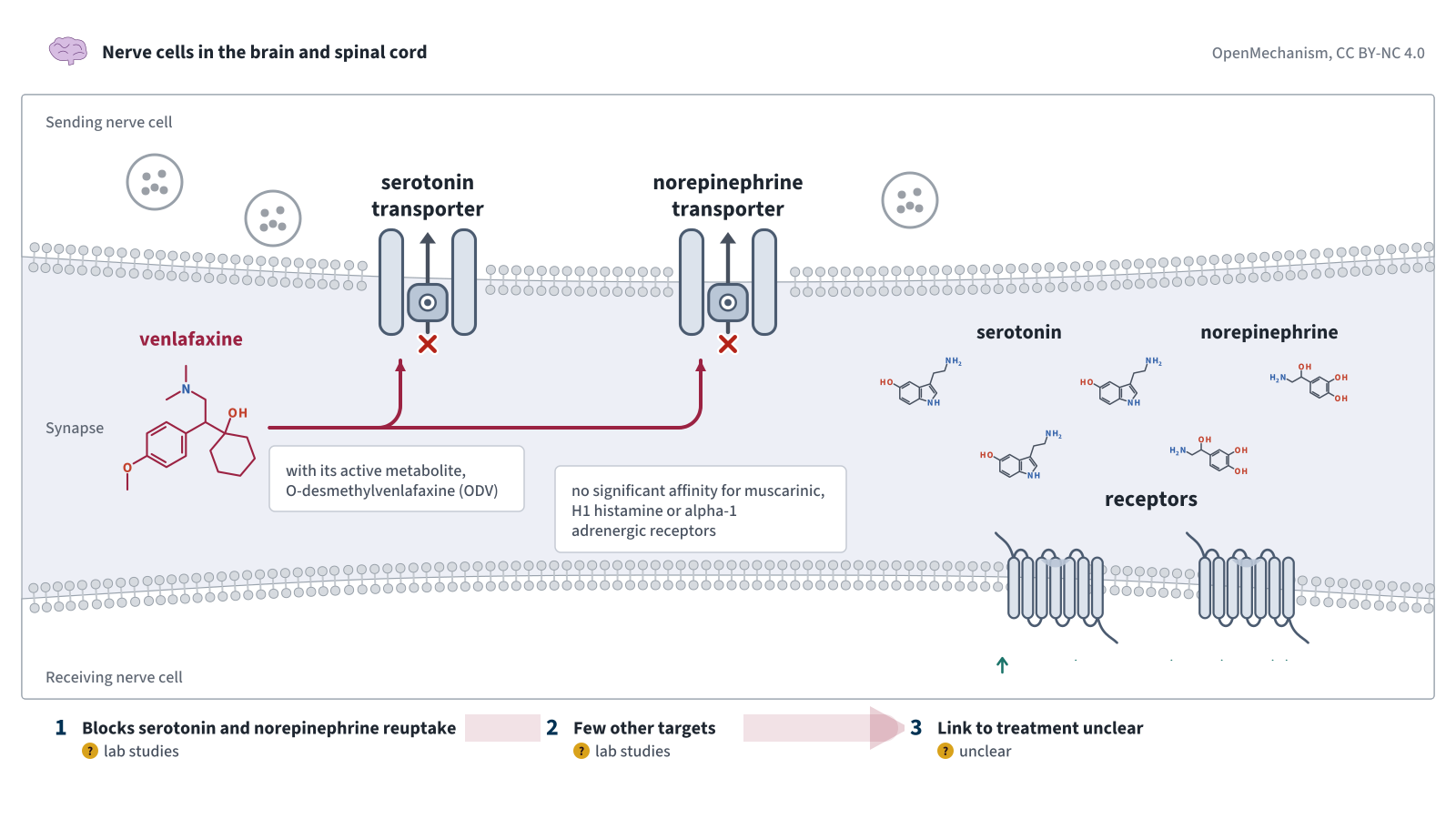
Blocks serotonin and norepinephrine reuptake. In laboratory studies, venlafaxine and its active metabolite, O-desmethylvenlafaxine (), are potent and selective inhibitors of the reuptake of serotonin and norepinephrine by nerve cells, and weak inhibitors of dopamine reuptake.1
Few other targets. Venlafaxine and ODV have no significant for muscarinic, or receptors in the laboratory, and they do not inhibit . The label says activity at those receptors is thought to be linked to the anticholinergic, sedative and cardiovascular effects seen with other psychotropic medicines.1
Link to treatment unclear. The label says how venlafaxine works in major depressive disorder, generalized anxiety disorder, social anxiety disorder and panic disorder is unclear; it is thought to relate to stronger serotonin and norepinephrine activity in the central nervous system, from blocking their reuptake.1
For teachers: download this drawing.
See also
Condition pages: anxiety disorders and depression.
Other serotonin reuptake inhibitors (SSRIs and related): amitriptyline, citalopram, desvenlafaxine, duloxetine, escitalopram, fluoxetine, nortriptyline, paroxetine and 2 more.
Body system: brain & nerves.
Sources
- 1Effexor XR (venlafaxine hydrochloride) extended-release capsules: FDA label1 Indications and Usage; 12.1 Mechanism of Action; 12.2 Pharmacodynamics
- 2ChEMBL CHEMBL637Target and action classification: Norepinephrine transporter inhibitor; Serotonin transporter inhibitor; Unknown
- 3Estimates of serotonin and norepinephrine transporter inhibition in depressed patients treated with paroxetine or venlafaxineOwens MJ et al. Neuropsychopharmacology 2008 (abstract)
- 4A randomized, placebo-controlled, dose-response trial of venlafaxine hydrochloride in the treatment of major depressionRudolph RL et al. J Clin Psychiatry 1998 (abstract)
- 5Serotonin transporter occupancy of five selective serotonin reuptake inhibitors at different doses: an [11C]DASB positron emission tomography studyMeyer JH et al. Am J Psychiatry 2004 (abstract)
Spotted a mistake? Report an error (hello@openmechanism.com). Since launch, every published error we fix is listed on the corrections page.
Notes and limits
- A schematic teaching drawing: not to scale, not exact structures, binding poses or a complete pathway, and not a guide to dosing, treatment or how a person will respond.
- The steps are in the order that explains them; one step is said to cause the next only where the source says so.
- The label says the mechanism of action of venlafaxine in major depressive disorder, generalized anxiety disorder, social anxiety disorder and panic disorder is unclear.
All recorded limits are on the evidence page, and notes that apply to every page are on How to read a page. Version 1.0.1, medically reviewed by Daniel Tran, PharmD, on 6 November 2026.
Cite this page
Tran D. Venlafaxine [Internet]. OpenMechanism; 2026 [updated 2026 Nov 6; cited 2026 Nov 6]. Available from: https://openmechanism.com/medicines/venlafaxine