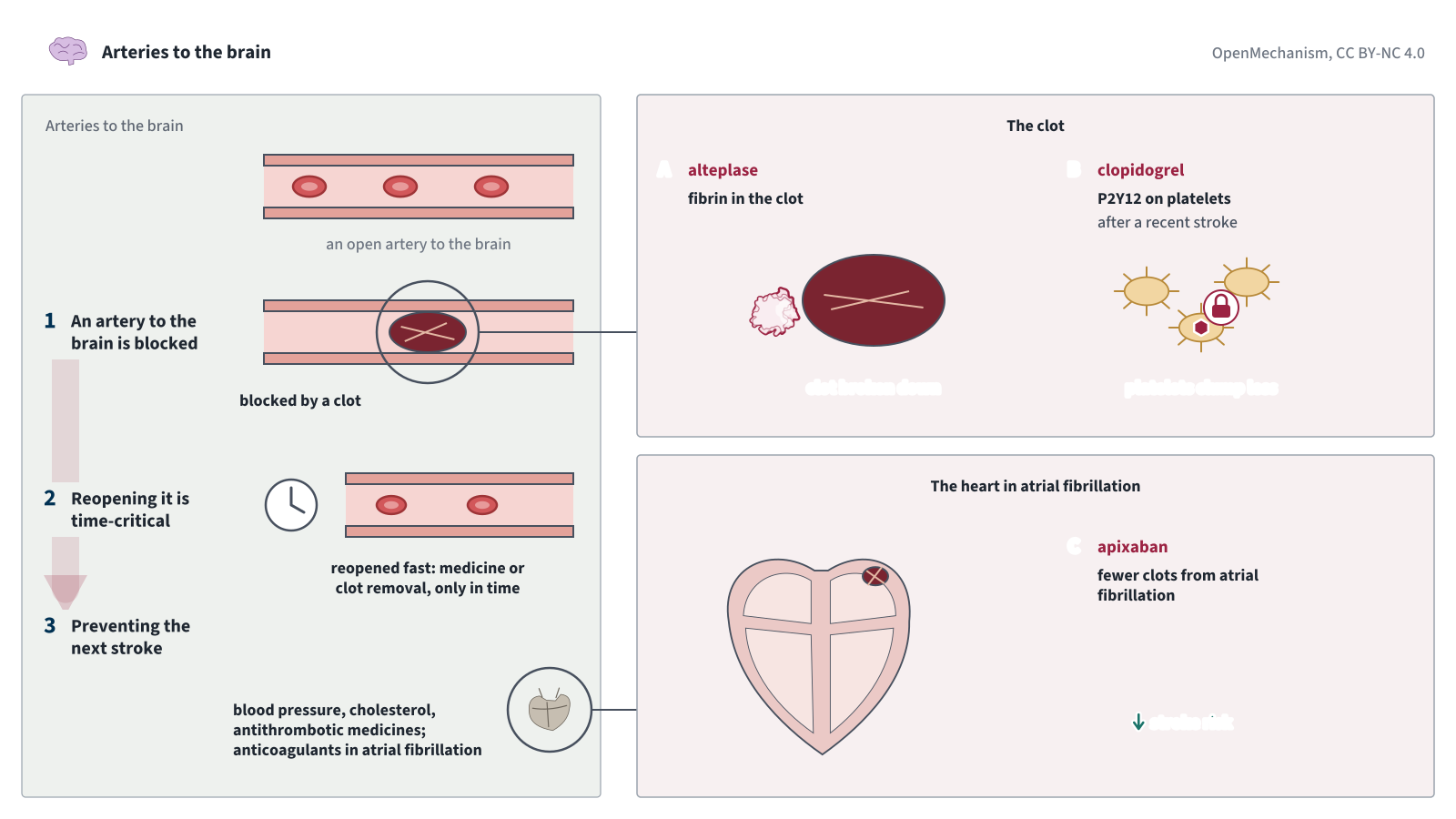
Most strokes are ischemic: an artery to the brain is blocked. Treatment aims to reopen it fast, with a clot-dissolving medicine or a procedure that removes the clot; both reduce disability but are time-critical. Preventing another stroke includes controlling blood pressure and cholesterol and using antithrombotic medicines, with for atrial fibrillation.
What goes wrong in ischemic stroke, and where medicines act. Schematic, not to scale. Alteplase outline from the catalytic domain of tPA. License CC BY-NC 4.0.
Reopening it is time-critical. Treatment aims to reopen the artery fast with clot-dissolving medicine or a clot-removing procedure; both reduce disability but only in time. A 2019 review found the medicine reduces disability when given within 4.5 hours of stroke onset, and also helps some people up to 9 hours, when brain scans show tissue that can still be saved.1
What the source says
“Management focuses on rapid reperfusion with intravenous thrombolysis and endovascular thrombectomy, which both reduce disability but are time-critical.”
“Thrombolysis also benefits selected patients with evidence from perfusion imaging of salvageable brain tissue for up to 9 h and in patients who awake with stroke symptoms.”
Preventing the next stroke. Prevention includes blood pressure control, cholesterol management and antithrombotic medicines, with anticoagulation for atrial fibrillation.1
What the source says
“Secondary prevention of ischaemic stroke shares many common elements with cardiovascular risk management in other fields, including blood pressure control, cholesterol management and antithrombotic medications.”
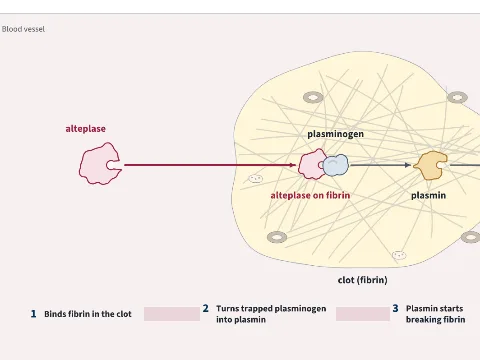
Alteplase binds fibrin in the clot and turns the plasminogen trapped there into plasmin, which breaks the clot down; its label lists acute ischemic stroke, after bleeding inside the skull has been ruled out as the main cause of the symptoms, with treatment started as soon as possible but within 3 hours of symptom onset.2
What the source says
“alteplase binds to fibrin in a thrombus and converts the entrapped plasminogen to plasmin.”
“Exclude intracranial hemorrhage as the primary cause of stroke signs and symptoms prior to initiation of treatment [see Contraindications (4.1) ] . Initiate treatment as soon as possible but within 3 hours after symptom onset.”
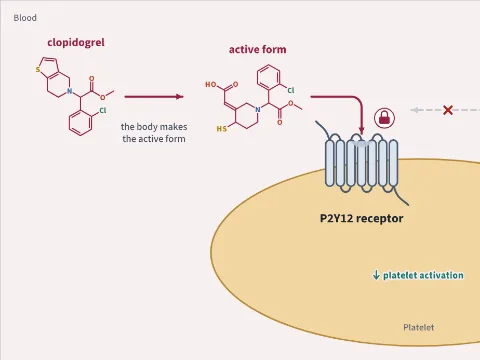
Clopidogrel's active form binds the receptors on platelets for good, so they activate and clump less; after a recent stroke it lowers the rate of heart attack and stroke.3
What the source says
“Clopidogrel is an inhibitor of platelet activation and aggregation through the irreversible binding of its active metabolite to the P2Y 12 class of ADP receptors on platelets.”
“In patients with established peripheral arterial disease or with a history of recent myocardial infarction (MI) or recent stroke Plavix is indicated to reduce the rate of MI and stroke.”
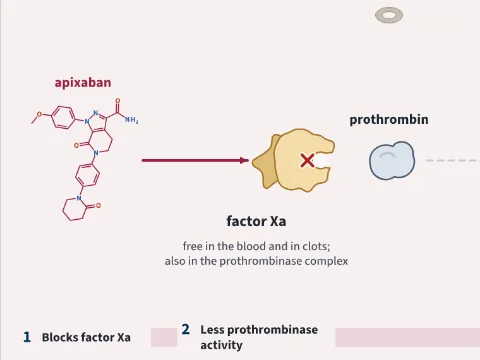
Apixaban blocks , so less thrombin is made and clots develop less readily; it reduces the risk of stroke in adults with nonvalvular atrial fibrillation. A 2005 review says people with atrial fibrillation are at increased risk of a stroke caused by a clot that travels from the heart, and that most of these clots form in the left atrial appendage.4,5
What the source says
“By inhibiting FXa, apixaban decreases thrombin generation and thrombus development.”
“Patients with atrial fibrillation are at an increased risk of having a cardioembolic stroke. Most of the thrombi responsible for these ischemic events originate in the left atrial appendage.”
Also used for it: tenecteplase (“TNKase is indicated for the treatment of acute ischemic stroke (AIS) in adults.”6) and rivaroxaban (to lower the risk of stroke in adults with nonvalvular atrial fibrillation: “XARELTO is indicated to reduce the risk of stroke and systemic embolism in adult patients with nonvalvular atrial fibrillation.”7).
Claude Opus 5.5 (AI source check), 29 October 2026: 29 statements compared with their sources, 8 flagged for the reviewer. An automated check, not a medical review.
Conflict of interest
Apixaban: Pfizer, the reviewer's former employer, makes or markets this medicine. Atorvastatin: Pfizer, the reviewer's former employer, used to market this medicine as Lipitor. The label this site cites is from Viatris. Details
Next review due
29 April 2028
Cite this page
Tran D. Ischemic stroke [Internet]. OpenMechanism; 2026 [updated 2026 Oct 29; cited 2026 Oct 29]. Available from: https://openmechanism.com/conditions/ischemic-stroke