Tranylcypromine
Tranylcypromine irreversibly inhibits (MAO). Its label lists it for major depressive disorder in adults who have not responded adequately to other antidepressants, and says it is not for the initial treatment of major depressive disorder because of the potential for serious adverse reactions and drug interactions and the need for dietary restrictions. The label says how it works as an antidepressant is not fully understood, but is presumed to be linked to stronger monoamine neurotransmitter activity in the central nervous system. It is eliminated within a day, yet MAO activity takes up to 3 to 5 days to recover, and the label says MAO inhibition may persist up to 10 days after stopping.
- Acts on
- Monoamine oxidase (MAO)
- Where
- Nerve cells in the brain and spinal cord
- Medicine type
- Small molecule
- Used for
- Brain & nerves
- Drug class
- MAO inhibitors
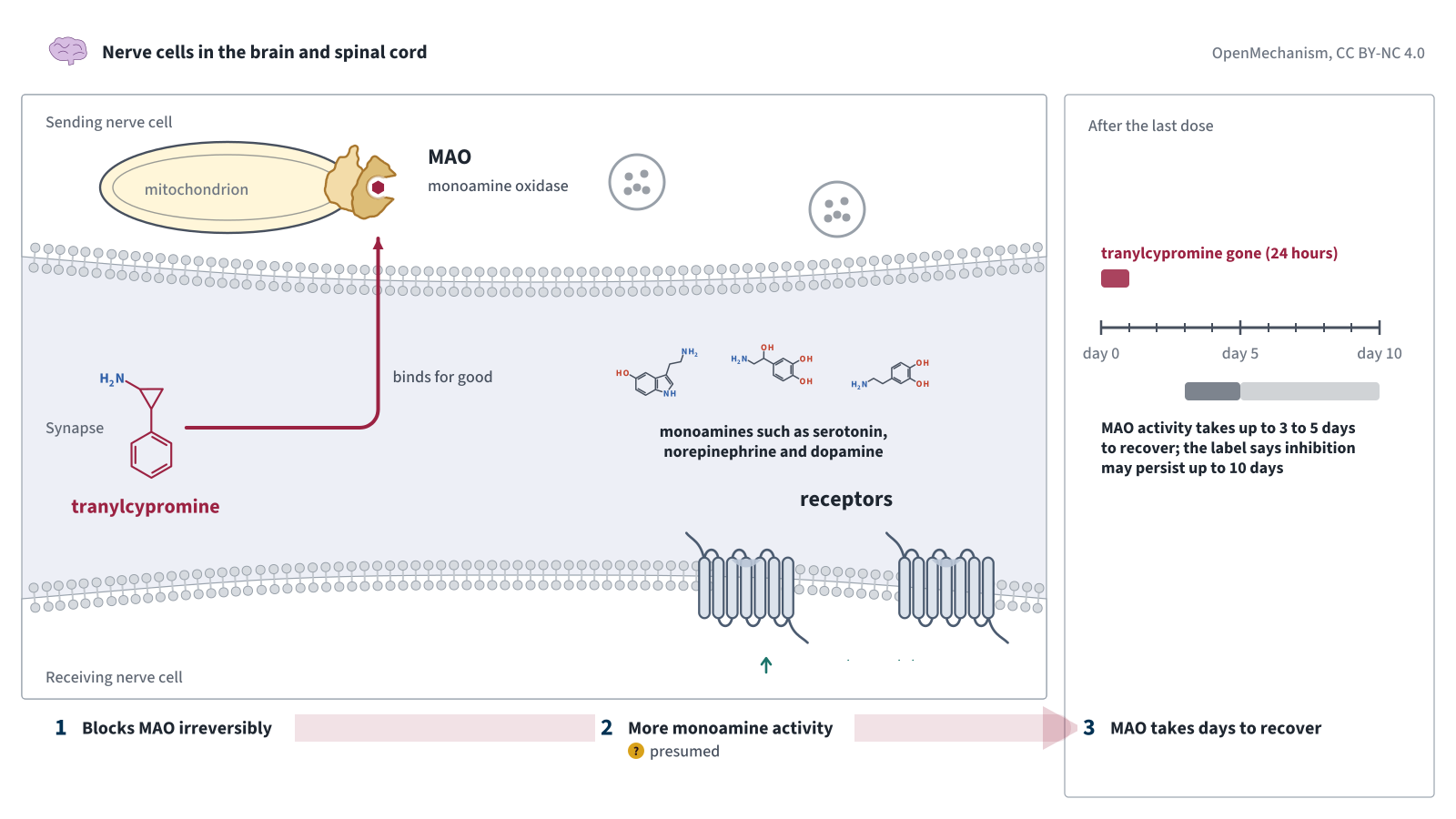
Step 2: presumed
The tranylcypromine label says: The mechanism of action of tranylcypromine sulfate tablets as an antidepressant is not fully understood, but is presumed to be linked to potentiation of monoamine neurotransmitter activity in the central nervous system (CNS) resulting from its irreversible inhibition of the enzyme monoamine oxidase (MAO).
Clinical study: In McGrath and colleagues' 2006 randomized, open-label trial (part of STAR*D), adult outpatients with nonpsychotic major depression who had not remitted, or had stopped because of side effects, in three earlier medicine trials took tranylcypromine (58 people) or extended-release venlafaxine plus mirtazapine (51); the trial measured remission, not how tranylcypromine works: Remission rates were not significantly different between the two treatment groups (6.9% for the tranylcypromine group and 13.7% for the venlafaxine plus mirtazapine group). The mean daily dose at exit for tranylcypromine was 36.9 mg (SD=18.5); for venlafaxine, 210.3 mg (SD=95.2); and for mirtazapine, 35.7 mg (SD=17.6). Tranylcypromine was associated with significantly less symptom reduction and greater attrition due to intolerance.
McGrath PJ et al., Am J Psychiatry 2006 (PMID 16946177)
Key terms in this drawing
- MAO
- Monoamine oxidase. Enzymes (MAO-A and MAO-B) that break down amines from food and messengers such as serotonin.
How it works
Blocks MAO irreversibly. Tranylcypromine is an irreversible inhibitor of the enzyme monoamine oxidase (MAO).1
More monoamine activity. The label says how it works as an antidepressant is not fully understood, but is presumed to be linked to the potentiation of monoamine neurotransmitter activity in the central nervous system that results from its block of MAO.1
MAO takes days to recover. Although tranylcypromine is eliminated within 24 hours, MAO activity takes up to 3 to 5 days to recover. The label adds that MAO inhibition may persist up to 10 days after the medicine is stopped.1
For teachers: download this drawing.
See also
Condition pages: depression.
Other MAO inhibitors: rasagiline.
Explained: MAO inhibitors and tyramine.
Related drawings: rasagiline (also blocks monoamine oxidase B for good).
Body system: brain & nerves.
Sources
- 1Tranylcypromine sulfate tablets (Actavis): FDA label1 Indications and Usage; 5.9 Risk of Clinically Significant Adverse Reactions due to Persistence of MAO Inhibition after Discontinuation; 12.1 Mechanism of Action; 12.2 Pharmacodynamics; Boxed Warning
- 2ChEMBL CHEMBL3989843Target and action classification: Monoamine oxidase inhibitor
- 3Tranylcypromine versus venlafaxine plus mirtazapine following three failed antidepressant medication trials for depression: a STAR*D reportMcGrath PJ et al. Am J Psychiatry 2006 (abstract)
Also used for the drawing
The drawing names serotonin, norepinephrine and dopamine as examples of the monoamines MAO breaks down, and draws MAO on a mitochondrion, as this review describes it. The monoamine oxidase outline is traced from the crystal structure below.
- 4Human monoamine oxidase B with tranylcyprominePDB 2XFU; Bonivento, D. et al. J. Biol. Chem. 2010; 285:36849-36856
- 5Monoamine oxidase inactivation: from pathophysiology to therapeuticsBortolato M, Chen K, Shih JC. Adv Drug Deliv Rev 2008 (abstract)
Spotted a mistake? Report an error (hello@openmechanism.com). Since launch, every published error we fix is listed on the corrections page.
Notes and limits
- A schematic teaching drawing: not to scale, not exact structures, binding poses or a complete pathway, and not a guide to dosing, treatment or how a person will respond.
- The tranylcypromine label has a boxed warning: antidepressants increased the risk of suicidal thoughts and behaviors in pediatric and young adult patients in short-term studies, and too much food or drink with a high tyramine content, or certain other medicines, taken with tranylcypromine or after stopping it can bring on a hypertensive crisis.
- The label says how tranylcypromine works as an antidepressant is not fully understood, and that its link to stronger monoamine activity is presumed.
All recorded limits are on the evidence page, and notes that apply to every page are on How to read a page. Version 1.0.1, medically reviewed by Daniel Tran, PharmD, on 7 November 2026.
Cite this page
Tran D. Tranylcypromine [Internet]. OpenMechanism; 2026 [updated 2026 Nov 7; cited 2026 Nov 7]. Available from: https://openmechanism.com/medicines/tranylcypromine