Glaucoma
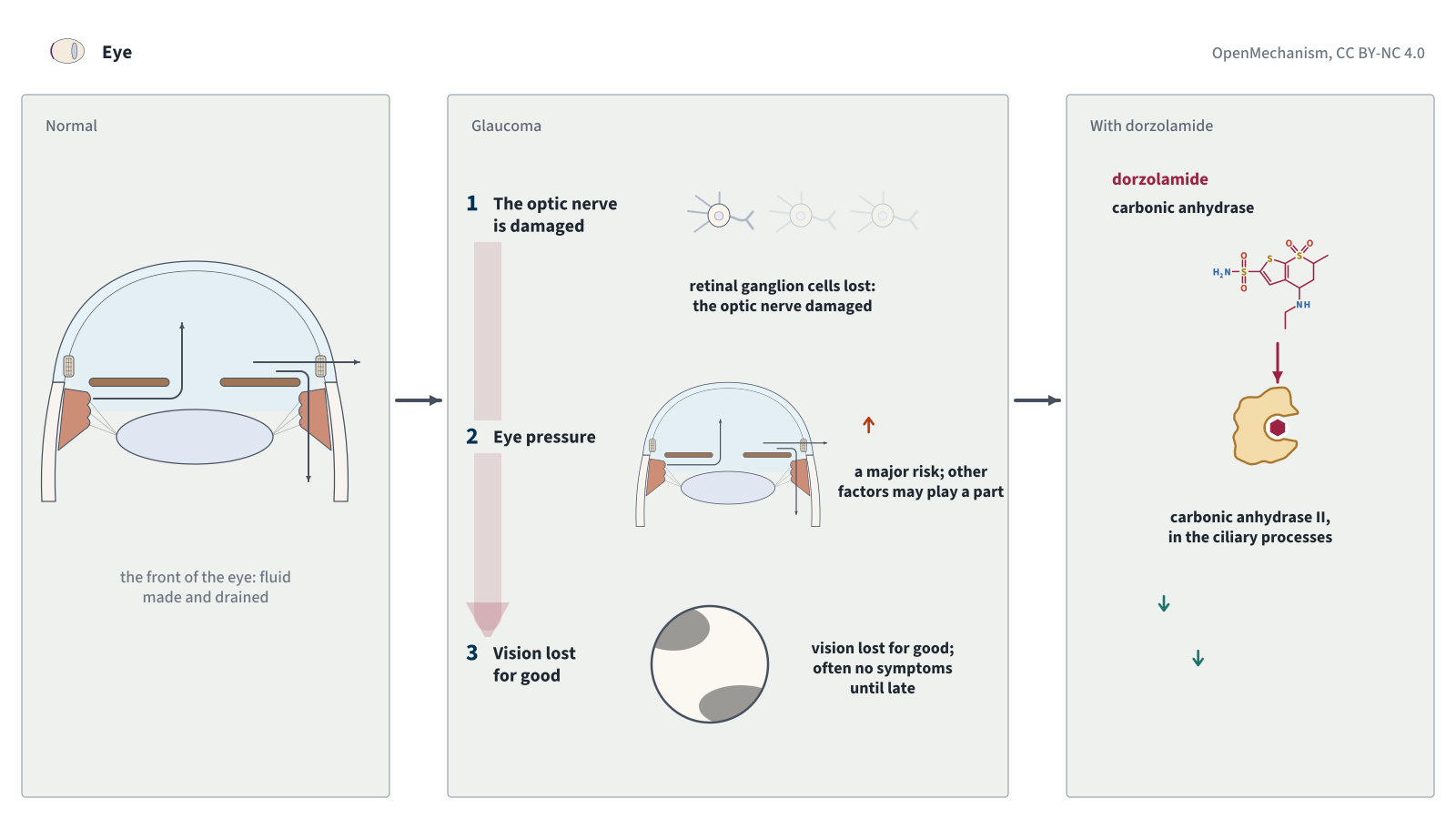
The glaucomas are progressive diseases of the optic nerve: retinal ganglion cells are lost. The loss is related to eye pressure, though other factors may play a part. Glaucoma is a leading cause of irreversible vision loss and may cause no symptoms until late. Dorzolamide blocks carbonic anhydrase in the eye, so less fluid is made and the pressure falls.
- Where
- Eye
- Body system
- Brain & nerves
- Medicines
- 1 medicine
For teachers: download this drawing.
What goes wrong
The optic nerve is damaged. The glaucomas are progressive diseases of the optic nerve, in which retinal ganglion cells are lost.1
What the source says
“The glaucomas are a group of progressive optic neuropathies characterized by degeneration of retinal ganglion cells and resulting changes in the optic nerve head.”
Source 1Eye pressure. The loss is related to the pressure inside the eye, though other factors may play a part; raised eye pressure is a major risk factor.1,2
Vision lost for good. Glaucoma is a leading cause of irreversible vision loss worldwide, and may cause no symptoms until late.1
Where medicines act
- A
Dorzolamide: less fluid made in the eye
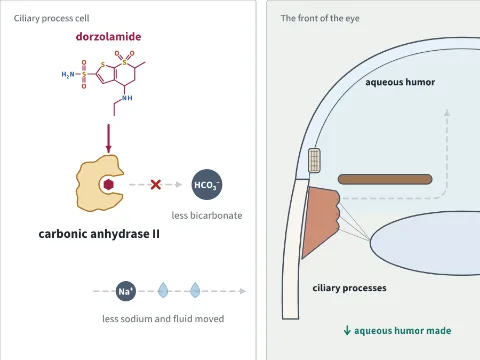
Dorzolamide blocks carbonic anhydrase in the eye's ciliary processes, so less aqueous humor is made and eye pressure falls. It treats raised eye pressure in open-angle glaucoma.2
What the source says
“Inhibition of carbonic anhydrase in the ciliary processes of the eye decreases aqueous humor secretion, presumably by slowing the formation of bicarbonate ions with subsequent reduction in sodium and fluid transport.”
Source 2“The result is a reduction in intraocular pressure (IOP).”
Source 2“Dorzolamide hydrochloride ophthalmic solution is indicated in the treatment of elevated intraocular pressure in patients with ocular hypertension or open-angle glaucoma.”
Source 2
See also
Body system: brain & nerves.
Zoom in: fluid and pressure in the eye.
Also used for it: pilocarpine (for high eye pressure in open-angle glaucoma or ocular hypertension: “The reduction of elevated intraocular pressure (IOP) in patients with open-angle glaucoma or ocular hypertension.”3).
Related medicines: latanoprost, timolol and brimonidine.
Side effects: why beta-blockers can tighten the airways.
Sources
- 1The pathophysiology and treatment of glaucoma: a reviewWeinreb RN et al. JAMA 2014 (abstract). Saved copy
- 2Dorzolamide hydrochloride ophthalmic solution: FDA label1 Indications and Usage; 12.1 Mechanism of Action. Saved copy
- 3Pilocarpine hydrochloride ophthalmic solution (Sandoz): FDA label1 Indications and Usage. Saved copy
- 4Human carbonic anhydrase II with dorzolamidePDB 4M2U; Pinard, M.A. et al. Bioorg.Med.Chem. 2013;21:7210-7215. The carbonic anhydrase outline in the drawing is traced from this structure. Saved copy
Notes and limits
- Lowering eye pressure is the only proven treatment, though factors other than pressure may play a part.1
Notes that apply to every page are on How to read a page.
Spotted a mistake? Report an error (hello@openmechanism.com). Since launch, every published error we fix is listed on the corrections page.
Cite this page
Tran D. Glaucoma [Internet]. OpenMechanism; 2026 [updated 2026 Oct 19; cited 2026 Oct 19]. Available from: https://openmechanism.com/conditions/glaucoma