Quetiapine
Quetiapine binds many receptors, most strongly , adrenergic α1b and serotonin , and dopamine D2 more weakly; its metabolite norquetiapine generally binds more strongly. Its label lists it for schizophrenia in adults and teenagers aged 13 to 17; for acute manic episodes of bipolar I disorder, alone from age 10 or with lithium or divalproex in adults; for acute depressive episodes of bipolar disorder, alone, in adults; and for maintenance treatment of bipolar I disorder in adults, with lithium or divalproex. The label says how it works in these uses is unclear, and that its effect could come from blocking D2 and receptors together.
- Acts on
- Many receptors, including dopamine D2 and serotonin 5-HT2A
- Where
- Nerve cells in the brain
- Medicine type
- Small molecule
- Used for
- Brain & nerves
- Drug class
- Antipsychotics
Also called Seroquel.
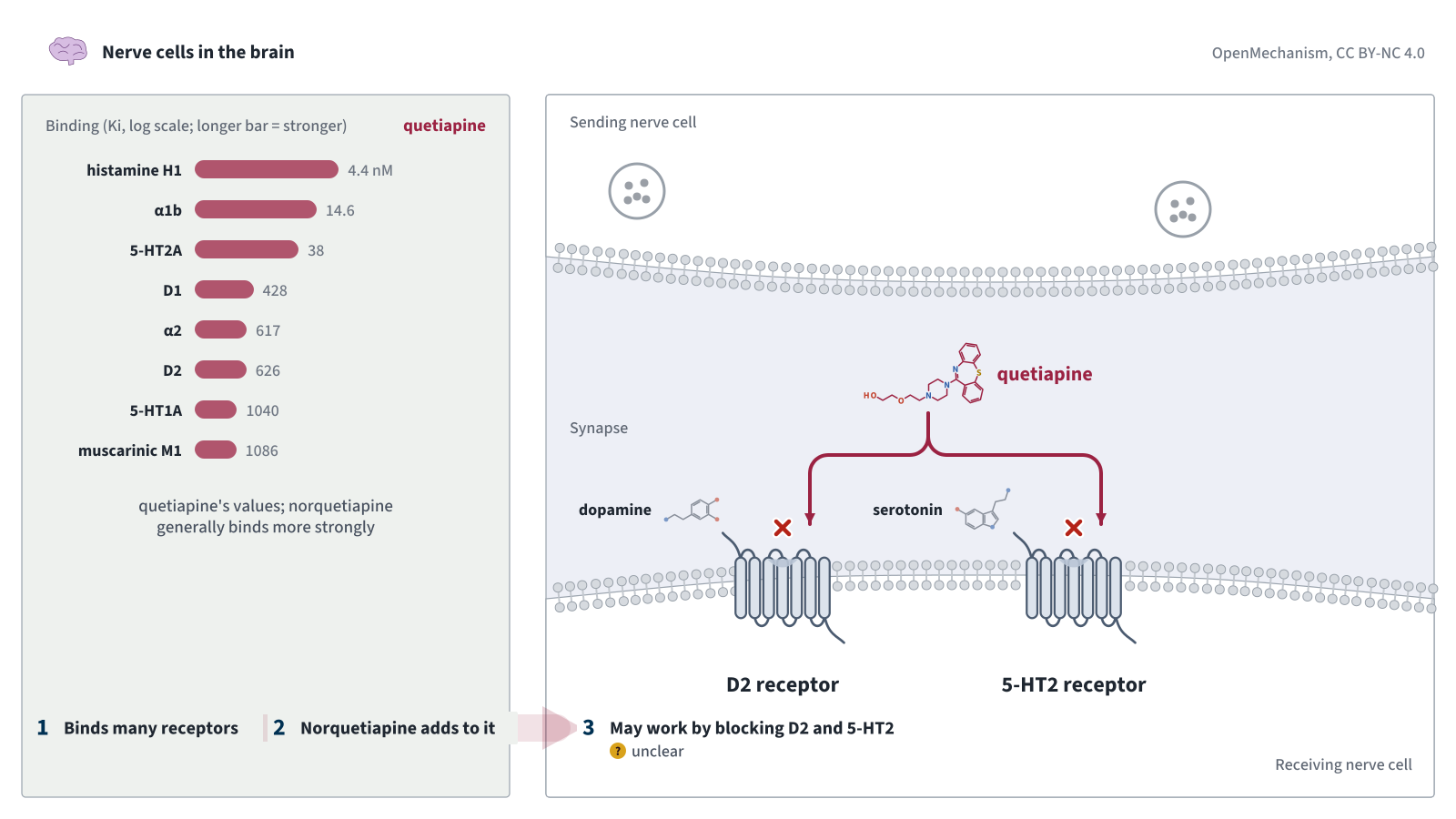
Step 3: unclear
The Seroquel label says: The mechanism of action of quetiapine in the listed indications is unclear. However, the efficacy of quetiapine in these indications could be mediated through a combination of dopamine type 2 (D 2 ) and serotonin type 2 (5HT 2 ) antagonism.
Clinical study: In Arvanitis and Miller's 1997 randomized, double-blind trial of five fixed doses of quetiapine (75 to 750 mg a day), haloperidol (12 mg a day) or placebo for 6 weeks, in people with an acute worsening of chronic schizophrenia (361 entered); the trial measured symptom ratings, not how quetiapine works: Quetiapine is well tolerated and clinically effective in the treatment of schizophrenia. It is both superior to placebo and comparable to haloperidol in reducing positive symptoms at doses ranging from 150 to 750 mg/day and in reducing negative symptoms at a dose of 300 mg/day.
Arvanitis LA, Miller BG, Biol Psychiatry 1997 (PMID 9270900)
Key terms in this drawing (6)
- 5-HT receptors
- Serotonin (5-hydroxytryptamine, 5-HT) receptors. Receptors that serotonin acts on; they come in several subtypes, such as 5-HT1A and 5-HT2A.
- 5-HT1A receptor
- Serotonin 1A receptor. One of the serotonin receptors; in lab studies, buspirone binds it strongly.
- 5-HT2A receptor
- Serotonin 2A receptor. One of the serotonin receptors; olanzapine binds it strongly.
- D2 receptor
- Dopamine D2 receptor. A dopamine receptor; in Parkinson disease, ropinirole's effect is thought to be related to its ability to stimulate D2 receptors in the caudate-putamen of the brain.
- H1 receptor
- Histamine H1 receptor. A histamine receptor; medicines that block it (antihistamines) treat allergies and often make people sleepy.
- muscarinic receptors
- Muscarinic receptors (M1 to M5). The receptors that antimuscarinic (anticholinergic) medicines block; they come in five subtypes, M1 to M5.
How it works
Binds many receptors. Quetiapine and its metabolite norquetiapine bind many messenger receptors; quetiapine binds most strongly to histamine H1, adrenergic α1b and serotonin 5-HT2A receptors, and more weakly to dopamine D2. They lack appreciable for benzodiazepine receptors.1
Norquetiapine adds to it. Its active metabolite, norquetiapine, generally binds more strongly than quetiapine; it has similar activity at D2 but greater activity at 5-HT2A receptors. The label adds that, in adults, quetiapine's activity is mainly due to quetiapine itself.1
May work by blocking D2 and 5-HT2. The label says how quetiapine works in the uses it lists is unclear, and that its effect could come from a combination of blocking dopamine D2 and serotonin 5-HT2 receptors.1
For teachers: download this drawing.
See also
Condition pages: bipolar disorder and schizophrenia.
Other antipsychotics: aripiprazole, clozapine, haloperidol, olanzapine, risperidone and ziprasidone.
Body system: brain & nerves.
Sources
- 1Seroquel (quetiapine): FDA label1 Indications and Usage; 12.1 Mechanism of Action; 12.2 Pharmacodynamics; 12.3 Pharmacokinetics
- 2ChEMBL CHEMBL716Target and action classification: Dopamine D2 receptor antagonist; Serotonin 2a (5-HT2a) receptor antagonist; Serotonin 2c (5-HT2c) receptor antagonist
- 3Multiple fixed doses of "Seroquel" (quetiapine) in patients with acute exacerbation of schizophrenia: a comparison with haloperidol and placebo. The Seroquel Trial 13 Study GroupArvanitis LA, Miller BG. Biol Psychiatry 1997 (abstract)
Also used for the drawing
The drawing places quetiapine's binding in the brain. The Seroquel label names the neurotransmitter receptors it binds but not where they are; this PET study measured its binding at dopamine D2 receptors in the striatum and serotonin 5-HT2 receptors in the frontal cortex.
- 4Time course of central nervous dopamine-D2 and 5-HT2 receptor blockade and plasma drug concentrations after discontinuation of quetiapine (Seroquel) in patients with schizophreniaGefvert O et al., Psychopharmacology (Berl) 1998 (abstract)
Spotted a mistake? Report an error (hello@openmechanism.com). Since launch, every published error we fix is listed on the corrections page.
Notes and limits
- A schematic teaching drawing: not to scale, not exact structures, binding poses or a complete pathway, and not a guide to dosing, treatment or how a person will respond.
- The label says the mechanism of action of quetiapine in the listed indications is unclear, and that its efficacy could be mediated through a combination of D2 and 5HT2 antagonism.
All recorded limits are on the evidence page, and notes that apply to every page are on How to read a page. Version 1.0.1, medically reviewed by Daniel Tran, PharmD, on 3 November 2026.
Cite this page
Tran D. Quetiapine [Internet]. OpenMechanism; 2026 [updated 2026 Nov 3; cited 2026 Nov 3]. Available from: https://openmechanism.com/medicines/quetiapine