Cancer
How cells divide under control, how cancer cells escape it, and where cancer medicines act.
For teachers: download this drawing.
Key terms in this drawing (8)
- BCR-ABL
- BCR-ABL fusion protein. An always-on enzyme made from a joined gene, found in some leukemia cells.
- CML
- Chronic myeloid leukemia. A blood cancer marked by the Philadelphia chromosome, a rearrangement that joins two genes; the joined gene makes BCR-ABL, an always-on kinase.
- DNA
- Deoxyribonucleic acid. The molecule that stores genes.
- ligand
- Ligand. A molecule that binds a receptor; its binding can start signaling inside the cell that carries the receptor.
- microtubule
- Microtubule. A structure inside the cell, built from the protein tubulin, that the cell needs for dividing and for other vital work.
- PD-1
- Programmed cell death protein 1. A receptor on T cells that acts as a brake when PD-L1 or PD-L2 binds it.
- PD-L1
- Programmed death-ligand 1. One of the two PD-1 ligands (PD-L1 and PD-L2): it binds PD-1 on T cells and holds them back, and some tumors make more of it.
- T cell
- T lymphocyte. A white blood cell of the immune system.
How it works
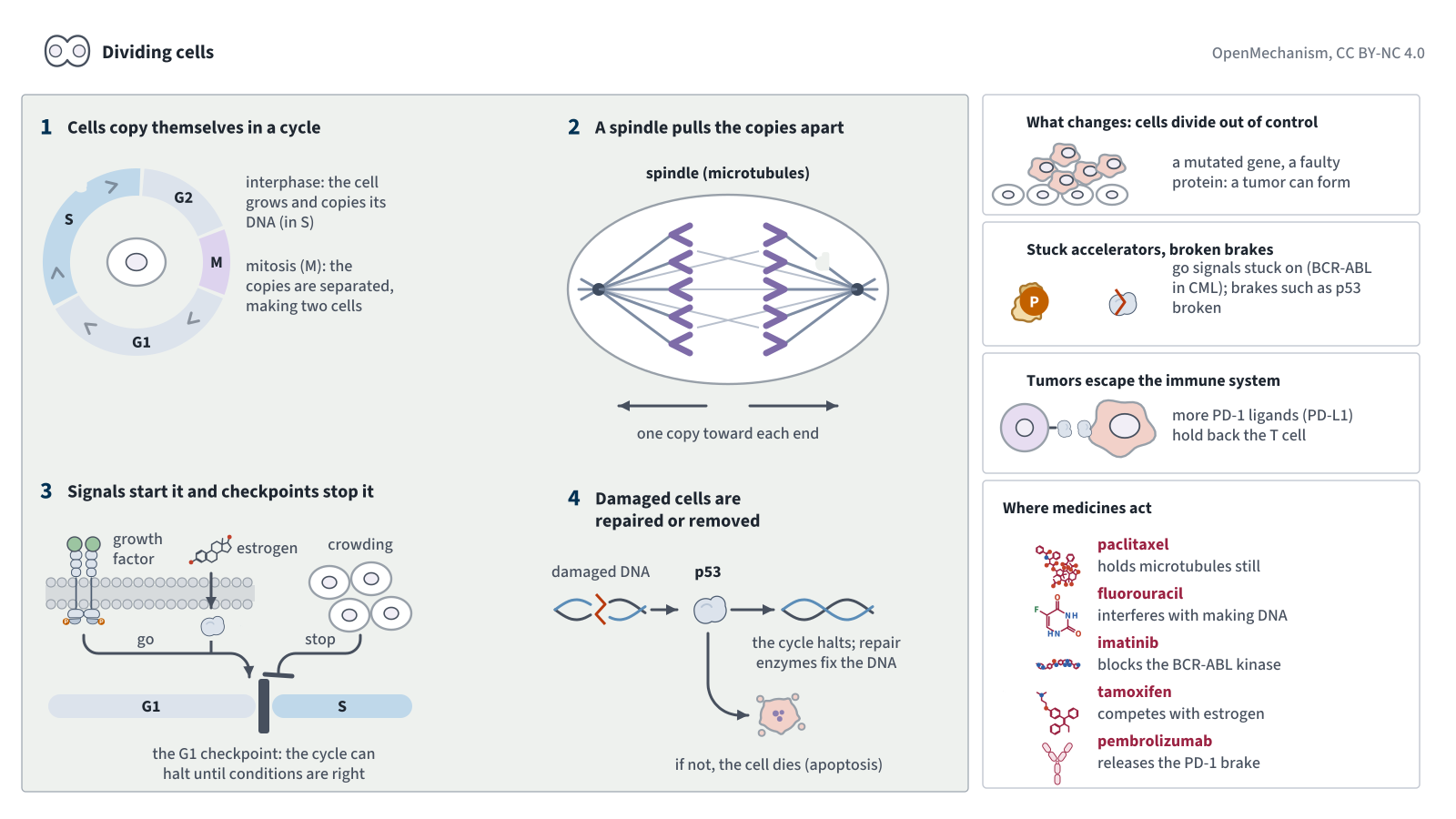
Cells copy themselves in a cycle. The cell cycle is an ordered series of growth and division that makes two new cells: in interphase the cell grows and copies its , and in the mitotic phase the copies are separated.1
What the source says
“The cell cycle is an ordered series of events involving cell growth and cell division that produces two new daughter cells.”
Source 1“During interphase, the cell grows and DNA is replicated.”
Source 1“During the mitotic phase, the replicated DNA and cytoplasmic contents are separated”
Source 1A spindle pulls the copies apart. In mitosis, a spindle of pulls each pair of copied chromosomes apart, one copy toward each end of the cell.1
What the source says
“The two centrosomes will give rise to the mitotic spindle, the apparatus that orchestrates the movement of chromosomes during mitosis.”
Source 1“the centrosomes begin to move to opposite poles of the cell”
Source 1“Microtubules that will form the mitotic spindle extend between the centrosomes, pushing them farther apart as the microtubule fibers lengthen.”
Source 1“Each chromatid, now called a single chromosome, is pulled rapidly toward the centrosome to which its microtubule is attached.”
Source 1Signals start it and checkpoints stop it. Signals such as growth factors help carry a cell past the G1 checkpoint, and crowding can stop division; at each checkpoint the cycle can be halted until conditions are right.2
What the source says
“External influences, such as growth factors, play a large role in carrying the cell past the G1 checkpoint.”
Source 2“Crowding of cells can also inhibit cell division.”
Source 2“A checkpoint is one of several points in the eukaryotic cell cycle at which the progression of a cell to the next stage in the cycle can be halted until conditions are favorable.”
Source 2Damaged cells are repaired or removed. If DNA is damaged, the protein p53 halts the cycle and calls in repair enzymes; if the DNA cannot be repaired, p53 can make the cell die (apoptosis).2
What changes in disease
Cells divide out of control. Cancer is many diseases with one common mechanism, uncontrolled cell growth. Each starts when a gene mutation makes a faulty protein with a key role in cell division, and a tumor can result.3
What the source says
“Cancer comprises many different diseases caused by a common mechanism: uncontrolled cell growth.”
Source 3“All cancers start when a gene mutation gives rise to a faulty protein that plays a key role in cell reproduction.”
Source 3“Uncontrolled growth of the mutated cells outpaces the growth of normal cells in the area, and a tumor (“-oma”) can result.”
Source 3Stuck accelerators, broken brakes. Altered genes called oncogenes speed up the cycle, and a cell with a mutated tumor suppressor, such as p53, might not be able to halt it. Mutated p53 genes have been found in more than half of human tumor cells.3
What the source says
“An oncogene is any gene that, when altered, leads to an increase in the rate of cell-cycle progression.”
Source 3“The collective function of the best-understood tumor suppressor gene proteins, Rb, p53, and p21, is to put up a roadblock to cell-cycle progression until certain events are completed.”
Source 3“A cell that carries a mutated form of a negative regulator might not be able to halt the cell cycle if there is a problem.”
Source 3“Mutated p53 genes have been identified in more than 50 percent of all human tumor cells.”
Source 3Tumors escape the immune system. The immune system can recognize and destroy cancer cells, but cancer remains a common cause of death. Some tumors make more of the signals that bind , which can hold back the watching for them.4,5
What the source says
“It is known that the immune system can recognize and destroy cancerous cells”
Source 4“Despite these mechanisms for removing cancerous cells from the body, cancer remains a common cause of death.”
Source 4“Upregulation of PD-1 ligands occurs in some tumors and signaling through this pathway can contribute to inhibition of active T-cell immune surveillance of tumors.”
Source 5
Where medicines act
- d
Paclitaxel
Stabilizes microtubules, stopping the reorganization that dividing cells need.
- e
Fluorouracil
Interferes with making DNA, which affects rapidly growing cells.
- f
Imatinib
Blocks BCR-ABL, the abnormal, always-active kinase made by the Philadelphia chromosome in CML.
- g
Tamoxifen
Competes with estrogen for its receptor, which can lower estrogen-driven growth in breast tissue.
- h
Pembrolizumab
Binds PD-1 on T cells, releasing a brake on the immune response, including against the tumor.
See also
Zoom in: immune attack on a tumor and the cell cycle.
Body systems: immune system.
Conditions
- Acute lymphoblastic leukemia
- Acute myeloid leukemia
- Anemia from cancer treatment
- B-cell lymphomas
- Bladder bleeding from chemotherapy (hemorrhagic cystitis)
- Bladder cancer
- Breast cancer
- Cervical cancer
- Chemotherapy nausea and vomiting
- Chronic lymphocytic leukemia
- Chronic myeloid leukemia
- Colorectal cancer
- Cutaneous T-cell lymphoma
- Endometrial cancer
- Gastrointestinal stromal tumors (GIST)
- Head and neck cancer
- High calcium from cancer
- Hodgkin lymphoma
- Kaposi sarcoma
- Kidney cancer
- Melanoma
- Multiple myeloma
- Myelodysplastic syndromes (MDS)
- Neuroblastoma
- Non-small cell lung cancer
- Osteosarcoma
- Ovarian cancer
- Pancreatic cancer
- Pheochromocytoma and paraganglioma
- Prostate cancer
- Small cell lung cancer
- Stomach cancer
- Testicular cancer
- Tumor lysis syndrome
- Von Hippel-Lindau disease
More medicines for this area
- Abiraterone acetate
- Anastrozole
- Belzutifan
- Bevacizumab
- Bleomycin
- Blinatumomab
- Bortezomib
- Brentuximab vedotin
- Cisplatin
- Cyclophosphamide
- Cytarabine
- Doxorubicin
- Enzalutamide
- Etoposide
- Fulvestrant
- Gemcitabine
- Hydroxyurea
- Iobenguane I131
- Ipilimumab
- Irinotecan
- Lenalidomide
- Letrozole
- Leuprolide
- Loncastuximab tesirine
- Lurbinectedin
- Mercaptopurine
- Methotrexate
- Mifamurtide
- Olaparib
- Osimertinib
- Padeliporfin
- Pegaspargase
- Pertuzumab
- Rituximab
- Selinexor
- Talimogene laherparepvec
- Tisagenlecleucel
- Trastuzumab
- Trastuzumab deruxtecan
- Venetoclax
- Vincristine
- Vorinostat
Sources
- 1The cell cycleOpenStax Biology 2e, section 10.2 (CC BY-NC-SA 4.0). Saved copy
- 2Control of the cell cycleOpenStax Biology 2e, section 10.3 (CC BY-NC-SA 4.0). Saved copy
- 3Cancer and the cell cycleOpenStax Biology 2e, section 10.4 (CC BY-NC-SA 4.0). Saved copy
- 4Cancer immunobiology and immunotherapyOpenStax Microbiology, section 19.5 (CC BY-NC-SA 4.0). Saved copy
- 5Keytruda (pembrolizumab): FDA label12.1 Mechanism of Action. Saved copy
- 6Paclitaxel injection: FDA labelClinical Pharmacology. Saved copy
- 7Fluorouracil injection: FDA label12.1 Mechanism of Action. Saved copy
- 8Gleevec (imatinib): FDA label12.1 Mechanism of Action. Saved copy
- 9Soltamox (tamoxifen): FDA label12.1 Mechanism of Action. Saved copy
- 10Human ABL kinase domain with imatinibPDB 2HYY; Cowan-Jacob, S.W. et al. ACTA CRYSTALLOGR.,SECT.D 2007;63:80-93. The BCR-ABL outline in the drawing is traced from this structure. Saved copy
Notes and limits
Spotted a mistake? Report an error (hello@openmechanism.com). Since launch, every published error we fix is listed on the corrections page.
Cite this page
Tran D. Cancer [Internet]. OpenMechanism; 2026 [updated 2026 Nov 13; cited 2026 Nov 13]. Available from: https://openmechanism.com/body/cancer