Chronic myeloid leukemia
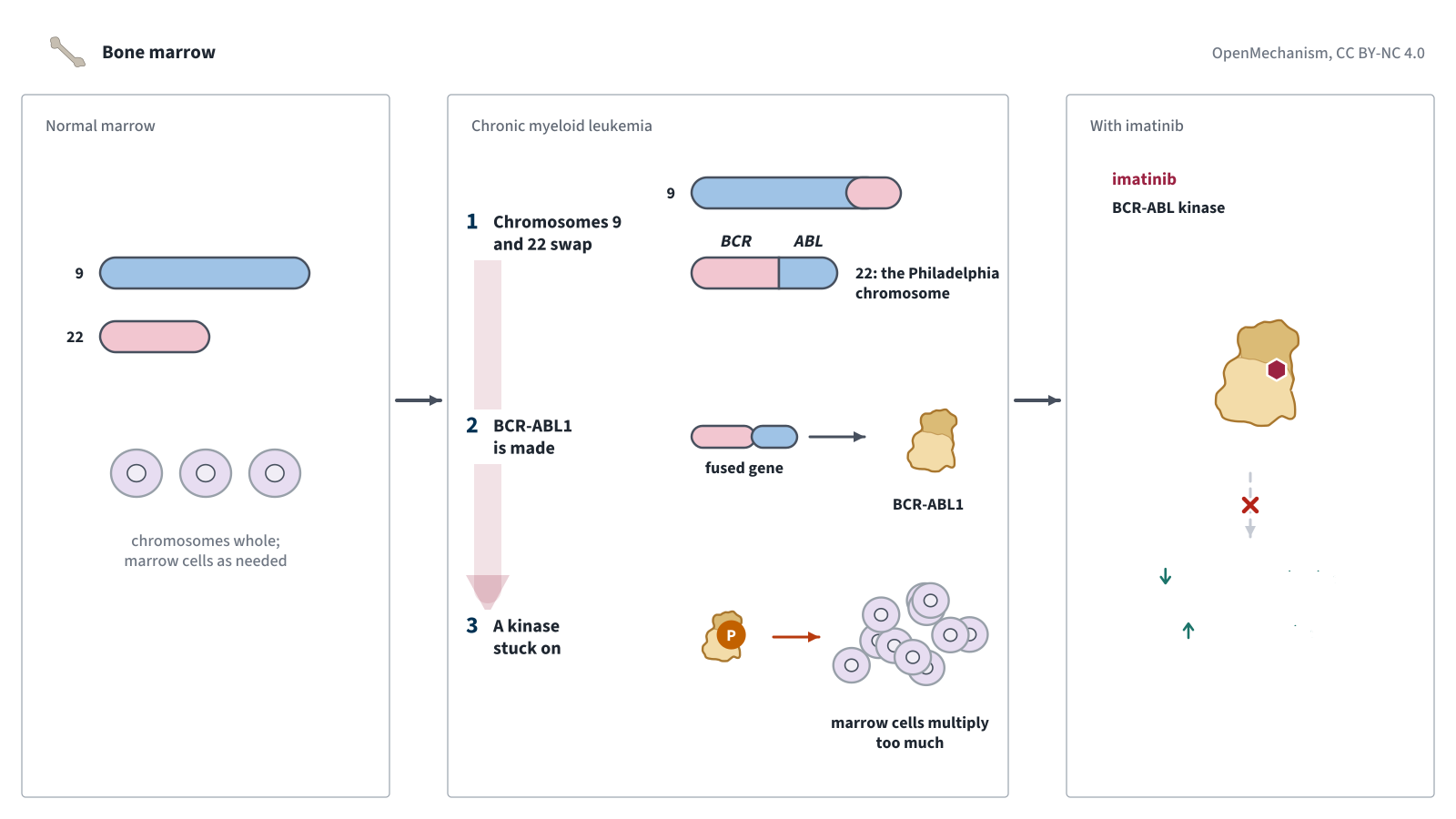
In chronic myeloid leukemia, pieces of chromosomes 9 and 22 swap places, forming the Philadelphia chromosome and fusing the ABL1 gene to BCR. The fused gene makes BCR-ABL1, a tyrosine kinase that is always switched on, and bone-marrow cells multiply too much. Imatinib blocks the BCR-ABL kinase.
- Where
- Bone marrow
- Body systems
- Cancer, Blood & clotting
- Medicines
- 1 medicine
For teachers: download this drawing.
Key terms in this drawing
- ABL
- Abelson gene (ABL1). A gene on chromosome 9; in chronic myeloid leukemia it is fused with BCR from chromosome 22, which makes the Philadelphia chromosome.
- BCR
- Breakpoint cluster region gene. A gene on chromosome 22; in chronic myeloid leukemia it is fused with ABL1 from chromosome 9, which makes the Philadelphia chromosome.
- BCR-ABL
- BCR-ABL fusion protein. An always-on enzyme made from a joined gene, found in some leukemia cells.
- CML
- Chronic myeloid leukemia. A blood cancer marked by the Philadelphia chromosome, a rearrangement that joins two genes; the joined gene makes BCR-ABL, an always-on kinase.
What goes wrong
Chromosomes 9 and 22 swap. Pieces of chromosomes 9 and 22 swap places, fusing the gene to the gene; this is the Philadelphia chromosome.1
What the source says
“CML is characterized by a balanced genetic translocation, t(9;22)(q34;q11.2), involving a fusion of the Abelson gene (ABL1) from chromosome 9q34 with the breakpoint cluster region (BCR) gene on chromosome 22q11.2. This rearrangement is known as the Philadelphia chromosome.”
Source 1BCR-ABL1 is made. The fused gene makes the cancer protein.1
What the source says
“The molecular consequence of this translocation is the generation of a BCR-ABL1 fusion oncogene, which in turn translates into a BCR-ABL1 oncoprotein.”
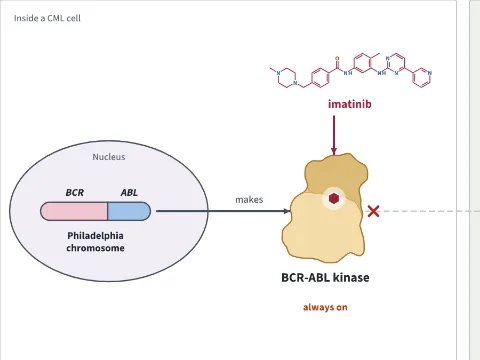
Source 1A kinase stuck on. BCR-ABL is a tyrosine kinase that is always on; is a cancer in which bone-marrow cells multiply too much.1,2
Where medicines act
- A
Imatinib: the BCR-ABL kinase blocked
Imatinib blocks the BCR-ABL tyrosine kinase; it stops BCR-ABL-positive leukemia cells multiplying and makes them die. It treats Philadelphia chromosome-positive CML.2
What the source says
“Imatinib mesylate is a protein-tyrosine kinase inhibitor that inhibits the BCR-ABL tyrosine kinase”
Source 2“Imatinib inhibits proliferation and induces apoptosis in BCR-ABL positive cell lines as well as fresh leukemic cells”
Source 2“Newly diagnosed adult and pediatric patients with Philadelphia chromosome positive chronic myeloid leukemia (Ph+ CML) in chronic phase.”
Source 2
See also
Body systems: cancer and blood & clotting.
Also used for it: cyclophosphamide (“Cyclophosphamide Tablets is indicated for the treatment of: … chronic granulocytic leukemia (it is usually ineffective in acute blastic crisis)”3), cytarabine (for the blast phase: “It has also been found useful in the treatment of acute lymphocytic leukemia and the blast phase of chronic myelocytic leukemia.”4) and hydroxyurea (for resistant chronic myeloid leukemia: “HYDREA is indicated for the treatment of: … Resistant chronic myeloid leukemia.”5).
Other conditions: acute lymphoblastic leukemia, acute myeloid leukemia, chronic lymphocytic leukemia, Hodgkin lymphoma, multiple myeloma and B-cell lymphomas.
Sources
- 1Chronic myeloid leukemia: 2018 update on diagnosis, therapy and monitoringJabbour E, Kantarjian H. Am J Hematol 2018 (abstract). Saved copy
- 2Gleevec (imatinib): FDA label1 Indications and Usage; 12.1 Mechanism of Action. Saved copy
- 3Cyclophosphamide tablets (Baxter): FDA label1 Indications and Usage. Saved copy
- 4Cytarabine injection (Meitheal): FDA labelIndications and Usage. Saved copy
- 5Hydrea (hydroxyurea): FDA labelIndications and Usage. Saved copy
- 6Human ABL kinase domain with imatinibPDB 2HYY; Cowan-Jacob, S.W. et al. ACTA CRYSTALLOGR.,SECT.D 2007;63:80-93. The BCR-ABL outline in the drawing is traced from this structure. Saved copy
Notes and limits
- In a 2018 review, a BCR-ABL1 change called T315I made the cancer resistant to all but one of the kinase blockers then available.1
Notes that apply to every page are on How to read a page.
Spotted a mistake? Report an error (hello@openmechanism.com). Since launch, every published error we fix is listed on the corrections page.
Cite this page
Tran D. Chronic myeloid leukemia [Internet]. OpenMechanism; 2026 [updated 2026 Oct 19; cited 2026 Oct 19]. Available from: https://openmechanism.com/conditions/chronic-myeloid-leukemia