Cutaneous T-cell lymphoma
Primary cutaneous T-cell lymphomas (CTCL) appear in the skin, with no sign of disease elsewhere when found. Some are slow, some very aggressive, and how they arise is not yet fully understood. Quality of life is lower and effective treatments are few. Vorinostat blocks histone deacetylases, opening chromatin; methotrexate treats mycosis fungoides; brentuximab vedotin carries a cell poison to CD30.
- Where
- Skin
- Body systems
- Cancer; Skin, hair & nails; Immune system
- Medicines
- 3 medicines
For teachers: download this drawing.
Key terms in this drawing
- CD30
- CD30. A receptor in the tumor necrosis factor receptor family, found on the surface of some lymphoma cells.
- DNA
- Deoxyribonucleic acid. The molecule that stores genes.
- microtubule
- Microtubule. A structure inside the cell, built from the protein tubulin, that the cell needs for dividing and for other vital work.
- T cell
- T lymphocyte. A white blood cell of the immune system.
What goes wrong
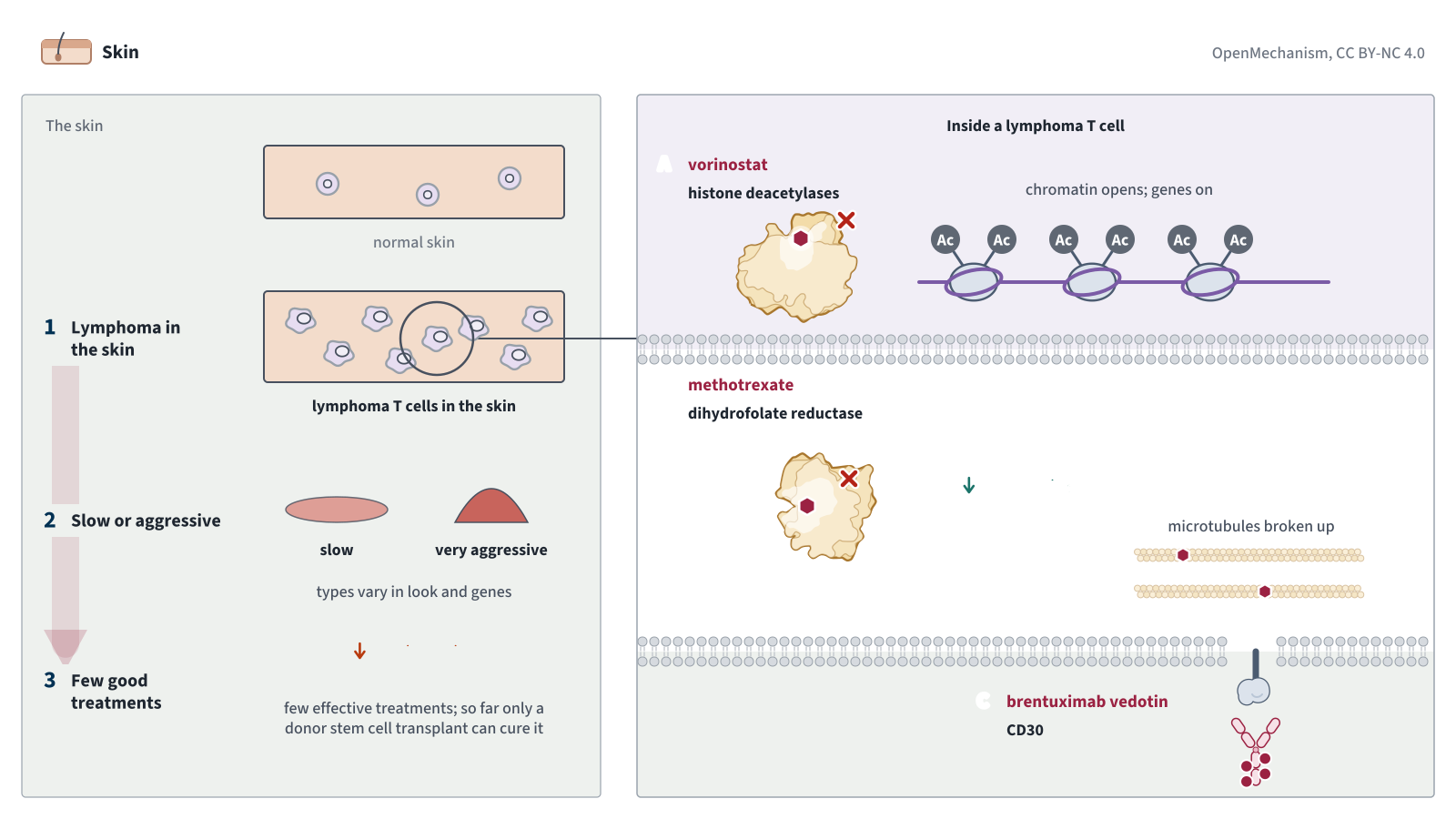
Lymphoma in the skin. Primary cutaneous T-cell lymphomas are lymphomas that appear in the skin, with no sign of disease elsewhere when found.1
What the source says
“Primary cutaneous T cell lymphomas (CTCLs) are a heterogeneous group of lymphomas that present in the skin with no evidence of extracutaneous disease at the time of diagnosis.”
Source 1Slow or aggressive. Their types vary in appearance and genes, and can follow a slow or a very aggressive course.1
What the source says
“CTCL subtypes demonstrate a variety of clinical, histological, and molecular features, and can follow an indolent or a very aggressive course.”
Source 1Few good treatments. People with CTCL have a lower quality of life and few effective treatments; so far only a stem cell transplant from a donor can cure it.1
Where medicines act
- A
Vorinostat: chromatin opened
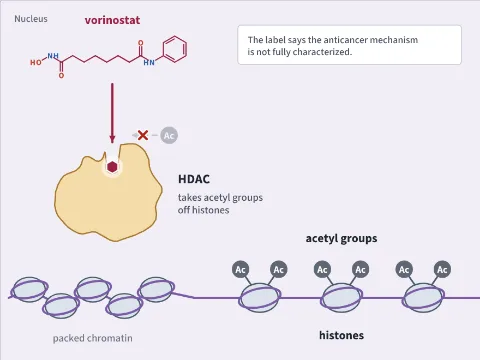
Vorinostat blocks histone deacetylases; acetyl groups build up on histones, chromatin opens and genes are switched on. In the lab it stalls the cell cycle or triggers apoptosis in some cancer cells. It treats the skin signs of CTCL that persists or returns after two systemic treatments.2
What the source says
“Vorinostat inhibits the enzymatic activity of histone deacetylases HDAC1, HDAC2 and HDAC3 (Class I) and HDAC6 (Class II)”
Source 2“Inhibition of HDAC activity allows for the accumulation of acetyl groups on the histone lysine residues resulting in an open chromatin structure and transcriptional activation.”
Source 2“vorinostat causes the accumulation of acetylated histones and induces cell cycle arrest and/or apoptosis of some transformed cells.”
Source 2“is indicated for the treatment of cutaneous manifestations in patients with cutaneous T-cell lymphoma who have progressive, persistent or recurrent disease on or following two systemic therapies.”
Source 2 - B
Methotrexate: a folate enzyme blocked
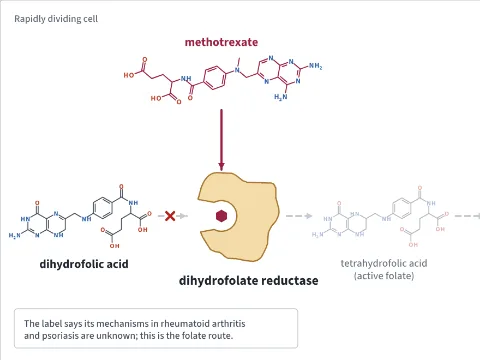
Methotrexate blocks dihydrofolate reductase, an enzyme cells need to make building blocks, so it interferes with DNA making and cell division. It treats mycosis fungoides, a cutaneous T-cell lymphoma, alone or with other chemotherapy.3
What the source says
“Methotrexate inhibits dihydrofolic acid reductase.”
Source 3“Dihydrofolates must be reduced to tetrahydrofolates by this enzyme before they can be utilized as carriers of one-carbon groups in the synthesis of purine nucleotides and thymidylate.”
Source 3“Therefore, methotrexate interferes with DNA synthesis, repair, and cellular replication.”
Source 3“treatment of adults with mycosis fungoides (cutaneous T-cell lymphoma) as a single agent or as part of a combination chemotherapy regimen”
Source 3 - C
Brentuximab vedotin: a poison delivered to CD30
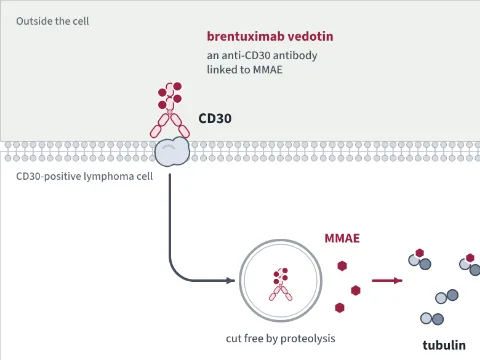
Brentuximab vedotin is an antibody against , found on some T-cell lymphomas, joined to a cell poison, , which breaks up so the cell dies. It treats primary cutaneous anaplastic large cell lymphoma and CD30-expressing mycosis fungoides after earlier treatment.4
What the source says
“CD30 is variably expressed in other T-cell lymphomas.”
Source 4“Brentuximab vedotin is an antibody-drug conjugate (ADC).”
Source 4“The antibody is a chimeric IgG1 directed against CD30. The small molecule, MMAE, is a microtubule-disrupting agent.”
Source 4“Binding of MMAE to tubulin disrupts the microtubule network within the cell, subsequently inducing cell cycle arrest and apoptotic death of the cells.”
Source 4“Adult patients with primary cutaneous anaplastic large cell lymphoma (pcALCL) or CD30-expressing mycosis fungoides (MF) who have received prior systemic therapy”
Source 4
See also
Body systems: cancer; skin, hair & nails; and immune system.
Also used for it: methylprednisolone (“Dermatologic diseases … mycosis fungoides”5), hydrocortisone (“Dermatologic diseases … mycosis fungoides”6), dexamethasone (“Dermatologic Diseases … Mycosis fungoides”7) and cyclophosphamide (“Cyclophosphamide Tablets is indicated for the treatment of: … mycosis fungoides (advanced disease)”8).
Other conditions: B-cell lymphomas, juvenile idiopathic arthritis, lupus nephritis, rheumatoid arthritis, acute lymphoblastic leukemia and pemphigus.
Sources
- 1Cutaneous T cell lymphomaDummer R et al. Nat Rev Dis Primers 2021 (abstract). Saved copy
- 2Zolinza (vorinostat): FDA label1 Indications and Usage; 12.1 Mechanism of Action. Saved copy
- 3Trexall (methotrexate): FDA label1 Indications and Usage; 12.1 Mechanism of Action. Saved copy
- 4Adcetris (brentuximab vedotin): FDA label1 Indications and Usage; 12.1 Mechanism of Action. Saved copy
- 5Solu-Medrol (methylprednisolone sodium succinate): FDA labelIndications and Usage. Saved copy
- 6Solu-Cortef (hydrocortisone sodium succinate): FDA labelIndications and Usage. Saved copy
- 7Dexamethasone sodium phosphate injection: FDA labelIndications and Usage. Saved copy
- 8Cyclophosphamide tablets (Baxter): FDA label1 Indications and Usage. Saved copy
- 9Human HDAC2 with vorinostatPDB 4LXZ; Lauffer, B.E. et al. J.Biol.Chem. 2013;288:26926-26943. The HDAC outline in the drawing is traced from this structure. Saved copy
- 10Dihydrofolate reductase (DHFR) with methotrexate and NADPHPDB 1U72; Cody, V. et al. Acta Crystallogr.,Sect.D 2005;61:147-155. The DHFR outline in the drawing is traced from this structure. Saved copy
Notes and limits
Notes that apply to every page are on How to read a page.
Spotted a mistake? Report an error (hello@openmechanism.com). Since launch, every published error we fix is listed on the corrections page.
Cite this page
Tran D. Cutaneous T-cell lymphoma [Internet]. OpenMechanism; 2026 [updated 2026 Oct 19; cited 2026 Oct 19]. Available from: https://openmechanism.com/conditions/cutaneous-t-cell-lymphoma