Hodgkin lymphoma
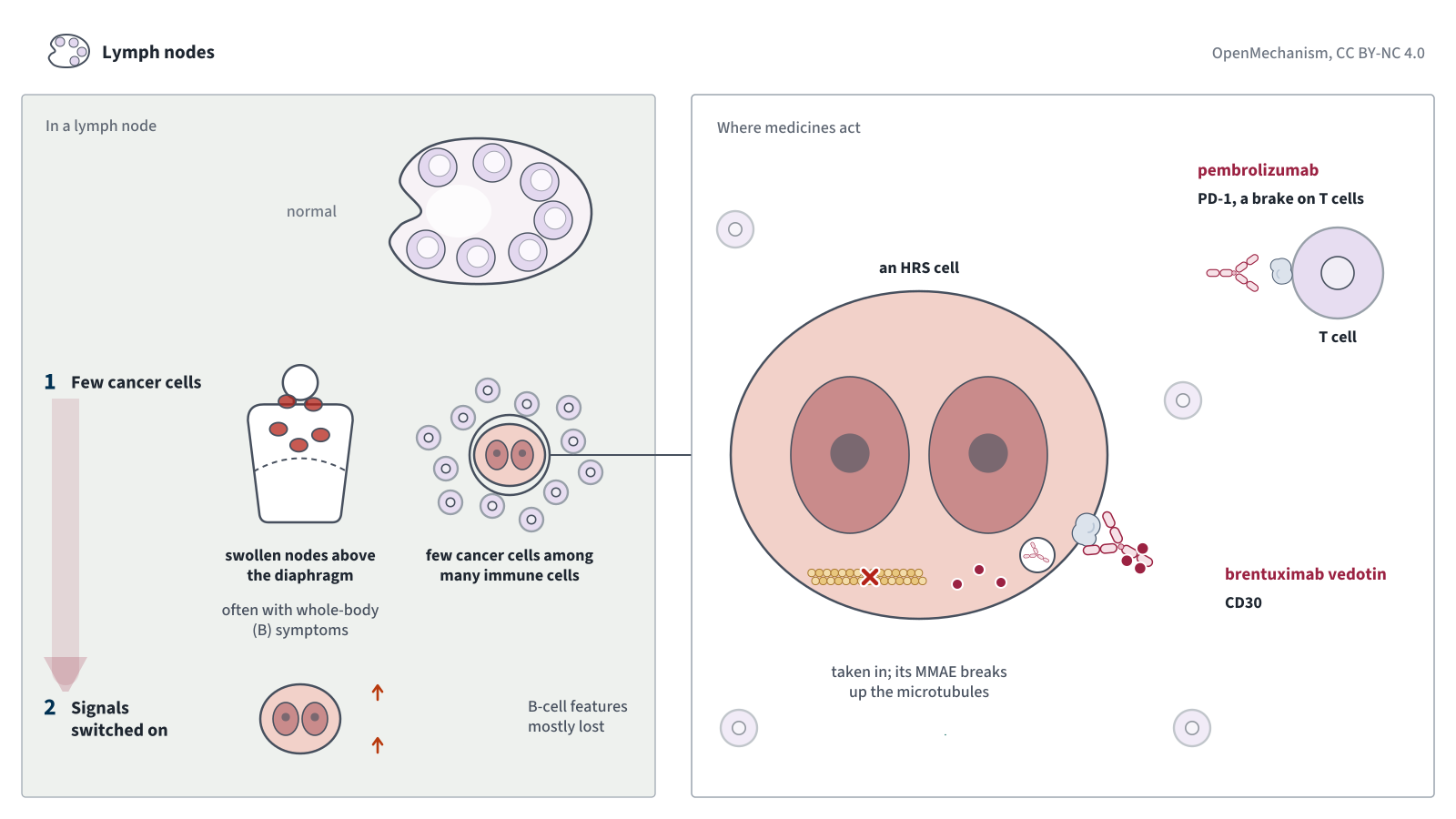
Hodgkin lymphoma is a B-cell cancer: its few cancer cells, Hodgkin and Reed-Sternberg cells, sit among many immune cells and have many signaling pathways switched on. It is most common in teenagers and young adults and highly curable even when advanced. Brentuximab vedotin carries a cell poison to CD30 on the cancer cells; pembrolizumab releases a brake on T cells.
- Where
- Lymph nodes
- Body systems
- Cancer, Blood & clotting, Immune system
- Medicines
- 2 medicines
For teachers: download this drawing.
Key terms in this drawing (8)
- CD30
- CD30. A receptor in the tumor necrosis factor receptor family, found on the surface of some lymphoma cells.
- HRS
- Hodgkin and Reed-Sternberg cells. The tumor cells of Hodgkin lymphoma; they are usually very rare in the tissue.
- JAK/STAT
- Janus kinase/signal transducer and activator of transcription pathway. A signaling pathway inside cells; mutations affecting it are frequent in Hodgkin lymphoma.
- microtubule
- Microtubule. A structure inside the cell, built from the protein tubulin, that the cell needs for dividing and for other vital work.
- MMAE
- MMAE. The small molecule carried by brentuximab vedotin; it disrupts microtubules.
- NF-κB
- Nuclear factor kappa B pathway. A signaling pathway inside cells; mutations affecting it are frequent in Hodgkin lymphoma.
- PD-1
- Programmed cell death protein 1. A receptor on T cells that acts as a brake when PD-L1 or PD-L2 binds it.
- T cell
- T lymphocyte. A white blood cell of the immune system.
What goes wrong
Few cancer cells. Hodgkin lymphoma is a B-cell cancer. Its cancer cells, the Hodgkin and Reed-Sternberg () cells, are few and sit among many immune cells. It shows as swollen lymph nodes above the diaphragm, often with whole-body symptoms (B symptoms).1,2,3
What the source says
“Hodgkin lymphoma (HL) is a B cell lymphoma characterized by few malignant cells and numerous immune effector cells in the tumour microenvironment.”
Source 1“In HL, the tumor cells--Hodgkin and Reed-Sternberg (HRS) cells--are usually very rare in the tissue.”
Source 2“Patients are commonly diagnosed with HL in their 20s and 30s, and they present with supradiaphragmatic lymphadenopathy, often with systemic B symptoms.”
Source 3Signals switched on. HRS cells come from mature B cells but have lost most B-cell features. Many signaling pathways are switched on, partly through the cells around them and partly through gene changes; changes affecting and are frequent.2
What the source says
“Although HRS cells are derived from mature B cells, they have largely lost their B cell phenotype”
Source 2“HRS cells show deregulated activation of multiple signaling pathways and transcription factors.”
Source 2“The activation of these pathways and factors is partly mediated through interactions of HRS cells with various other types of cells in the microenvironment, but also through genetic lesions.”
Source 2“mutations affecting the NF-κB and JAK/STAT pathways are frequent”
Source 2
Where medicines act
- A
Brentuximab vedotin: a poison delivered to CD30
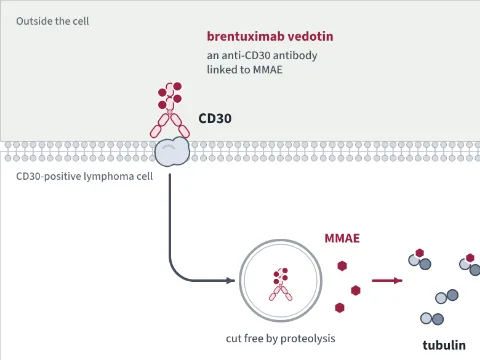
Brentuximab vedotin is an antibody joined to a cell poison, . It binds , which sits on the surface of HRS cells, is taken into the cell, and releases MMAE, which breaks up the cell's so the cell dies. It treats classical Hodgkin lymphoma, including untreated stage III or IV disease together with chemotherapy.4
What the source says
“CD30 is a member of the tumor necrosis factor receptor family and is expressed on the surface of sALCL cells and on Hodgkin Reed-Sternberg (HRS) cells in cHL.”
Source 4“Brentuximab vedotin is an antibody-drug conjugate (ADC).”
Source 4“Nonclinical data suggest that the anticancer activity of ADCETRIS is due to the binding of the ADC to CD30-expressing cells, followed by internalization of the ADC”
Source 4“Binding of MMAE to tubulin disrupts the microtubule network within the cell, subsequently inducing cell cycle arrest and apoptotic death of the cells.”
Source 4“Adult patients with previously untreated Stage III or IV classical Hodgkin lymphoma (cHL), in combination with doxorubicin, vinblastine, and dacarbazine”
Source 4 - B
Pembrolizumab: the PD-1 brake released
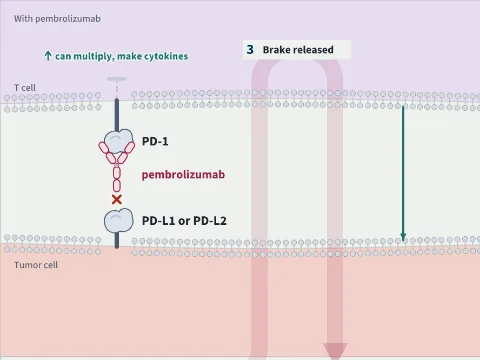
Pembrolizumab blocks , a brake on , and so releases the immune response against the cancer. It treats classical Hodgkin lymphoma that has come back or not responded, in adults and children.5
What the source says
“Binding of the PD-1 ligands, PD-L1 and PD-L2, to the PD-1 receptor found on T cells, inhibits T cell proliferation and cytokine production.”
Source 5“Pembrolizumab is a monoclonal antibody that binds to the PD-1 receptor and blocks its interaction with PD-L1 and PD-L2, releasing PD-1 pathway-mediated inhibition of the immune response, including the anti-tumor immune response.”
Source 5“KEYTRUDA is indicated for the treatment of adult patients with relapsed or refractory classical Hodgkin lymphoma (cHL).”
Source 5“KEYTRUDA is indicated for the treatment of pediatric patients with refractory cHL, or cHL that has relapsed after 2 or more lines of therapy.”
Source 5
See also
Body systems: cancer, blood & clotting and immune system.
Also used for it: cyclophosphamide (“Cyclophosphamide Tablets is indicated for the treatment of: … malignant lymphomas (Stages III and IV of the Ann Arbor staging system), Hodgkin’s disease”6); doxorubicin (“Doxorubicin Hydrochloride Injection is indicated for the treatment of … Hodgkin lymphoma”7); vincristine (“Vincristine Sulfate Injection has also been shown to be useful in combination with other oncolytic agents in Hodgkin's disease, non–Hodgkin's malignant lymphomas, rhabdomyosarcoma, neuroblastoma, and Wilms' tumor.”8); and bleomycin (“It has been shown to be useful in the management of the following neoplasms either as a single agent or in proven combinations with other approved chemotherapeutic agents: … Lymphomas: Hodgkin's disease”9).
Related medicines: prednisone.
Other conditions: B-cell lymphomas, acute lymphoblastic leukemia, breast cancer, neuroblastoma, ovarian cancer and chronic lymphocytic leukemia.
Side effects: why doxorubicin can damage the heart, why vincristine can damage nerves and why bleomycin can scar the lungs.
Sources
- 1Hodgkin lymphomaConnors JM et al. Nat Rev Dis Primers 2020 (abstract). Saved copy
- 2Hodgkin lymphomaKüppers R, Engert A, Hansmann ML. J Clin Invest 2012 (abstract). Saved copy
- 3Hodgkin lymphoma: a review and update on recent progressShanbhag S, Ambinder RF. CA Cancer J Clin 2018 (abstract). Saved copy
- 4Adcetris (brentuximab vedotin): FDA label1 Indications and Usage; 12.1 Mechanism of Action. Saved copy
- 5Keytruda (pembrolizumab): FDA label1 Indications and Usage; 12.1 Mechanism of Action. Saved copy
- 6Cyclophosphamide tablets (Baxter): FDA label1 Indications and Usage. Saved copy
- 7Doxorubicin hydrochloride injection (Pfizer): FDA label1 Indications and Usage. Saved copy
- 8Vincristine sulfate injection (Hospira): FDA labelIndications and Usage. Saved copy
- 9Bleomycin for injection (Meitheal): FDA labelIndications and Usage. Saved copy
Notes and limits
- The changes that start the disease are only partly understood.2
- Most cases are one of four types of classical Hodgkin lymphoma, which the labels name; nodular lymphocyte-predominant HL is a separate type.1
Notes that apply to every page are on How to read a page.
Spotted a mistake? Report an error (hello@openmechanism.com). Since launch, every published error we fix is listed on the corrections page.
Cite this page
Tran D. Hodgkin lymphoma [Internet]. OpenMechanism; 2026 [updated 2026 Oct 21; cited 2026 Oct 21]. Available from: https://openmechanism.com/conditions/hodgkin-lymphoma