Melanoma
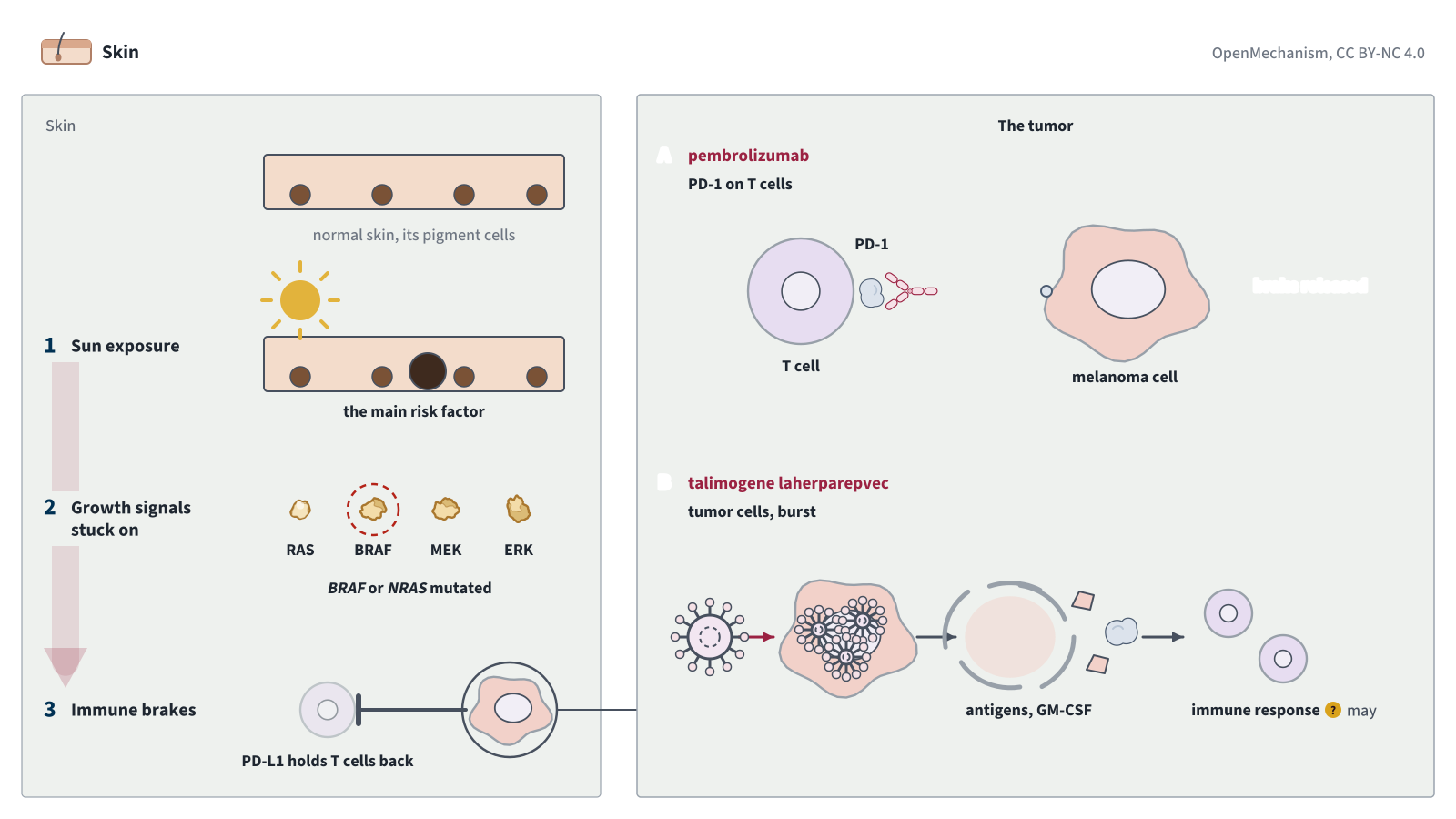
Melanoma is a cancer of the skin's pigment cells; sun exposure is the main risk factor. Most carry MAP kinase growth pathway mutations, typically BRAF or NRAS in skin melanoma, and melanoma cells carry PD-L1 and PD-L2, ligands of the PD-1 brake. Pembrolizumab releases that brake; talimogene laherparepvec, a modified virus, bursts tumor cells and may stir an immune response.
- Where
- Skin
- Body systems
- Cancer; Skin, hair & nails
- Medicines
- 2 medicines
May
The Imlygic (talimogene laherparepvec) label says: IMLYGIC causes lysis of tumors, followed by release of tumor-derived antigens, which together with virally derived GM-CSF may promote an antitumor immune response. … However, the exact mechanism of action is unknown.
Source 3: Imlygic (talimogene laherparepvec): FDA label, 1 Indications and Usage; 12.1 Mechanism of Action
Clinical study: In a randomized, open-label trial in 436 people with advanced melanoma, talimogene laherparepvec injected into the tumors was compared with GM-CSF injections; the trial measured lasting responses and survival, not the immune response: T-VEC is the first oncolytic immunotherapy to demonstrate therapeutic benefit against melanoma in a phase III clinical trial.
Andtbacka RH et al., J Clin Oncol 2015 (PMID 26014293)
This study was picked with a literature search and is not yet checked by our reviewer.
For teachers: download this drawing.
Key terms in this drawing (6)
- BRAF
- BRAF gene. A gene often mutated in melanomas of the skin, as is NRAS.
- GM-CSF
- Granulocyte-macrophage colony-stimulating factor. A signal protein that stimulates certain white blood cells.
- NRAS
- NRAS gene. A gene often mutated in melanomas of the skin, as is BRAF.
- PD-1
- Programmed cell death protein 1. A receptor on T cells that acts as a brake when PD-L1 or PD-L2 binds it.
- PD-L1
- Programmed death-ligand 1. One of the two PD-1 ligands (PD-L1 and PD-L2): it binds PD-1 on T cells and holds them back, and some tumors make more of it.
- T cell
- T lymphocyte. A white blood cell of the immune system.
What goes wrong
Sun exposure. Sun exposure is still considered the main risk factor for melanoma.1
What the source says
“Sun exposure is still considered to be the major risk factor for melanoma.”
Source 1Growth signals stuck on. Most melanomas carry mutations in the growth pathway; and mutations are typical of skin melanoma.1
Immune brakes. Immune checkpoint pathways matter: melanoma cells and immune cells carry and , the of the brake.1
Where medicines act
- A
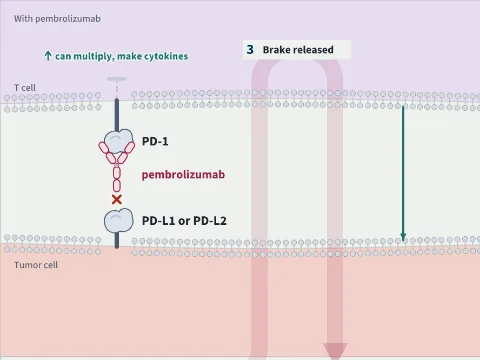
Pembrolizumab: the PD-1 brake released
Pembrolizumab binds PD-1 on and blocks PD-L1 and PD-L2, releasing the brake on the immune response against tumors. It treats melanoma that cannot be removed or has spread.2
What the source says
“Pembrolizumab is a monoclonal antibody that binds to the PD-1 receptor and blocks its interaction with PD-L1 and PD-L2, releasing PD-1 pathway-mediated inhibition of the immune response, including the anti-tumor immune response.”
Source 2“for the treatment of patients with unresectable or metastatic melanoma.”
Source 2 - B
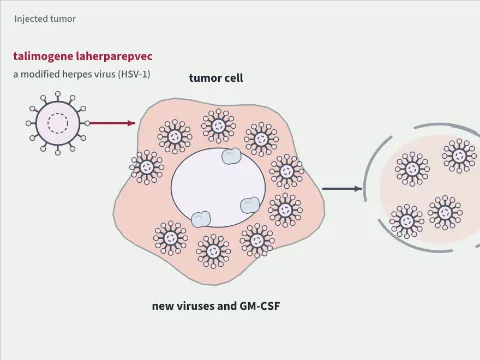
Talimogene laherparepvec: tumor cells burst
Talimogene laherparepvec is a virus modified to multiply in tumors and make ; it bursts tumor cells, releasing tumor antigens that, with GM-CSF, may start an immune response. It is injected into melanoma lesions that come back after surgery.3
What the source says
“IMLYGIC has been genetically modified to replicate within tumors and to produce the immune stimulatory protein GM-CSF. IMLYGIC causes lysis of tumors, followed by release of tumor-derived antigens, which together with virally derived GM-CSF may promote an antitumor immune response. However, the exact mechanism of action is unknown.”
Source 3“indicated for the local treatment of unresectable cutaneous, subcutaneous, and nodal lesions in patients with melanoma recurrent after initial surgery.”
Source 3
See also
Body systems: cancer; and skin, hair & nails.
Zoom in: immune attack on a tumor.
Also used for it: ipilimumab (for unresectable or metastatic melanoma: “YERVOY, as a single agent or in combination with nivolumab, is indicated for the treatment of unresectable or metastatic melanoma in adult and pediatric patients 12 years and older.”4).
Other conditions: colorectal cancer, kidney cancer, non-small cell lung cancer, B-cell lymphomas, bladder cancer and breast cancer.
Side effects: why checkpoint inhibitors can inflame healthy organs.
Sources
- 1MelanomaSchadendorf D et al. Nat Rev Dis Primers 2015 (abstract). Saved copy
- 2Keytruda (pembrolizumab): FDA label1 Indications and Usage; 12.1 Mechanism of Action. Saved copy
- 3Imlygic (talimogene laherparepvec): FDA label1 Indications and Usage; 12.1 Mechanism of Action. Saved copy
- 4Yervoy (ipilimumab): FDA label1 Indications and Usage. Saved copy
- 5Talimogene Laherparepvec Improves Durable Response Rate in Patients With Advanced MelanomaAndtbacka RH et al. J Clin Oncol 2015 (abstract). Saved copy
- 6Human NRAS bound to a GTP analoguePDB 5UHV; Johnson, C.W. et al. J. Biol. Chem. 2017;292:12981-12993. The RAS outline in the drawing is traced from this structure. Saved copy
- 7The kinase domain of human BRAF with an ATP analogue (from its complex with MEK1)PDB 6U2G; Liau, N.P.D. et al. Nat.Struct.Mol.Biol. 2020;27:134-141. The BRAF outline in the drawing is traced from this structure. Saved copy
- 8Human MEK1 with an ATP analoguePDB 3W8Q; Nakae, S. et al. Acta Crystallogr.,Sect.F 2021;77:459-464. The MEK outline in the drawing is traced from this structure. Saved copy
- 9Human ERK2, activated, with an ATP analoguePDB 5V60; Lechtenberg, B.C. et al. ACS Med Chem Lett 2017;8:726-731. The ERK outline in the drawing is traced from this structure. Saved copy
Notes and limits
- Talimogene laherparepvec has not been shown to improve overall survival or to affect spread to internal organs.3
Notes that apply to every page are on How to read a page.
Spotted a mistake? Report an error (hello@openmechanism.com). Since launch, every published error we fix is listed on the corrections page.
Cite this page
Tran D. Melanoma [Internet]. OpenMechanism; 2026 [updated 2026 Oct 21; cited 2026 Oct 21]. Available from: https://openmechanism.com/conditions/melanoma