Imatinib
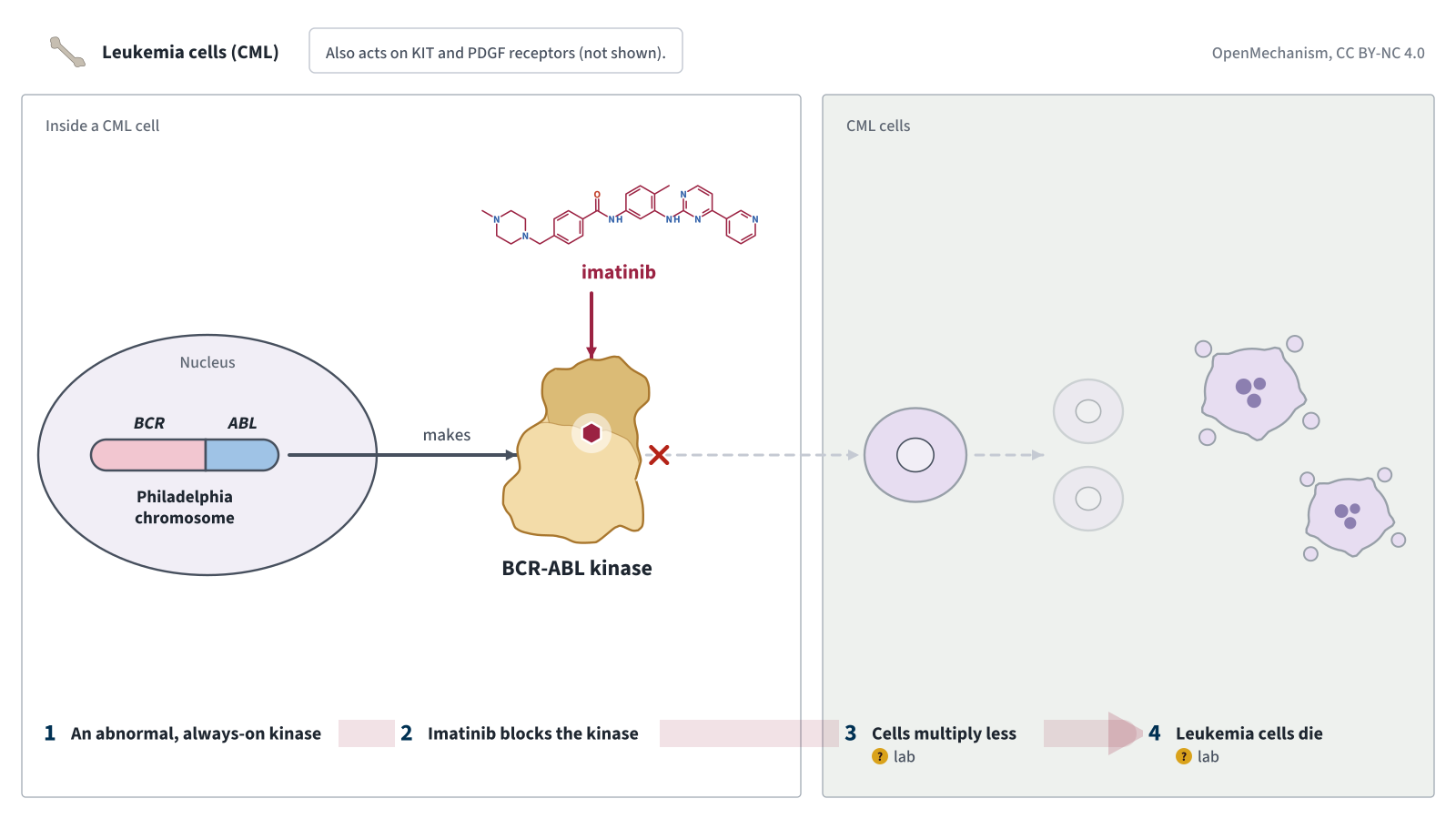
The Philadelphia chromosome creates , an always-on tyrosine kinase found in chronic myeloid leukemia (). Imatinib blocks this kinase; in cell lines and patient samples, CML cells multiply less and die. The Gleevec label lists its uses, among them Philadelphia chromosome positive chronic myeloid leukemia (CML), newly diagnosed in chronic phase in adults and children, or in blast crisis or accelerated phase, or in chronic phase after interferon-alpha therapy has failed; Philadelphia chromosome positive acute lymphoblastic leukemia, relapsed or refractory in adults, or newly diagnosed in children and given with chemotherapy; and Kit (CD117) positive malignant gastrointestinal stromal tumors () that cannot be removed by surgery or have spread, and, in adults, after surgery has removed them.
- Acts on
- BCR-ABL tyrosine kinase; also the and stem cell factor (c-Kit) receptor tyrosine kinases
- Where
- CML cells with the Philadelphia chromosome
- Medicine type
- Small molecule
- Used for
- Cancer
- Drug class
- Kinase inhibitors
Also called Gleevec.
Step 3: lab
The Gleevec label says: Imatinib inhibits proliferation and induces apoptosis in BCR-ABL positive cell lines as well as fresh leukemic cells from Philadelphia chromosome positive chronic myeloid leukemia.
Source 1: Gleevec (imatinib mesylate): FDA label, 1 Indications and Usage; 12.1 Mechanism of Action
Clinical study: In IRIS, a 2003 randomized trial of imatinib or interferon alfa with low-dose cytarabine in 1106 people with newly diagnosed chronic-phase CML (its abstract gives no doses); the trial measured blood and chromosome (hematologic and cytogenetic) responses, side effects and progression in people, not whether the leukemia cells multiply less: After a median follow-up of 19 months, the estimated rate of a major cytogenetic response (0 to 35 percent of cells in metaphase positive for the Philadelphia chromosome) at 18 months was 87.1 percent (95 percent confidence interval, 84.1 to 90.0) in the imatinib group and 34.7 percent (95 percent confidence interval, 29.3 to 40.0) in the group given interferon alfa plus cytarabine (P<0.001).
O'Brien SG et al., N Engl J Med 2003 (PMID 12637609)
Step 4: lab
The Gleevec label says: Imatinib inhibits proliferation and induces apoptosis in BCR-ABL positive cell lines as well as fresh leukemic cells from Philadelphia chromosome positive chronic myeloid leukemia.
Source 1: Gleevec (imatinib mesylate): FDA label, 1 Indications and Usage; 12.1 Mechanism of Action
Clinical study: In the same 2003 trial (IRIS), which measured blood and chromosome responses, side effects and progression in people, not whether the leukemia cells die: At 18 months, the estimated rate of freedom from progression to accelerated-phase or blast-crisis CML was 96.7 percent in the imatinib group and 91.5 percent in the combination-therapy group (P<0.001).
O'Brien SG et al., N Engl J Med 2003 (PMID 12637609)
Key terms in this drawing (6)
- ABL
- Abelson gene (ABL1). A gene on chromosome 9; in chronic myeloid leukemia it is fused with BCR from chromosome 22, which makes the Philadelphia chromosome.
- BCR
- Breakpoint cluster region gene. A gene on chromosome 22; in chronic myeloid leukemia it is fused with ABL1 from chromosome 9, which makes the Philadelphia chromosome.
- BCR-ABL
- BCR-ABL fusion protein. An always-on enzyme made from a joined gene, found in some leukemia cells.
- CML
- Chronic myeloid leukemia. A blood cancer marked by the Philadelphia chromosome, a rearrangement that joins two genes; the joined gene makes BCR-ABL, an always-on kinase.
- KIT
- KIT gene. A gene with activating mutations in many gastrointestinal stromal tumors (GIST); a 2021 review says some of these mutations are sensitive to the kinase blocker imatinib.
- PDGF
- Platelet-derived growth factor. A growth factor; imatinib also blocks its receptor's tyrosine kinase.
How it works
An abnormal, always-on kinase. The Philadelphia chromosome creates the constitutively active BCR-ABL tyrosine kinase.1
Imatinib blocks the kinase. Imatinib inhibits this kinase.1
Cells multiply less. BCR-ABL-positive cell lines and patient-derived CML samples show proliferation inhibition.1
Leukemia cells die. In the same cell lines and patient samples, imatinib also induces apoptosis.1
For teachers: download this drawing or build a slide deck.
See also
Condition pages: acute lymphoblastic leukemia, chronic myeloid leukemia and gastrointestinal stromal tumors (GIST).
Other kinase inhibitors: osimertinib, sirolimus and tofacitinib.
Body system: cancer.
Sources
- 1Gleevec (imatinib mesylate): FDA label1 Indications and Usage; 12.1 Mechanism of Action
- 2ChEMBL CHEMBL941Target and action classification: Bcr/Abl fusion protein inhibitor; Platelet-derived growth factor receptor beta inhibitor; Stem cell growth factor receptor inhibitor; Tyrosine-protein kinase ABL inhibitor
- 3Imatinib compared with interferon and low-dose cytarabine for newly diagnosed chronic-phase chronic myeloid leukemiaO'Brien SG et al. N Engl J Med 2003 (abstract)
Also used for the drawing
The BCR-ABL outline is traced from the crystal structure below.
- 4Human ABL kinase domain with imatinibPDB 2HYY; Cowan-Jacob, S.W. et al. ACTA CRYSTALLOGR.,SECT.D 2007; 63:80-93
Spotted a mistake? Report an error (hello@openmechanism.com). Since launch, every published error we fix is listed on the corrections page.
Notes and limits
- A schematic teaching drawing: not to scale, not exact structures, binding poses or a complete pathway, and not a guide to dosing, treatment or how a person will respond.
- The steps are in the order that explains them; one step is said to cause the next only where the source says so.
- The page tells the BCR-ABL part only; the label says imatinib also inhibits the receptor tyrosine kinases for PDGF and for stem cell factor (c-Kit).
- Cell assays and nonclinical tumor models do not establish a universal patient response.
All recorded limits are on the evidence page, and notes that apply to every page are on How to read a page. Version 1.0.1, medically reviewed by Daniel Tran, PharmD, on 15 November 2026.
Cite this page
Tran D. Imatinib [Internet]. OpenMechanism; 2026 [updated 2026 Nov 15; cited 2026 Nov 15]. Available from: https://openmechanism.com/medicines/imatinib