Fulvestrant
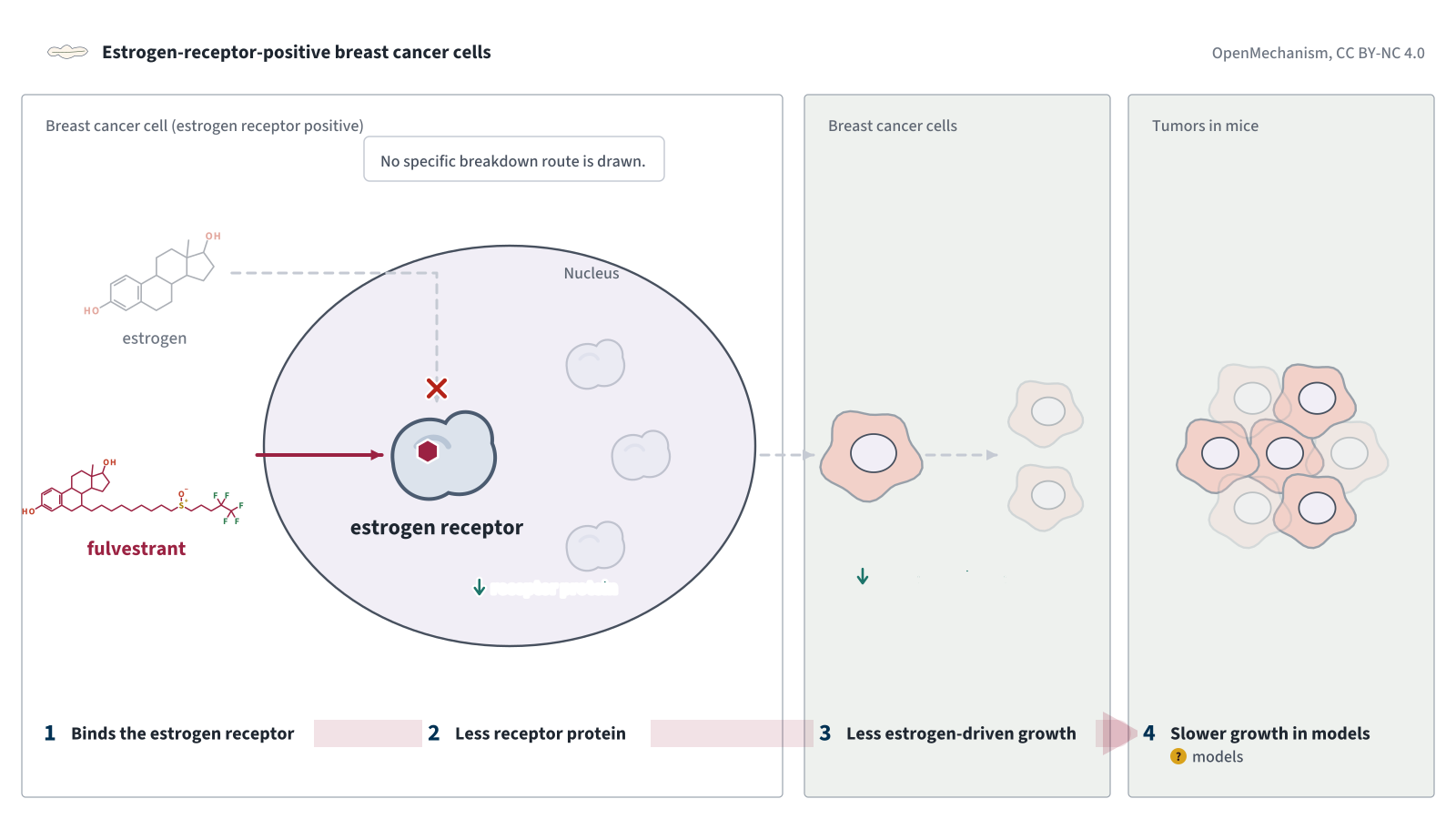
Fulvestrant binds estrogen receptors, blocking estrogen, and lowers the amount of receptor protein in breast cancer cells. In cell and animal models this slowed estrogen-driven growth.
- Acts on
- Estrogen receptor
- Where
- Estrogen-receptor-positive breast cancer cells
- Medicine type
- Small molecule
- Used for
- Cancer
- Drug class
- Hormone therapies for cancer
Also called Faslodex.
Step 4: models
The Faslodex label says: In vitro studies demonstrated that fulvestrant is a reversible inhibitor of the growth of tamoxifen-resistant, as well as estrogen-sensitive human breast cancer (MCF-7) cell lines. … In in vivo tumor studies, fulvestrant delayed the establishment of tumors from xenografts of human breast cancer MCF-7 cells in nude mice.
Source 1: Faslodex (fulvestrant): FDA label, 12.1 Mechanism of Action
Clinical study: In FALCON, a double-blind, phase 3 trial of fulvestrant or anastrozole in 462 postmenopausal patients with hormone receptor-positive advanced breast cancer who had not had hormone (endocrine) therapy before; the trial measured progression-free survival in people, not growth in cell or animal models: Progression-free survival was significantly longer in the fulvestrant group than in the anastrozole group (hazard ratio [HR] 0·797, 95% CI 0·637-0·999, p=0·0486).
Robertson JFR et al., Lancet 2016 (PMID 27908454)
This study was picked with a literature search and is not yet checked by our reviewer.
How it works
Binds the estrogen receptor. Fulvestrant binds estrogen receptors competitively.1
Less receptor protein. The label describes reduced estrogen receptor protein in human breast cancer cells.1
Less estrogen-driven growth. Receptor antagonism and downregulation oppose estrogen-driven growth in the cited cell models.1
Slower growth in models. Cell-culture and xenograft experiments showed growth inhibition or delayed tumor establishment.1
For teachers: download this drawing or build a slide deck.
See also
Condition pages: breast cancer.
Other hormone therapies for cancer: abiraterone acetate, anastrozole, enzalutamide, letrozole, leuprolide and tamoxifen.
Body system: cancer.
Sources
- 1Faslodex (fulvestrant): FDA label12.1 Mechanism of Action
- 2ChEMBL CHEMBL1358Target and action classification: Estrogen receptor alpha antagonist; Estrogen receptor degrader
- 3Fulvestrant 500 mg versus anastrozole 1 mg for hormone receptor-positive advanced breast cancer (FALCON): an international, randomised, double-blind, phase 3 trialRobertson JFR et al. Lancet 2016 (abstract)
Spotted a mistake? Report an error (hello@openmechanism.com). Since launch, every published error we fix is listed on the corrections page.
Notes and limits
- A schematic teaching drawing: not to scale, not exact structures, binding poses or a complete pathway, and not a guide to dosing, treatment or how a person will respond.
- The steps are in the order that explains them; one step is said to cause the next only where the source says so.
- The label supports receptor downregulation; this scene does not invent a specific ubiquitin ligase or degradation route.
- Cell-line/xenograft results are model evidence, not a prediction for every tumor.
All recorded limits are on the evidence page, and notes that apply to every page are on How to read a page. Version 1.0.0, not yet medically reviewed.
Cite this page
Tran D. Fulvestrant [Internet]. OpenMechanism; 2026 [updated 2026 Oct 15; cited 2026 Oct 15]. Available from: https://openmechanism.com/medicines/fulvestrant