Myelodysplastic syndromes (MDS)
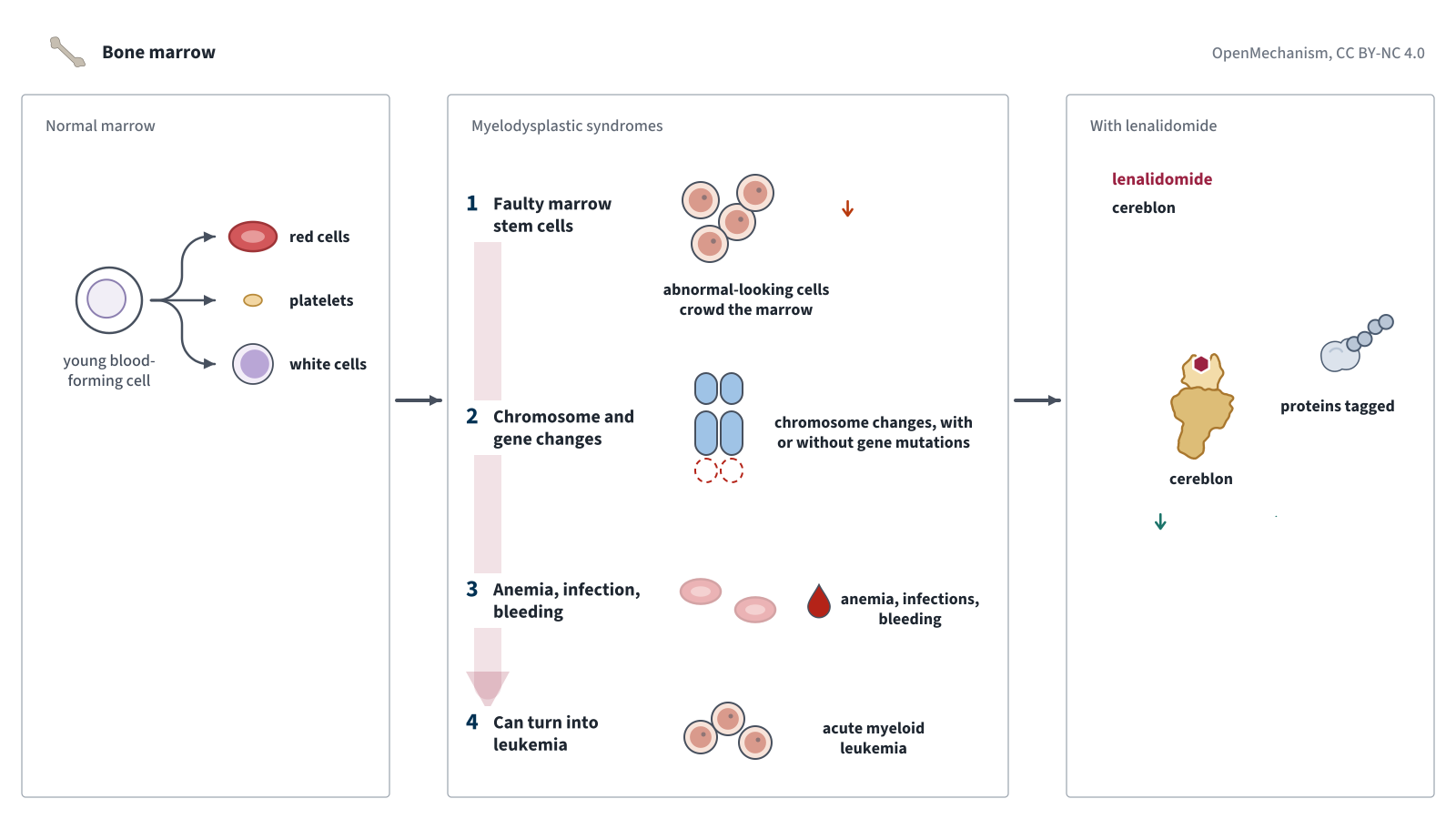
Myelodysplastic syndromes are disorders of a clone of marrow stem cells: blood-cell making is ineffective, so counts fall, causing anemia, infections and bleeding. Chromosome changes, with or without gene mutations, drive them; they are most common in elderly people, and 15% follow earlier cancer treatment. In a third of patients they turn into acute myeloid leukemia. Lenalidomide acts through cereblon.
- Where
- Bone marrow
- Body systems
- Cancer, Blood & clotting
- Medicines
- 1 medicine
For teachers: download this drawing.
Key terms in this drawing
- cereblon
- Cereblon. Part of an enzyme complex that tags proteins for destruction; lenalidomide works through it.
What goes wrong
Faulty marrow stem cells. MDS are disorders of a clone of bone-marrow stem cells. Blood-cell making is ineffective, so blood counts fall (cytopenias), while the marrow is crowded with abnormal-looking cells (dysplasia).1
What the source says
“Myelodysplastic syndromes are clonal marrow stem-cell disorders, characterised by ineffective haemopoiesis leading to blood cytopenias”
Source 1“Diagnosis is based on examination of blood and bone marrow showing blood cytopenias and hypercellular marrow with dysplasia, with or without excess of blasts.”
Source 1Chromosome and gene changes. Chromosome changes, with or without gene mutations, drive it, with widespread extra methylation in advanced stages.1
What the source says
“The pathophysiology involves cytogenetic changes with or without gene mutations and widespread gene hypermethylation at advanced stages.”
Source 1Anemia, infection, bleeding. The low counts cause the symptoms: anemia, infections and bleeding.1
What the source says
“Clinical manifestations result from cytopenias (anaemia, infection, and bleeding).”
Source 1Can turn into leukemia. In a third of patients it turns into acute myeloid leukemia.1
What the source says
“and by progression to acute myeloid leukaemia in a third of patients.”
Source 1
Where medicines act
- A
Lenalidomide: through cereblon
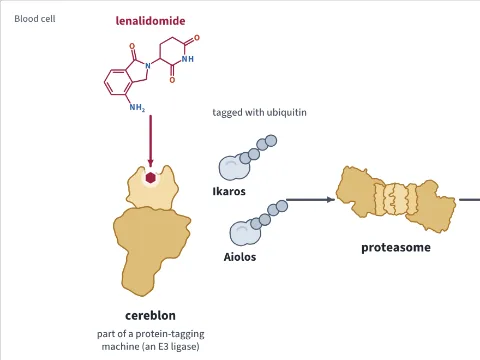
Lenalidomide works through , part of an enzyme complex that tags proteins for destruction, and in the lab it stops del(5q) MDS cells growing and makes them die. It treats transfusion-dependent anemia in low- or intermediate-1-risk MDS with a deletion 5q; lenalidomide is one of the treatments for anemia in lower-risk MDS.1,2
What the source says
“Cellular activities of lenalidomide are mediated through its target cereblon, a component of a cullin ring E3 ubiquitin ligase enzyme complex.”
Source 2“Lenalidomide inhibits proliferation and induces apoptosis of certain hematopoietic tumor cells including MM, mantle cell lymphoma, and del (5q) myelodysplastic syndromes”
Source 2“REVLIMID is indicated for the treatment of adult patients with transfusion-dependent anemia due to low- or intermediate-1-risk myelodysplastic syndromes (MDS) associated with a deletion 5q cytogenetic abnormality with or without additional cytogenetic abnormalities.”
Source 2“Treatment of patients with lower-risk myelodysplastic syndromes, especially for anaemia, includes growth factors, lenalidomide, and transfusions.”
Source 1
See also
Body systems: cancer and blood & clotting.
Other conditions: multiple myeloma, B-cell lymphomas, acute lymphoblastic leukemia, acute myeloid leukemia, anemia from cancer treatment and chronic lymphocytic leukemia.
Sources
- 1Myelodysplastic syndromesAdès L, Itzykson R, Fenaux P. Lancet 2014 (abstract). Saved copy
- 2Revlimid (lenalidomide): FDA label1.2 Myelodysplastic Syndromes; 12.1 Mechanism of Action. Saved copy
- 3Human cereblon with DDB1 and lenalidomidePDB 9FJX; Chrisochoidou, Y. et al. Blood 2025;145:2630-2644. The cereblon outline in the drawing is traced from this structure. Saved copy
Notes and limits
- MDS are most common in elderly people, and 15% of cases follow chemotherapy or radiotherapy for an earlier cancer.1
- The outlook depends mostly on the share of immature cells (blasts) in the marrow, how many counts are low and by how much, and the chromosome changes.1
- Lenalidomide's label covers only lower-risk MDS with a deletion 5q; higher-risk MDS is treated with hypomethylating medicines and, when possible, a donor stem-cell transplant.1
Notes that apply to every page are on How to read a page.
Spotted a mistake? Report an error (hello@openmechanism.com). Since launch, every published error we fix is listed on the corrections page.
Cite this page
Tran D. Myelodysplastic syndromes (MDS) [Internet]. OpenMechanism; 2026 [updated 2026 Oct 19; cited 2026 Oct 19]. Available from: https://openmechanism.com/conditions/myelodysplastic-syndromes