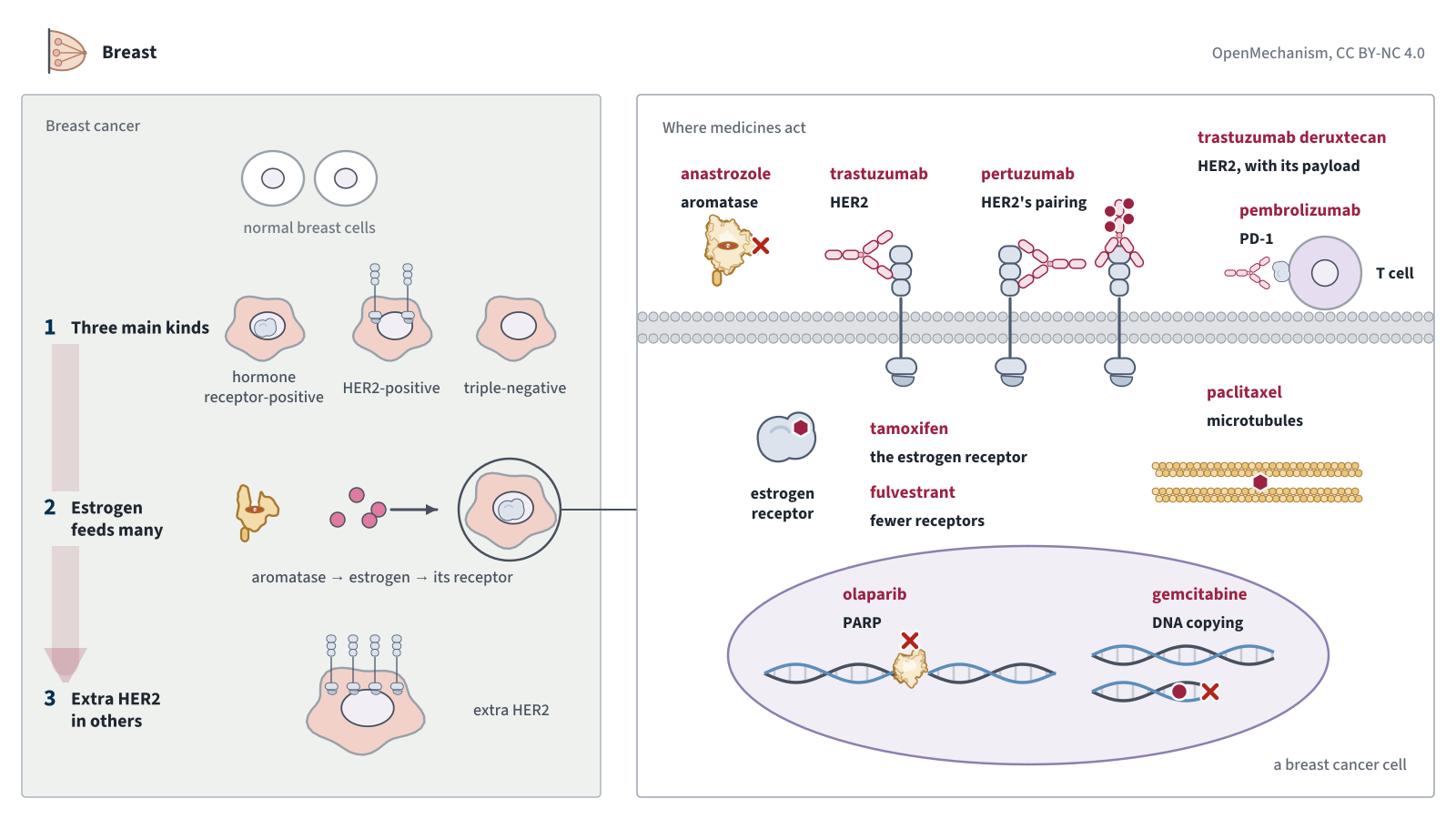
Breast cancer comes in three main kinds, with the shares a 2019 review gives: hormone receptor-positive and HER2-negative (about 70 percent), where estrogen can drive growth; HER2-positive (15 to 20 percent); and triple-negative (about 15 percent). Medicines act on the estrogen route, on HER2 (a growth-factor receptor), on PARP when a BRCA mutation is inherited, or on a T-cell brake in triple-negative cancer; paclitaxel stabilizes microtubules, and gemcitabine stops DNA copying.
Deoxyribonucleic acid. The molecule that stores genes.
HER2
Human epidermal growth factor receptor 2. A receptor that some cancer cells have in large amounts.
microtubule
Microtubule. A structure inside the cell, built from the protein tubulin, that the cell needs for dividing and for other vital work.
PARP
Poly(ADP-ribose) polymerase. An enzyme involved in repairing DNA.
PD-1
Programmed cell death protein 1. A receptor on T cells that acts as a brake when PD-L1 or PD-L2 binds it.
T cell
T lymphocyte. A white blood cell of the immune system.
What goes wrong
Three main kinds. In a 2019 review, breast cancer is grouped by estrogen and progesterone receptors and : hormone receptor-positive and HER2-negative (about 70 percent), HER2-positive (15 to 20 percent) and triple-negative, lacking all three (about 15 percent).1
What the source says
“Breast cancer is categorized into 3 major subtypes based on the presence or absence of molecular markers for estrogen or progesterone receptors and human epidermal growth factor 2 (ERBB2; formerly HER2): hormone receptor positive/ERBB2 negative (70% of patients), ERBB2 positive (15%-20%), and triple-negative (tumors lacking all 3 standard molecular markers; 15%).”
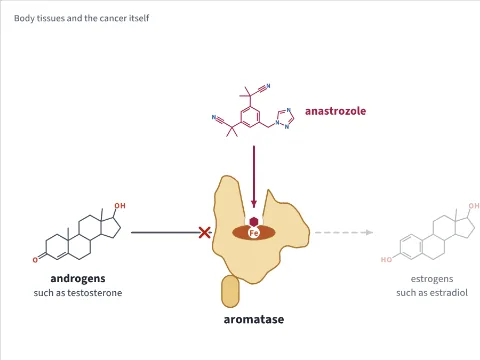
Estrogen feeds many. Many breast cancers carry estrogen receptors, and estrogen can drive their growth; after menopause, estrogen comes mainly from the aromatase enzyme.2,3
What the source says
“Many breast cancers have estrogen receptors (ER) and the growth of these tumors can be stimulated by estrogen.”
“The HER2 (or c-erbB2) proto-oncogene encodes a transmembrane receptor protein of 185 kDa, which is structurally related to the epidermal growth factor receptor.”
Anastrozole blocks aromatase and lowers estradiol. In women after menopause, it treats hormone receptor-positive early breast cancer after surgery; as a first treatment, hormone receptor-positive or hormone receptor-unknown breast cancer that is locally advanced or has spread; and advanced breast cancer that has grown despite tamoxifen, though the label says patients with estrogen receptor-negative disease, and patients who had not responded to tamoxifen, rarely responded to anastrozole.3
What the source says
“Anastrozole is a selective non-steroidal aromatase inhibitor. It significantly lowers serum estradiol concentrations”
“Treatment of advanced breast cancer in postmenopausal women with disease progression following tamoxifen therapy. Patients with ER-negative disease and patients who did not respond to previous tamoxifen therapy rarely responded to ARIMIDEX”
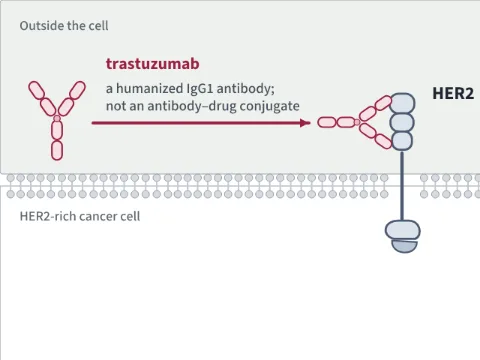
Trastuzumab slowed the growth of HER2-overexpressing tumor cells in lab and animal studies, and it brings about antibody-dependent cellular cytotoxicity (), which in lab studies acted more on cancer cells with extra HER2 than on cancer cells without it. It treats HER2-overexpressing breast cancer in adults.4
What the source says
“Herceptin has been shown, in both in vitro assays and in animals, to inhibit the proliferation of human tumor cells that overexpress HER2. Herceptin is a mediator of antibody-dependent cellular cytotoxicity (ADCC).”
“Herceptin-mediated ADCC has been shown to be preferentially exerted on HER2 overexpressing cancer cells compared with cancer cells that do not overexpress HER2.”
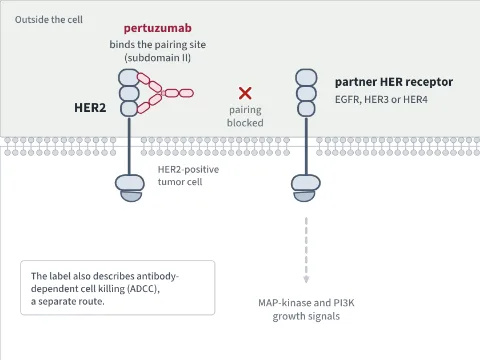
Pertuzumab binds HER2 where it pairs with other , blocking the pairs that form when a binds, and their growth signals. With trastuzumab and chemotherapy, it treats HER2-positive breast cancer in adults: before surgery, when the cancer is locally advanced, inflammatory, or early but larger than 2 cm or node-positive; after surgery, when early cancer is at high risk of coming back; and, with docetaxel, cancer that has spread and has not yet been treated for its spread with chemotherapy or an anti-HER2 medicine.5
What the source says
“Pertuzumab targets the extracellular dimerization domain (Subdomain II) of the human epidermal growth factor receptor 2 protein (HER2) and, thereby, blocks ligand-dependent heterodimerization of HER2 with other HER family members, including EGFR, HER3, and HER4. As a result, pertuzumab inhibits ligand-initiated intracellular signaling through two major signal pathways, mitogen-activated protein (MAP) kinase, and phosphoinositide 3-kinase (PI3K). Inhibition of these signaling pathways can result in cell growth arrest and apoptosis, respectively.”
“PERJETA is indicated for use in combination with trastuzumab and docetaxel for the treatment of adults with HER2-positive metastatic breast cancer who have not received prior anti-HER2 therapy or chemotherapy for metastatic disease”
“PERJETA is indicated for use in combination with trastuzumab and chemotherapy for the neoadjuvant treatment of adults with HER2-positive, locally advanced, inflammatory, or early stage breast cancer (either greater than 2 cm in diameter or node positive) as part of a complete treatment regimen for early breast cancer”
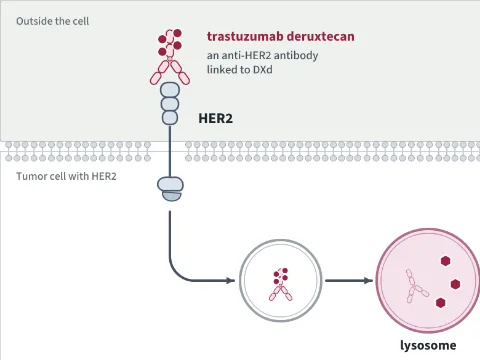
Trastuzumab deruxtecan is an anti-HER2 antibody carrying , a topoisomerase I blocker; after binding HER2 it is taken in, the DNA-damaging compound is released and damages the cell's . In adults, it treats HER2-positive breast cancer before surgery (Stage II or III, followed by a taxane, trastuzumab and pertuzumab), after surgery (when invasive cancer remains after earlier trastuzumab and taxane treatment), and when it cannot be removed or has spread (first, with pertuzumab; or alone, after earlier anti-HER2 treatment for its spread, or when it came back during or within six months of such treatment before or after surgery). Alone, it also treats breast cancer that cannot be removed or has spread when it is HER2-low and has had chemotherapy for its spread or came back during or within 6 months of chemotherapy after surgery, or when it is hormone receptor-positive, HER2-low or HER2-ultralow and has grown despite endocrine (hormone) therapy for its spread.6
What the source says
“Fam-trastuzumab deruxtecan-nxki is a HER2-directed antibody-drug conjugate.”
“Following binding to HER2 on tumor cells, fam-trastuzumab deruxtecan-nxki undergoes internalization and intracellular linker cleavage by lysosomal enzymes. Upon release, the membrane-permeable DXd causes DNA damage and apoptotic cell death.”
“as neoadjuvant treatment of adult patients with HER2-positive (IHC 3+ or ISH+) Stage II or III breast cancer, as determined by an FDA-authorized test followed by a taxane, trastuzumab, and pertuzumab (THP).”
“as adjuvant treatment of adult patients with HER2-positive (IHC 3+ or ISH+) breast cancer who have residual invasive disease following neoadjuvant trastuzumab (with or without pertuzumab) and taxane-based treatment.”
“in combination with pertuzumab as first-line treatment of adult patients with unresectable or metastatic HER2-positive (IHC 3+ or ISH+) breast cancer, as determined by an FDA-authorized test.”
“as monotherapy for the treatment of adult patients with unresectable or metastatic HER2-positive (IHC 3+ or ISH+) breast cancer who have received a prior anti-HER2-based regimen either in the metastatic setting, or, in the neoadjuvant or adjuvant setting and have developed disease recurrence during or within six months of completing therapy.”
“as monotherapy for the treatment of adult patients with unresectable or metastatic hormone receptor (HR)-positive, HER2-low (IHC 1+ or IHC 2+/ISH-) or HER2-ultralow (IHC 0 with membrane staining) breast cancer, as determined by an FDA-authorized test, that has progressed on one or more endocrine therapies in the metastatic setting.”
“as monotherapy for the treatment of adult patients with unresectable or metastatic HER2-low (IHC 1+ or IHC 2+/ISH-) breast cancer, as determined by an FDA-authorized test, who have received a prior chemotherapy in the metastatic setting; or developed disease recurrence during or within 6 months of completing adjuvant chemotherapy.”
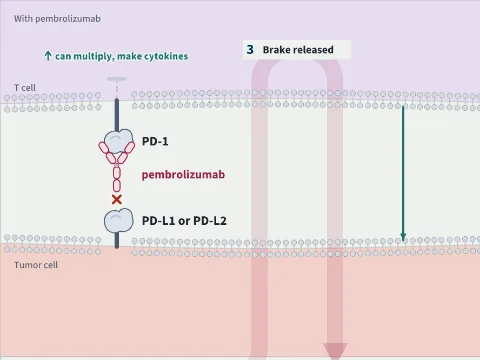
Pembrolizumab blocks , a brake on , and so releases the immune response, including the response against the cancer. It treats triple-negative breast cancer: high-risk early cancer, with chemotherapy before surgery and then alone after it; and, with chemotherapy, cancer that has come back nearby and cannot be removed, or has spread, when a test shows the tumor carries (CPS ≥10). With sacituzumab govitecan, it is also a first treatment for adults whose triple-negative cancer is locally advanced and cannot be removed, or has spread, when a test shows the tumor carries PD-L1 (CPS ≥10).7
What the source says
“Binding of the PD-1 ligands, PD-L1 and PD-L2, to the PD-1 receptor found on T cells, inhibits T cell proliferation and cytokine production.”
“Pembrolizumab is a monoclonal antibody that binds to the PD-1 receptor and blocks its interaction with PD-L1 and PD-L2, releasing PD-1 pathway-mediated inhibition of the immune response, including the anti-tumor immune response.”
“for the treatment of patients with high-risk early-stage TNBC in combination with chemotherapy as neoadjuvant treatment, and then continued as a single agent as adjuvant treatment after surgery.”
“in combination with chemotherapy, for the treatment of patients with locally recurrent unresectable or metastatic TNBC whose tumors express PD-L1 (CPS ≥10) as determined by an FDA-authorized test.”
“KEYTRUDA, in combination with sacituzumab govitecan-hziy, is indicated for the first-line treatment of adult patients with unresectable locally advanced or metastatic TNBC whose tumors express PD-L1 (CPS ≥10) as determined by an FDA-authorized test”
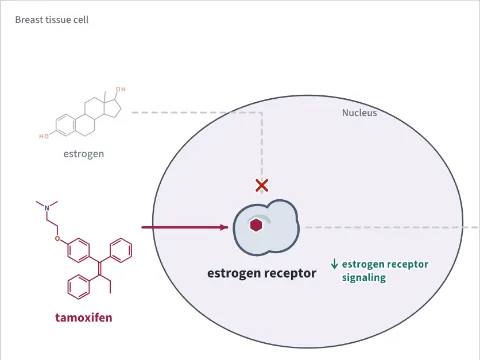
Tamoxifen, which its label calls an estrogen /, competes with estrogen for its receptor, which can reduce estrogen-driven growth in breast tissue. It treats estrogen receptor-positive breast cancer in adults.8
What the source says
“Tamoxifen is an estrogen agonist/antagonist. Tamoxifen competes with estrogen for binding to the estrogen receptor, which can result in a decrease in estrogen receptor signaling-dependent growth in breast tissue.”
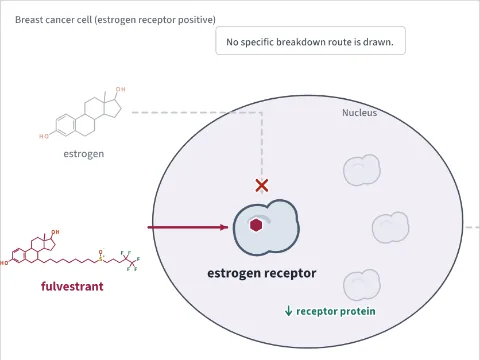
Fulvestrant blocks the estrogen receptor and lowers the amount of it in breast cancer cells. On its own, it treats hormone receptor-positive advanced breast cancer after menopause: HER2-negative cancer not yet treated with endocrine (hormone) therapy, or cancer that has grown despite endocrine therapy.2
What the source says
“Fulvestrant is an estrogen receptor antagonist that binds to the estrogen receptor in a competitive manner with affinity comparable to that of estradiol and downregulates the ER protein in human breast cancer cells.”
“Hormone receptor (HR)-positive, human epidermal growth factor receptor 2 (HER2)-negative advanced breast cancer in postmenopausal women not previously treated with endocrine therapy”
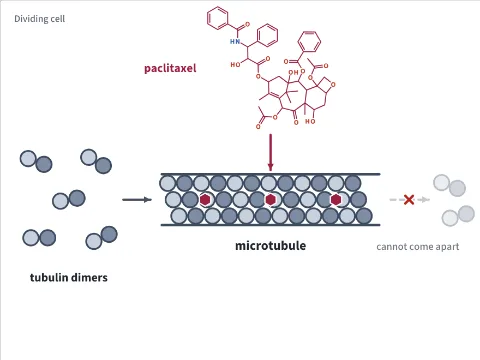
Paclitaxel helps build and stabilizes them so the cell cannot reorganize them, which it needs to divide. It treats node-positive breast cancer after surgery, given after doxorubicin-containing chemotherapy (the label says the trial showed a favorable effect overall, but the benefit was specifically shown, at a median follow-up of 30 months, only in tumors without estrogen and progesterone receptors), and breast cancer after combination chemotherapy for its spread has failed, or that came back within 6 months of chemotherapy given after surgery; for that use, the label says the earlier treatment should have included an anthracycline, unless that was ruled out for medical reasons.9
What the source says
“Paclitaxel is a novel antimicrotubule agent that promotes the assembly of microtubules from tubulin dimers and stabilizes microtubules by preventing depolymerization.”
“This stability results in the inhibition of the normal dynamic reorganization of the microtubule network that is essential for vital interphase and mitotic cellular functions.”
“Paclitaxel Injection USP is indicated for the adjuvant treatment of node-positive breast cancer administered sequentially to standard doxorubicin-containing combination chemotherapy.”
“In the clinical trial, there was an overall favorable effect on disease-free and overall survival in the total population of patients with receptor-positive and receptor-negative tumors, but the benefit has been specifically demonstrated by available data (median follow-up 30 months) only in the patients with estrogen and progesterone receptor-negative tumors”
“Paclitaxel Injection USP is indicated for the treatment of breast cancer after failure of combination chemotherapy for metastatic disease or relapse within 6 months of adjuvant chemotherapy.”
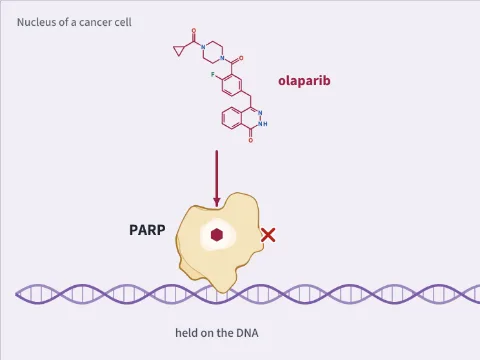
Olaparib blocks enzymes, which help repair DNA. It treats HER2-negative breast cancer in adults with an inherited mutation who have already had chemotherapy: after surgery when the risk is high, and when the cancer has spread; for that use, the label says patients with hormone receptor-positive cancer should have had endocrine (hormone) therapy before, or be considered unsuitable for it.10,11
What the source says
“Olaparib is an inhibitor of poly (ADP-ribose) polymerase (PARP) enzymes, including PARP1, PARP2, and PARP3. PARP enzymes are involved in normal cellular functions, such as DNA transcription and DNA repair.”
“for the adjuvant treatment of adult patients with deleterious or suspected deleterious g BRCA m human epidermal growth factor receptor 2 (HER2)-negative high risk early breast cancer who have been treated with neoadjuvant or adjuvant chemotherapy.”
“for the treatment of adult patients with deleterious or suspected deleterious gBRCA m, HER2-negative metastatic breast cancer who have been treated with chemotherapy in the neoadjuvant, adjuvant or metastatic setting.”
“Patients with hormone receptor (HR)-positive breast cancer should have been treated with a prior endocrine therapy or be considered inappropriate for endocrine therapy.”
“A gene change in the body's reproductive cells (egg or sperm) that becomes incorporated into the DNA of every cell in the body of offspring; germline mutations are passed on from parents to offspring.”
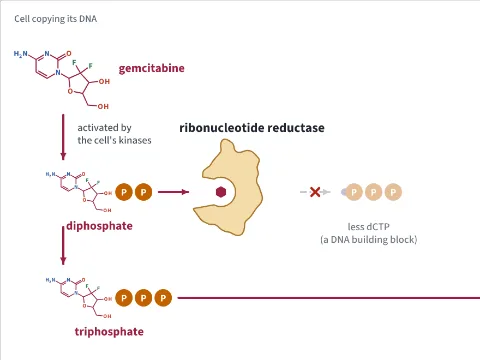
Gemcitabine is turned into gemcitabine triphosphate, which is built into new DNA and stops it growing, so it kills cells that are copying their DNA. With paclitaxel, it is a first treatment for breast cancer that has spread after anthracycline-containing chemotherapy given after surgery has failed, unless anthracyclines were ruled out for medical reasons.12
What the source says
“Gemcitabine kills cells undergoing DNA synthesis and blocks the progression of cells through the G1/S-phase boundary.”
“After the gemcitabine nucleotide is incorporated into DNA, only one additional nucleotide is added to the growing DNA strands which eventually results in the initiation of apoptotic cell death.”
“in combination with paclitaxel, for first-line treatment of metastatic breast cancer after failure of prior anthracycline-containing adjuvant chemotherapy, unless anthracyclines were clinically contraindicated.”
The National Cancer Institute's treatment summary for breast cancer (updated 25 April 2025) describes these combinations. For the lettered medicines above, the page gives only the uses their own labels list. The quotes may name medicines, combinations or groups of patients that a medicine's own label does not list, and may leave out its label's limits.
Stages I, II and III breast cancer, before surgery: “When considering preoperative therapy, treatment options include: For HER2-negative breast tumors, an anthracycline/taxane-based chemotherapy regimen. For HER2-positive disease, chemotherapy and HER2-targeted therapy.”19
Stage II or stage III triple-negative breast cancer, before surgery, the KEYNOTE-522 trial: “Participants were randomly assigned in a 2:1 ratio to receive neoadjuvant chemotherapy (paclitaxel plus carboplatin, followed by doxorubicin plus cyclophosphamide) with either neoadjuvant and adjuvant pembrolizumab or neoadjuvant and adjuvant placebo.”19
Metastatic HER2-negative hormone receptor-positive breast cancer: “CDK inhibitors have been approved by the U.S. Food and Drug Administration (FDA) in combination with endocrine therapy in both first-line and later-line treatment of advanced, HER2-negative hormone receptor–positive breast cancer. Three oral CDK4/6 inhibitors are currently available: palbociclib, ribociclib, and abemaciclib.”19
Also used for it: letrozole (“Adjuvant treatment of postmenopausal women with hormone receptor positive early breast cancer. … First and second-line treatment of postmenopausal women with hormone receptor positive or unknown advanced breast cancer.”13), cyclophosphamide (“Cyclophosphamide Tablets is indicated for the treatment of: … carcinoma of the breast”14), doxorubicin (“Doxorubicin Hydrochloride Injection is indicated as a component of multi-agent adjuvant chemotherapy for treatment of women with axillary lymph node involvement following resection of primary breast cancer”15), fluorouracil (for adenocarcinoma of the breast: “Fluorouracil is a nucleoside metabolic inhibitor indicated for the treatment of patients with … Adenocarcinoma of the Breast”16) and estradiol (for palliation only in appropriately selected women and men whose breast cancer has spread: “Treatment of breast cancer (for palliation only) in appropriately selected women and men with metastatic disease.”18).
Also used in people with breast cancer: denosumab (for bone loss in women at high risk for fracture receiving adjuvant aromatase inhibitor therapy: “Prolia is indicated as a treatment to increase bone mass in women at high risk for fracture receiving adjuvant aromatase inhibitor therapy for breast cancer”17).
In a 2019 review, triple-negative cancers come back more often than the other two types. In the 2019 review this page cites, the medicine treatment for triple-negative cancers that had not spread was chemotherapy alone, alongside surgery to remove the cancer; pembrolizumab now also treats high-risk early triple-negative cancer, together with chemotherapy.1,7
The steps are in the order that explains them; one step is said to cause the next only where a source says so.
The combinations quoted from the National Cancer Institute are examples of how these medicines are given together. They are not a full list of regimens, and nothing here is advice on choosing a treatment. The words are from the summary's version of 25 April 2025, and the summary may have changed since. The summary says: “It is intended as a resource to inform and assist clinicians in the care of their patients. It does not provide formal guidelines or recommendations for making health care decisions.”19
Claude Opus 5.5 (AI source check), 14 November 2026: 77 statements compared with their sources, 14 flagged for the reviewer. An automated check, not a medical review.
Conflict of interest
Gemcitabine: Pfizer, the reviewer's former employer, makes or markets this medicine. Doxorubicin: Pfizer, the reviewer's former employer, makes or markets this medicine. Details
Key terms
Definitions reworded since this review: ADCC, ligand and microtubule. Definitions are shared across pages, so a later rewording does not take the review line off (what a review covers).
Next review due
16 May 2028
Cite this page
Tran D. Breast cancer [Internet]. OpenMechanism; 2026 [updated 2026 Nov 15; cited 2026 Nov 15]. Available from: https://openmechanism.com/conditions/breast-cancer