High calcium from cancer
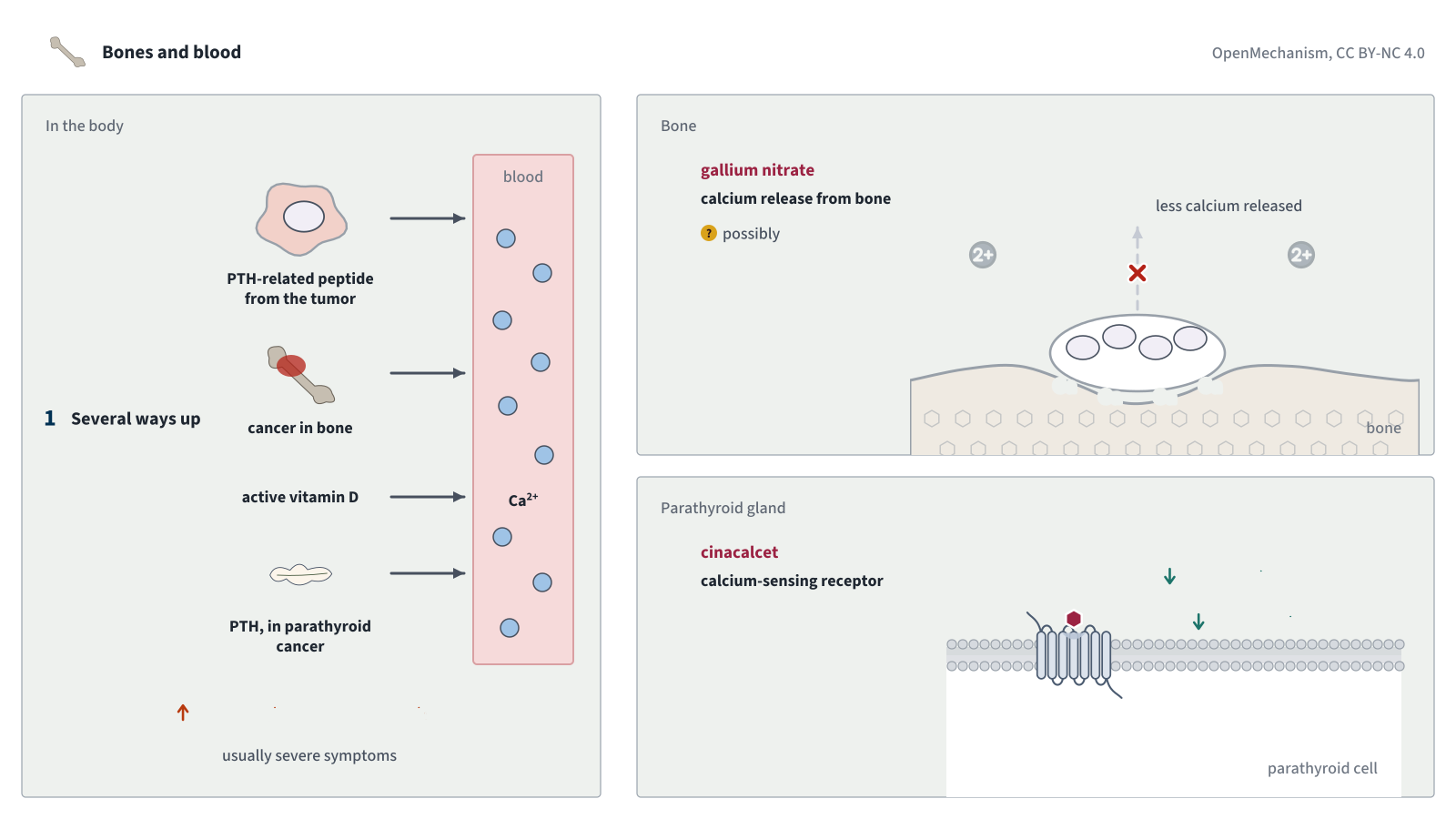
High blood calcium (hypercalcemia) is common in advanced cancers, and levels are usually very high, so it usually causes severe symptoms. Cancers raise calcium in several ways: a hormone-like peptide (PTH-related peptide), cancer eating into bone, active vitamin D, or parathyroid hormone itself in parathyroid cancer. Gallium nitrate slows calcium release from bone; cinacalcet lowers parathyroid hormone in parathyroid cancer.
- Where
- Bones and blood
- Body systems
- Hormones & metabolism, Kidney, Cancer
- Medicines
- 2 medicines
Possibly
The Ganite (gallium nitrate) label says: Ganite exerts a hypocalcemic effect by inhibiting calcium resorption from bone, possibly by reducing increased bone turnover.
Source 2: Ganite (gallium nitrate): FDA label, Indications and Usage; Clinical Pharmacology
Clinical study: In a randomized, double-blind trial in 50 people with cancer-related high blood calcium, gallium nitrate was compared with calcitonin; the trial measured whether calcium returned to normal, not bone turnover: Gallium nitrate therapy is highly effective and superior to maximally approved doses of calcitonin for acute control of cancer-related hypercalcemia.
Warrell RP et al., Ann Intern Med 1988 (PMID 3282463)
This study was picked with a literature search and is not yet checked by our reviewer.
For teachers: download this drawing.
Key terms in this drawing
- PTH
- Parathyroid hormone. A hormone from the parathyroid glands that raises blood calcium.
- PTH-related peptide
- Parathyroid hormone-related peptide. A peptide released by some tumors; it is one cause of high blood calcium in cancer (humoral hypercalcemia).
What goes wrong
Several ways up. Cancers raise calcium in several ways: from the tumor, cancer spreading into bone, active vitamin D, or parathyroid hormone itself in parathyroid cancer. Levels are usually very high, so it usually causes severe symptoms.1
What the source says
“Several major mechanisms are responsible for the development of hypercalcemia of malignancy including parathyroid hormone-related peptide-mediated humoral hypercalcemia, osteolytic metastases-related hypercalcemia, 1,25 Vitamin D-mediated hypercalcemia, and parathyroid hormone-mediated hypercalcemia in patients with parathyroid carcinoma and extra parathyroid cancers.”
Source 1“Hypercalcemia of malignancy usually presents with markedly elevated calcium levels and therefore, usually severely symptomatic.”
Source 1
Where medicines act
- A
Gallium nitrate: less calcium out of bone
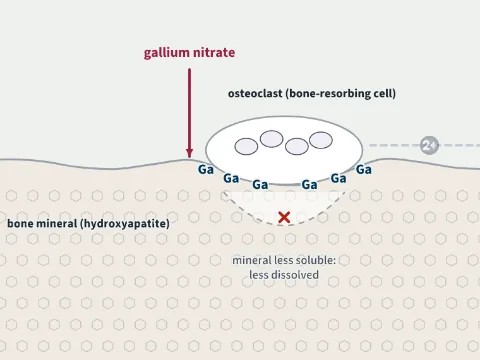
Gallium nitrate lowers blood calcium by slowing calcium release from bone, possibly by reducing raised bone turnover. Its label covers clearly symptomatic cancer-related hypercalcemia that has not responded to fluids; Drugs@FDA lists the product as discontinued.2,3
What the source says
“Ganite exerts a hypocalcemic effect by inhibiting calcium resorption from bone, possibly by reducing increased bone turnover.”
Source 2“Ganite is indicated for the treatment of clearly symptomatic cancer-related hypercalcemia that has not responded to adequate hydration.”
Source 2“Discontinued”
Source 3 - B
Cinacalcet: less parathyroid hormone
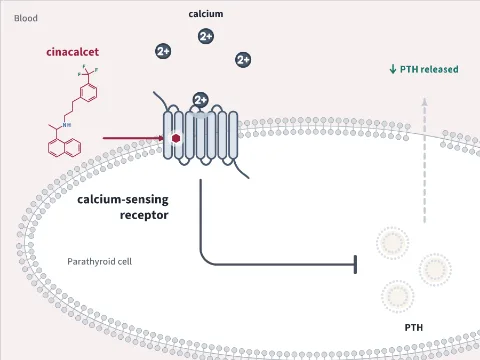
Cinacalcet makes the parathyroid's calcium-sensing receptor more sensitive to calcium, so less parathyroid hormone is made and blood calcium falls. It treats high calcium in parathyroid cancer.4
What the source says
“Cinacalcet, the active ingredient in Sensipar, is a calcimimetic agent that directly lowers PTH levels by increasing the sensitivity of the calcium-sensing receptor to activation by extracellular calcium.”
Source 4“The reduction in PTH is associated with a concomitant decrease in serum calcium levels.”
Source 4“Hypercalcemia in adult patients with Parathyroid Carcinoma (PC).”
Source 4
See also
Body systems: hormones & metabolism, kidney and cancer.
Also used for it: methylprednisolone (“hypercalcemia associated with cancer”5), hydrocortisone (“hypercalcemia associated with cancer”6) and dexamethasone (“Hypercalcemia associated with cancer”7).
Related medicines: prednisone.
Other conditions: adrenal insufficiency, lupus nephritis, ankylosing spondylitis, asthma, Crohn disease and gout.
Sources
- 1Hypercalcemia of malignancy: an update on pathogenesis and managementMirrakhimov AE. N Am J Med Sci 2015 (abstract). Saved copy
- 2Ganite (gallium nitrate): FDA labelIndications and Usage; Clinical Pharmacology. Saved copy
- 3Ganite (gallium nitrate): Drugs@FDANDA019961, marketing status. Saved copy
- 4Sensipar (cinacalcet): FDA label1 Indications and Usage; 12.1 Mechanism of Action. Saved copy
- 5Solu-Medrol (methylprednisolone sodium succinate): FDA labelIndications and Usage. Saved copy
- 6Solu-Cortef (hydrocortisone sodium succinate): FDA labelIndications and Usage. Saved copy
- 7Dexamethasone sodium phosphate injection: FDA labelIndications and Usage. Saved copy
- 8Gallium nitrate for acute treatment of cancer-related hypercalcemia. A randomized, double-blind comparison to calcitoninWarrell RP et al. Ann Intern Med 1988 (abstract). Saved copy
Notes and limits
- Exactly how gallium nitrate blocks calcium release from bone has not been worked out.2
Notes that apply to every page are on How to read a page.
Spotted a mistake? Report an error (hello@openmechanism.com). Since launch, every published error we fix is listed on the corrections page.
Cite this page
Tran D. High calcium from cancer [Internet]. OpenMechanism; 2026 [updated 2026 Oct 19; cited 2026 Oct 19]. Available from: https://openmechanism.com/conditions/hypercalcemia-of-malignancy