Prostate cancer
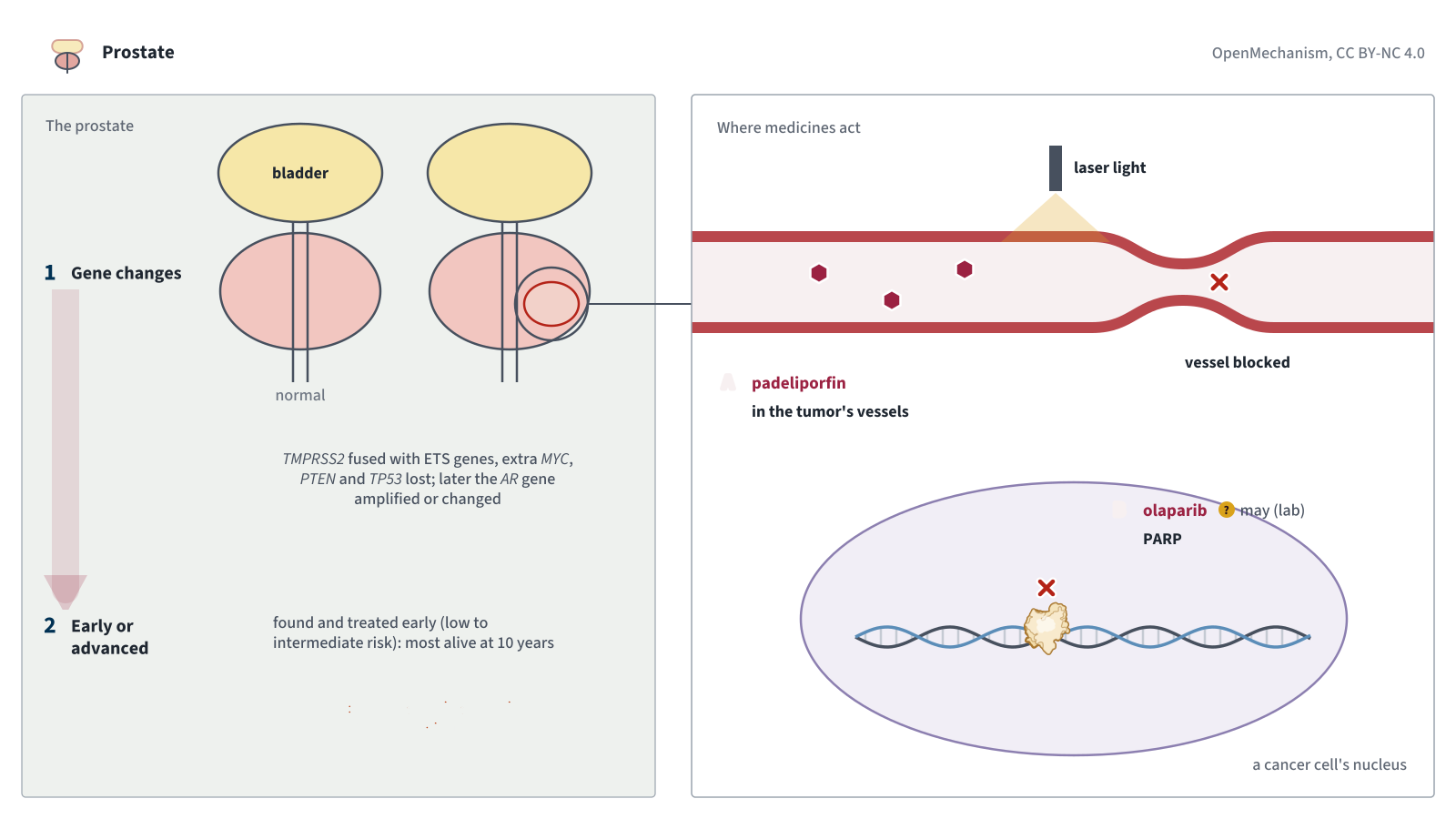
Prostate cancer affects millions of men worldwide, mostly in richer regions; gene changes include TMPRSS2-ETS gene fusions and lost PTEN and TP53. Found early at low to intermediate risk, 99% of men are alive at 10 years; advanced cancer often keeps growing despite hormone treatment and becomes incurable. Laser-activated padeliporfin shuts down the tumor's blood vessels; olaparib blocks PARP.
- Where
- Prostate
- Body systems
- Cancer, Bladder & reproductive organs
- Medicines
- 2 medicines
May (lab)
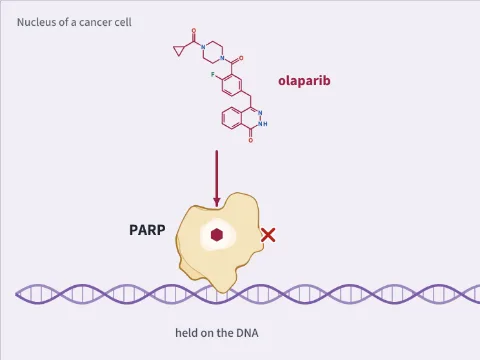
The Lynparza (olaparib) label says: In vitro studies have shown that olaparib-induced cytotoxicity may involve inhibition of PARP enzymatic activity and increased formation of PARP-DNA complexes, resulting in DNA damage and cancer cell death.
Source 4: Lynparza (olaparib): FDA label, 12.1 Mechanism of Action
Clinical study: In a randomized, open-label trial in men with metastatic castration-resistant prostate cancer and changes in DNA-repair genes, olaparib was compared with enzalutamide or abiraterone; the trial measured how long the cancer was held back on imaging, not how olaparib kills cells: In men with metastatic castration-resistant prostate cancer who had disease progression while receiving enzalutamide or abiraterone and who had alterations in genes with a role in homologous recombination repair, olaparib was associated with longer progression-free survival and better measures of response and patient-reported end points than either enzalutamide or abiraterone.
de Bono J et al., N Engl J Med 2020 (PMID 32343890)
This study was picked with a literature search and is not yet checked by our reviewer.
For teachers: download this drawing.
Key terms in this drawing (7)
- AR
- Androgen receptor. The androgen receptor; in advanced prostate cancer its gene is often amplified or mutated.
- ETS
- ETS family genes. A family of genes that, in prostate cancer, are often fused with TMPRSS2.
- MYC
- MYC oncogene. A cancer-driving gene (oncogene).
- PARP
- Poly(ADP-ribose) polymerase. An enzyme involved in repairing DNA.
- PTEN
- Phosphatase and tensin homolog. A protein inside cells that holds back growth signals.
- TMPRSS2
- TMPRSS2 gene. A gene that, in prostate cancer, is often fused with a gene of the ETS family.
- TP53
- TP53 tumor suppressor gene. A tumor suppressor gene; in some cancers it is switched off, lost or mutated.
What goes wrong
Gene changes. Gene changes include fusions with genes, extra , and loss of and ; in advanced disease, the androgen receptor gene is amplified or mutated.1
What the source says
“Key genetic alterations include fusions of TMPRSS2 with ETS family genes, amplification of the MYC oncogene, deletion and/or mutation of PTEN and TP53 and, in advanced disease, amplification and/or mutation of the androgen receptor (AR).”
Source 1Early or advanced. Found and treated early at low to intermediate risk, 99% of men are alive at 10 years; advanced cancer often keeps growing despite hormone treatment and becomes incurable.1
What the source says
“Patients with localized disease at a low to intermediate risk of recurrence generally have a favourable outcome of 99% overall survival for 10 years if the disease is detected and treated at an early stage.”
Source 1“Advanced prostate cancer often progresses despite androgen ablation and is then considered castration-resistant and incurable.”
Source 1
Where medicines act
- A
Padeliporfin: the tumor's vessels shut down
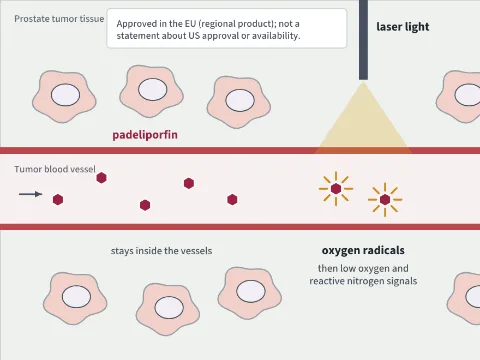
Padeliporfin stays in the blood vessels. Activated by laser light in the tumor, it sets off events that clot and block the tumor's blood vessels, and the targeted tissue dies within days. In low-risk prostate cancer, this treatment halved progression at 2 years compared with active surveillance.2,3
What the source says
“Padeliporfin is retained within the vascular system.”
Source 2“When activated with 753 nm wavelength laser light, padeliporfin triggers a cascade of pathophysiological events resulting in focal necrosis within a few days.”
Source 2“formation of blood clots at the interface of the arterial supply (feeding arteries) and tumour microcirculation, results in occlusion of the tumour vasculature.”
Source 2“The proportion of participants who had disease progression at month 24 was 58 (28%) of 206 in the vascular-targeted photodynamic therapy group compared with 120 (58%) of 207 in the active surveillance group”
Source 3 - B
Olaparib: PARP blocked
Olaparib's toxicity to cancer cells may involve blocking , resulting in damage and cancer cell death; in prostate cancer models, PARP1 helps the androgen receptor work. It is one of the treatments for advanced prostate cancer.1,4
What the source says
“olaparib-induced cytotoxicity may involve inhibition of PARP enzymatic activity and increased formation of PARP-DNA complexes, resulting in DNA damage and cancer cell death.”
Source 4“In prostate cancer models, PARP1 has been shown to contribute to androgen receptor (AR) activity regulation”
Source 4“Current treatment options include AR-targeted agents, chemotherapy, radionuclides and the poly(ADP-ribose) inhibitor olaparib.”
Source 1
See also
Body systems: cancer and bladder & reproductive organs.
Also used for it: leuprolide (“LUPRON DEPOT is a gonadotropin releasing hormone (GnRH) agonist indicated for: treatment of advanced prostate cancer.”5); enzalutamide (for castration-resistant or metastatic castration-sensitive prostate cancer: “XTANDI ® is indicated for the treatment of patients with: … castration-resistant prostate cancer (CRPC) … metastatic castration-sensitive prostate cancer (mCSPC)”6); abiraterone acetate (for metastatic castration-resistant or high-risk castration-sensitive prostate cancer, with prednisone: “ZYTIGA is a CYP17 inhibitor indicated in combination with prednisone for the treatment of patients with metastatic castration-resistant prostate cancer (CRPC). … metastatic high-risk castration-sensitive prostate cancer (CSPC).”7); and denosumab (for bone loss in men at high risk for fracture receiving androgen deprivation therapy for nonmetastatic prostate cancer: “Prolia is indicated as a treatment to increase bone mass in men at high risk for fracture receiving androgen deprivation therapy (ADT) for nonmetastatic prostate cancer.”8).
Related medicines: estradiol.
Other conditions: breast cancer, osteoporosis, ovarian cancer, absent periods (secondary amenorrhea), pancreatic cancer and bladder bleeding from chemotherapy (hemorrhagic cystitis).
The medicine in the body: why finasteride halves PSA.
Sources
- 1Prostate cancerRebello RJ et al. Nat Rev Dis Primers 2021 (abstract). Saved copy
- 2Tookad (padeliporfin): EU product information5.1 Pharmacodynamic properties. Saved copy
- 3Padeliporfin vascular-targeted photodynamic therapy versus active surveillance in men with low-risk prostate cancer (CLIN1001 PCM301)Azzouzi AR et al. Lancet Oncol 2017 (abstract). Saved copy
- 4Lynparza (olaparib): FDA label12.1 Mechanism of Action. Saved copy
- 5Lupron Depot (leuprolide acetate): FDA label1 Indications and Usage. Saved copy
- 6Xtandi (enzalutamide): FDA label1 Indications and Usage. Saved copy
- 7Zytiga (abiraterone acetate): FDA label1 Indications and Usage. Saved copy
- 8Prolia (denosumab): FDA label1 Indications and Usage. Saved copy
- 9Olaparib for Metastatic Castration-Resistant Prostate Cancerde Bono J et al. N Engl J Med 2020 (abstract). Saved copy
- 10PARP1 catalytic domain with olaparibPDB 7KK4; Ryan, K. et al. J.Biol.Chem. 2021;296:100251. The PARP outline in the drawing is traced from this structure. Saved copy
Notes and limits
Notes that apply to every page are on How to read a page.
Spotted a mistake? Report an error (hello@openmechanism.com). Since launch, every published error we fix is listed on the corrections page.
Cite this page
Tran D. Prostate cancer [Internet]. OpenMechanism; 2026 [updated 2026 Oct 20; cited 2026 Oct 20]. Available from: https://openmechanism.com/conditions/prostate-cancer