Irinotecan
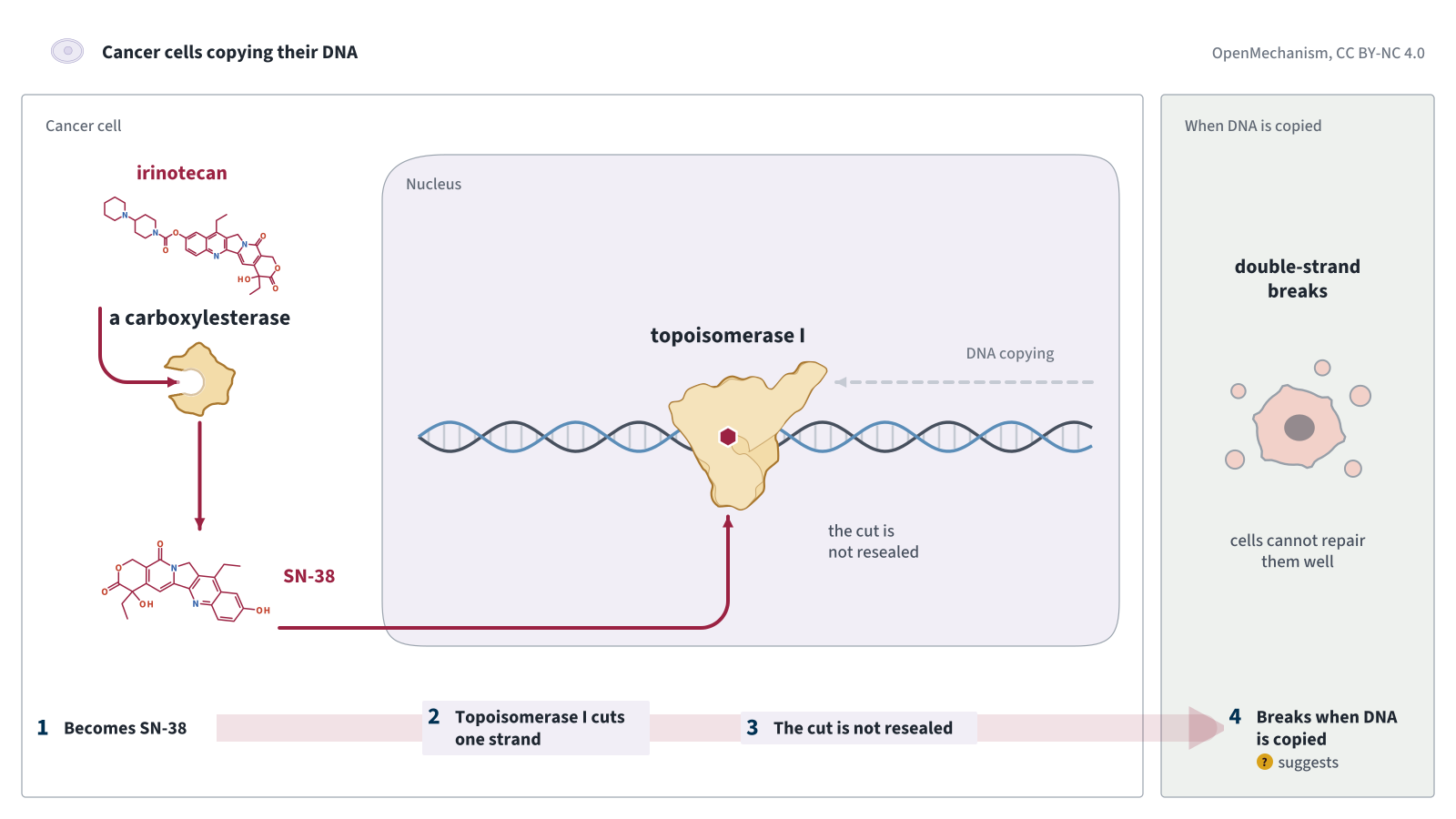
A carboxylesterase turns irinotecan into SN-38, which blocks topoisomerase I about 1000 times as strongly. Topoisomerase I relieves twisting in by cutting one strand and resealing it; irinotecan and SN-38 bind the enzyme on the DNA and stop the resealing. Current research suggests that the cells die from double-strand breaks made when the DNA is copied, which mammalian cells cannot repair well.
- Acts on
- Topoisomerase I
- Where
- Cancer cells copying their DNA
- Medicine type
- Small molecule
- Used for
- Cancer
- Drug class
- Topoisomerase inhibitors
Step 4: suggests
The irinotecan label says: Current research suggests that the cytotoxicity of irinotecan is due to double-strand DNA damage produced during DNA synthesis when replication enzymes interact with the ternary complex formed by topoisomerase I, DNA, and either irinotecan or SN-38.
Clinical study: In a randomized trial in 683 patients given first-line treatment for metastatic colorectal cancer; the trial measured how long the cancer was held back, not how it works: treatment with irinotecan, fluorouracil, and leucovorin resulted in significantly longer progression-free survival (median, 7.0 vs. 4.3 months; P=0.004)
Saltz LB et al., N Engl J Med 2000 (PMID 11006366)
This study was picked with a literature search and is not yet checked by our reviewer.
Key terms in this drawing
- DNA
- Deoxyribonucleic acid. The molecule that stores genes.
How it works
Becomes SN-38. A carboxylesterase cuts irinotecan into SN-38, its active metabolite, which blocks topoisomerase I about 1000 times as strongly.1
Topoisomerase I cuts one strand. Topoisomerase I relieves twisting strain in DNA by making single-strand breaks that it can reseal.1
The cut is not resealed. Irinotecan and SN-38 bind the topoisomerase I-DNA complex and stop these breaks from being resealed.1
Breaks when DNA is copied. Current research suggests that it kills cells through double-strand breaks made when DNA-copying enzymes meet this complex; mammalian cells cannot repair these breaks well.1
For teachers: download this drawing.
See also
Condition pages: colorectal cancer.
Also named on: non-small cell lung cancer, in combinations quoted from the National Cancer Institute.
Other topoisomerase inhibitors: doxorubicin, etoposide and trastuzumab deruxtecan.
Explained: irinotecan and the UGT1A1 gene.
Related drawings: trastuzumab deruxtecan (carries DXd, which also acts on topoisomerase I).
Body system: cancer.
Sources
- 1Irinotecan hydrochloride injection (Sagent): FDA label12.1 Mechanism of Action; 12.2 Pharmacodynamics
- 2ChEMBL CHEMBL481Target and action classification: DNA topoisomerase I inhibitor
- 3Irinotecan plus fluorouracil and leucovorin for metastatic colorectal cancer. Irinotecan Study GroupSaltz LB et al. N Engl J Med 2000 (abstract)
Also used for the drawing
The carboxylesterase and topoisomerase I outlines are traced from the crystal structures below.
- 4Human liver carboxylesterase 1 with ethyl acetatePDB 1YAH; Fleming, C.D. et al. J.Mol.Biol. 2005; 352:165-177
- 5Human topoisomerase I with DNA and topotecanPDB 1K4T; Staker, B.L. et al. Proc.Natl.Acad.Sci.USA 2002; 99:15387-15392
Spotted a mistake? Report an error (hello@openmechanism.com). Since launch, every published error we fix is listed on the corrections page.
Notes and limits
- A schematic teaching drawing: not to scale, not exact structures, binding poses or a complete pathway, and not a guide to dosing, treatment or how a person will respond.
- How much SN-38 contributes to irinotecan's activity is not known (12.2).
- The label: current research suggests (12.1).
All recorded limits are on the evidence page, and notes that apply to every page are on How to read a page. Version 1.0.0, not yet medically reviewed.
Cite this page
Tran D. Irinotecan [Internet]. OpenMechanism; 2026 [updated 2026 Oct 18; cited 2026 Oct 18]. Available from: https://openmechanism.com/medicines/irinotecan