Tumor lysis syndrome
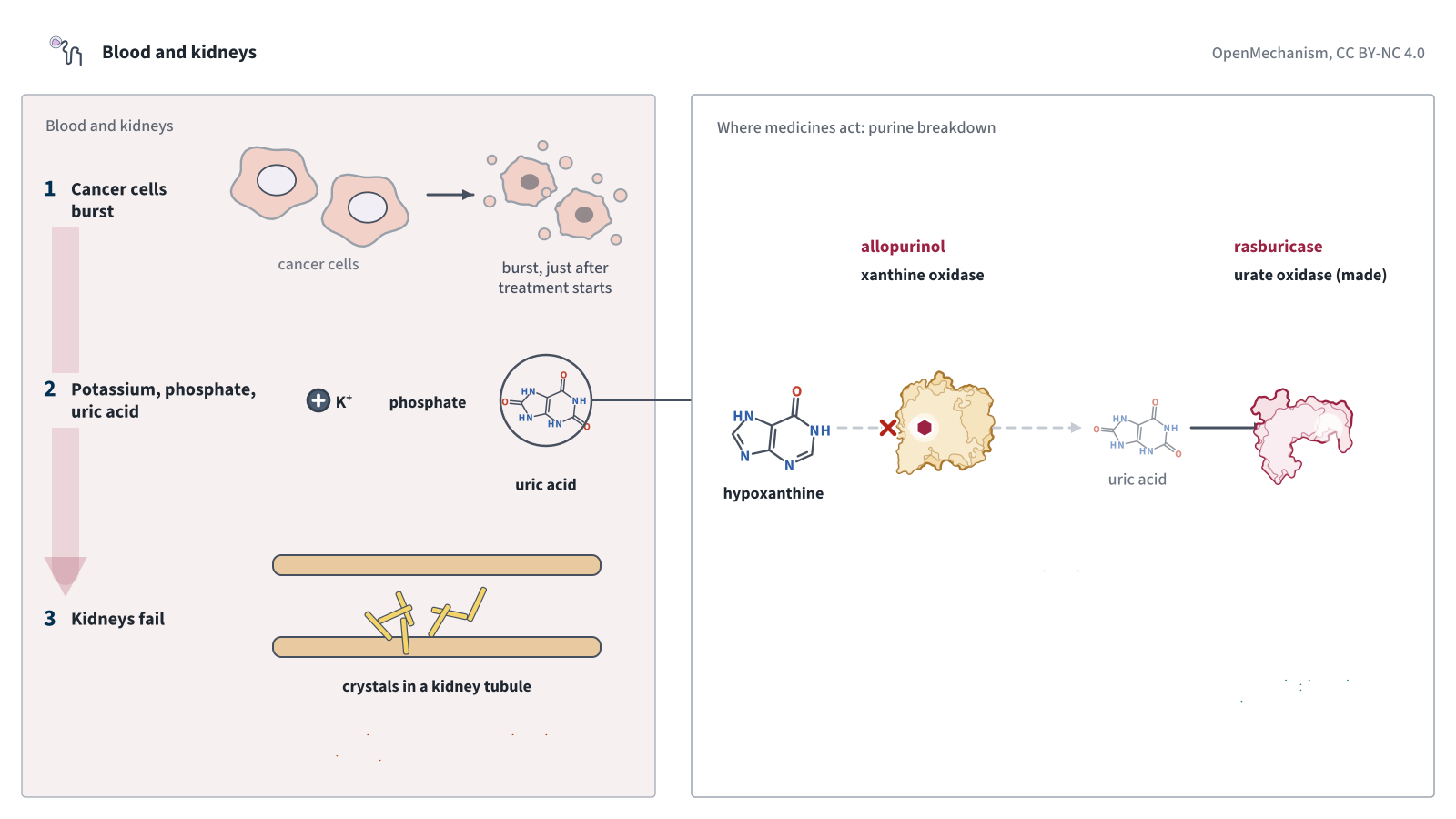
Tumor lysis syndrome is an emergency in which cancer cells burst, most often in blood cancers just after treatment starts. They release potassium, phosphate and uric acid; uric acid and calcium phosphate crystals can block the kidneys, and failing kidneys then let these build up further. Rasburicase turns uric acid into allantoin, which dissolves; allopurinol stops uric acid being made.
- Where
- Blood and kidneys
- Body systems
- Cancer, Blood & clotting, Kidney
- Medicines
- 2 medicines
For teachers: download this drawing.
What goes wrong
Cancer cells burst. Tumor lysis syndrome is an emergency set off when cancer cells burst and release their contents, most often in blood cancers just after treatment starts.1,2
What the source says
“Tumor lysis syndrome (TLS) is an oncologic emergency triggered by the rapid release of intracellular material from lysing malignant cells.”
Source 1“The syndrome typically occurs in patients with lymphoproliferative malignancies, most often after initiation of treatment.”
Source 2Potassium, phosphate, uric acid. The burst cells release large amounts of potassium, phosphate and uric acid, which comes from broken-down nucleic acids.1,2
Kidneys fail. Uric acid and calcium phosphate crystals can block the kidney tubules. Failing kidneys then clear less potassium, phosphorus and uric acid, which can be fatal.1,2
What the source says
“Deposition of uric acid and calcium phosphate crystals in the renal tubules may lead to acute renal failure”
Source 2“Kidney failure then limits the clearance of potassium, phosphorus, and uric acid leading to hyperkalemia, hyperphosphatemia, and secondary hypocalcemia, which can be fatal.”
Source 1
Where medicines act
- A
Allopurinol: uric acid making blocked
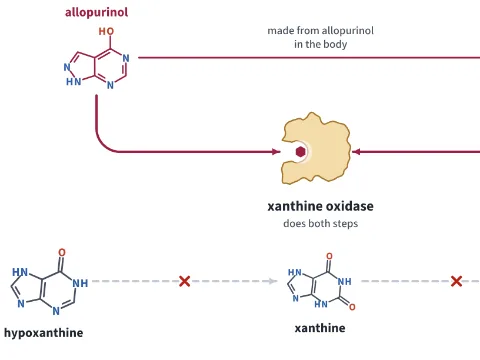
Allopurinol blocks xanthine oxidase, the enzyme that makes uric acid. It is used for people with leukemia, lymphoma and solid tumors whose cancer treatment raises uric acid.3
What the source says
“It is an inhibitor of xanthine oxidase, the enzyme responsible for the conversion of hypoxanthine to xanthine and of xanthine to uric acid”
Source 3“The management of adult and pediatric patients with leukemia, lymphoma and solid tumor malignancies who are receiving cancer therapy which causes elevations of serum and urinary uric acid levels”
Source 3 - B
Rasburicase: uric acid dissolved
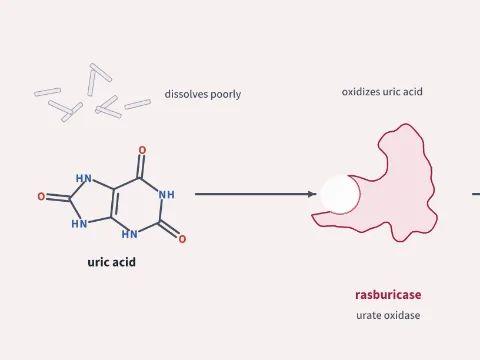
Rasburicase turns poorly soluble uric acid into allantoin, which dissolves better and is inactive. It manages blood uric acid in people with leukemia, lymphoma and solid tumors starting treatment expected to cause tumor lysis.4
What the source says
“Rasburicase catalyzes enzymatic oxidation of poorly soluble uric acid into an inactive and more soluble metabolite (allantoin).”
Source 4“Elitek is indicated for the initial management of plasma uric acid levels in pediatric and adult patients with leukemia, lymphoma, and solid tumor malignancies who are receiving anticancer therapy expected to result in tumor lysis and subsequent elevation of plasma uric acid.”
Source 4
See also
Body systems: cancer, blood & clotting and kidney.
Other conditions: gout.
Sources
- 1Tumor lysis syndrome: new challenges and recent advancesWilson FP, Berns JS. Adv Chronic Kidney Dis 2014 (abstract). Saved copy
- 2Pathophysiology, clinical consequences, and treatment of tumor lysis syndromeDavidson MB et al. Am J Med 2004 (abstract). Saved copy
- 3Allopurinol tablets: FDA labelIndications and Usage; Clinical Pharmacology. Saved copy
- 4Elitek (rasburicase): FDA label1 Indications and Usage; 12.1 Mechanism of Action. Saved copy
- 5Bovine milk xanthine dehydrogenase with oxipurinol boundPDB 3BDJ; Okamoto, K. et al. Nucleosides Nucleotides Nucleic Acids 2008;27:888-893. The xanthine oxidase outline in the drawing is traced from this structure. Saved copy
- 6Aspergillus flavus urate oxidase with an inhibitor (8-azaxanthine)PDB 1R51; Retailleau, P. et al. Acta Crystallogr.,Sect.D 2004;60:453-462. The urate oxidase outline in the drawing is traced from this structure. Saved copy
Notes and limits
- Prevention may work better than treatment, and finding who is at risk is still being studied.1
Notes that apply to every page are on How to read a page.
Spotted a mistake? Report an error (hello@openmechanism.com). Since launch, every published error we fix is listed on the corrections page.
Cite this page
Tran D. Tumor lysis syndrome [Internet]. OpenMechanism; 2026 [updated 2026 Oct 19; cited 2026 Oct 19]. Available from: https://openmechanism.com/conditions/tumor-lysis-syndrome